Материал: BASIC CLINICAL SYNDROMES IN INTERNAL DESEASES CLINIC
1. Renal colic syndrome
REASONS: acute violation of the outflow of urine due to obstruction of the upper urinary tract with a calculus, a blood clot, mucus or pus, a conglomerate of urine salts, caseous masses, rejected by necrotic papillae, as a result of an inflection, spasm of the ureter or spasm of the renal pelvis.
SYMPTOMS:
Acute, paroxysmal pain in the lower back, abdomen with irradiation down the ureters to the genitals. Duration from several minutes to several days. The attack is provoked by shaking riding, long walking, other physical exertion, the use of alcoholic beverages, diuretics.
Reflex nausea, vomiting of food eaten, gastric juice.
bloating.
Violation of urination: pollakiuria, stranguria.
An increase in body temperature with chills.
The patient is agitated, rushing about in bed and cannot find a position
relieving pain.
Hyperemia of the face and skin.
On palpation, soreness of the entire abdomen and lower back is more on the side of the lesion. A positive symptom of striking.
Soreness in the ureteric points on the affected side.
Symptom Tofilo - in the supine position, the patient bends the leg in the hip joint and presses the hip to the stomach, in the presence of pyelonephritis pain in the lumbar region intensifies, especially if you take a deep breath.
Sometimes, the amount of peristaltic noise decreases.
Relief after a warm bath, the introduction of antispasmodics.
After an attack in the urine, pyuria, macro-, microhematuria, salt crystals are possible.
2. Urinary Syndrome
REASONS: almost all diseases of the kidneys, urinary tract, prostate.
This is a clinical and laboratory concept characterized by qualitative and quantitative changes in the composition of urine.
It is realized in the form of changes in color, transparency, proteinuria, hematuria, leukocyturia, cylindruria, the presence of salts, mucus, bacteria.
Urinary syndrome is the most important and most permanent, and sometimes the only sign of damage to the kidneys and urinary tract.
Urinary syndrome is individual and the ratio of the symptoms of its components depends on the disease.
For example: macrohematuria in acute glomerulonephritis, pyuria (leukocyturia) in pyelonephritis.
Disorder of urinary excretion and formation REASONS: Most diseases of the kidneys and urinary tract.
The essence of the syndrome in its name. Clinically, he realizes himself individually for
various diseases in the form of:
Anuria - excretion of less than 50 ml of urine per day
oliguria - less than 500 ml
polyuria - more than 2 l
nocturia - the prevalence of nocturnal diuresis over daytime
pollakiuria - frequent urination more than 6 times a day
stranguria - painful urination in small portions, drops
Ischuria - urinary retention in the bladder
dysuria - the common name for all violations
4. Nephrotic syndrome
REASONS: secondary immune-inflammatory damage to the kidneys themselves, (chronic glomerulonephritis) arising from most diseases of the kidneys, especially of an immune nature, as well as under the influence of many chemical and toxic factors, renal vein thrombosis, heart failure, diabetic nephrosclerosis, and renal transplant rejection.
SYMPTOMS: Clinical - laboratory complex.
Severe renal edema and, as a result, a decrease in diuresis.
Hypo- and dysproteinemia
Hyperlipidemia, hypercholesterolemia
Hyperproteinuria (≥3.5 g protein / 1.75 m2 per day).
In the absence of edema and the presence of other signs, we can talk about the so-called "headless" nephrotic syndrome.
Hypertension Syndrome
CAUSES:
the actual renal arterial hypertension (most kidney diseases),
Vasorenal arterial hypertension is the result of narrowing of the renal arteries. It is considered in the framework of symptomatic arterial hypertension.
SYMPTOMS: see cardiology section
9. Renal eclampsia syndrome
REASONS: acute, chronic glomerulonephritis, last months of pregnancy, 1 day after birth. In
fact, this is a variant of acute cerebrovascular accident due to increased arterial, intracranial
pressure, and cerebral edema.
SYMPTOMS:
Harbingers: headache, dizziness, nausea, apathy, insomnia, blurred vision, high blood pressure - 240 / 130,300 / 160 mm. Hg. Art.
An attack occurs suddenly
loss of consciousness
cramps in the limbs
rolling eyes
biting the tongue: pink foam from the mouth
cyanosis of the face
shortness of breath
involuntary urination, defecation
coma
post-attack sleep
The duration of the attack is 1-30 minutes
After the attack, transient:
blindness (anaurosis)
dumbness or speech disorder
memory loss (amnesia)
Complications: - stroke
- pulmonary edema
- stillbirth in 13 -19% of women in labor after eclampsia - death in 5 - 9% of pregnant women
Acute renal failure (arf)
CAUSES:
Prerenal - a sharp decrease in blood pressure (shock, cardiac tamponade, vascular dilatation in sepsis, anaphylaxis, blood loss, dehydration).
Renal - ischemic or toxic nephronecrosis, glomerulonephritis, tubular disorders.
Postrenal - blockage or compression of the urinary tract, congenital anomalies.
Arenal - absence or removal of the kidneys.
Most often, acute renal failure is observed in patients due to hemocirculatory disorders (75%) and poisoning with nephrotoxic poisons (15%). Impaired renal blood flow and a drop in glomerular filtration are the most important mechanisms of acute renal failure.
SYMPTOMS:
Stage 1 - hours duration - up to 2 days. Signs of the underlying disease leading to acute renal failure are expressed.
stage. Oligo-anuric, up to 2 weeks - anuria, oliguria
- back pain - azotemia - anemia
- symptoms of uremia: lethargy, drowsiness, up to coma, muscle twitching, noisy breathing, the smell of urine, signs of gastritis, pericarditis, pleurisy, etc.
- skin is pale, dry bloating
88
hyperkalemia, leading to muscle paralysis, up to cardiac arrest
death or transition to stage 3.
3 stage. Polyuric, about 20 days
urine - more than 1800 ml / day
loss of electrolytes, including hypokalemia
protein dystrophy
vitamin deficiency
signs of uremia disappear
hypoproteinemia
4 stage. Recovery - 3-4 months - up to a year
- slow protein replenishment restoration of damaged kidney structures at the micro level
11. Chronic renal failure
REASONS: kidney disease with outcome in nephrosclerosis, arterial hypertension, diabetic
nephrosclerosis.
SYMPTOMS:
1st stage. Initial, latent, latent
there may be no complaints
signs of underlying disease
possible hypoisostenuria (urine density -1012-1017)
glomerular filtration (CF = 20% -50%), water reabsorption is changed little
creatinine up to 0.2-0.25 mmol / l
5. Acute nephritic syndrome (acute glomerulonephritis)
REASONS: violation of glomerular filtration due to an infectious allergic process, damage to the basement membrane of glomerular capillaries with the development of syndromes of arterial hypertension, edematous and urinary.
SYMPTOMS.
Complaints: swelling on the face, lower limbs, headache, dizziness, noise in the head, shortness of breath, discoloration of the urine (in the form of "meat slop"), a decrease in the daily amount of urine.
Examination: pale edematous face, swelling on the legs.
Palpation: apical impulse displaced to the left, strengthened, high, diffuse; the pulse is firm, intense.
Percussion: displacement of the left border of the relative dullness of the heart to the left.
Auscultation: accent II tone in the second intercostal space on the right.
Blood pressure: increased, especially diastolic.
ECG: signs of left ventricular overload.
Blood test: hypoproteinemia, dysproteinemia (an increase in the content of α2 - and γ - globulins), azotemia.
Urinalysis: oliguria, color of "meat slops", hyperstenuria, hematuria, cylindruria, cells of the renal epithelium.
Reberg test: reduced glomerular filtration.
Chronic nephritic syndrome (chronic glomerulonephritis)
CAUSES.
Chronic nephritic syndrome accompanies diseases of various etiologies, characterized by
diffuse sclerosis of the glomeruli of the kidneys and leading to chronic renal failure.
Chronic nephritic syndrome usually develops against the background of focal or segmental sclerosis of the kidney, membranous or membranous - proliferative glomerulonephritis.
SYMPTOMS.
Complaints: often patients have subjective complaints at the beginning of the development of the syndrome. In more severe cases, signs of uremia can be detected - nausea, vomiting, shortness of breath, itchy skin, increased fatigue.
Laboratory and instrumental manifestations: proteinuria, cylindruria, hematuria and arterial hypertension. In the general analysis of urine in patients, proteinuria, hematuria, erythrocyte and hyaline cylinders are detected. In the blood there is an increase in the level of urea and creatinine, anemia, signs of metabolic acidosis, hyperphosphatemia.
Diagnosis is by biopsy.
7. Edema syndrome (renal edema)
REASONS: hydremia, increased capillary permeability, hypoproteinemia, hyperaldosteronemia, increased hydrophilicity of tissues.
SYMPTOMS:
The speed of occurrence: first, hidden edema (McClure-Aldrich test), and after a few hours, days - obvious.
Edema first appears on the eyelids and face (Facies nephritica round, puffy, swollen face and eyelids, narrow eye slits), then on the abdominal wall and lower back, on the extremities. Up to the anasarca.
The swelling is pale, the skin is smooth, shiny.
Swelling is soft, like dough, easily displaceable.
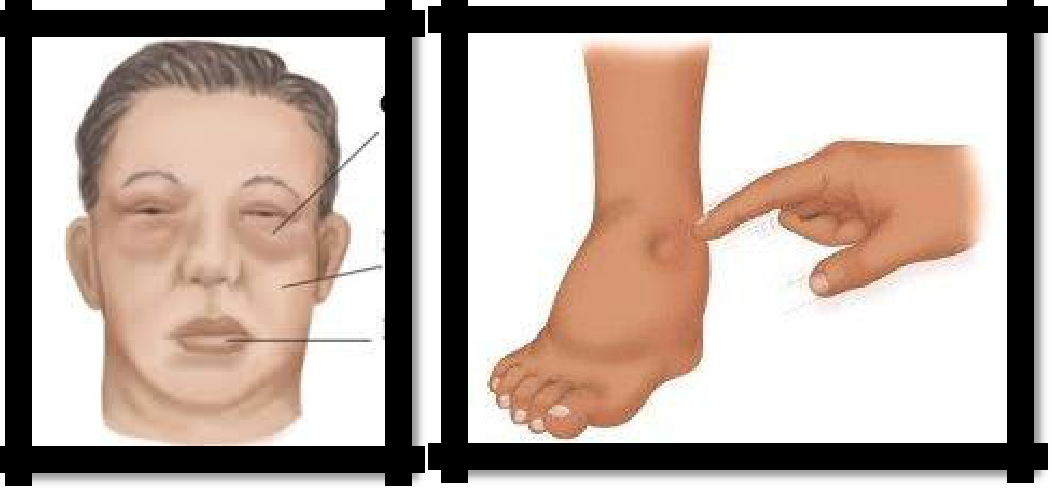
Pic 5.1 renal edema
2 stage. Azotemic
weakness, asthenia, disability
headache
cough
arterial hypertension
dyspeptic disorders: loss of appetite, discomfort in the epigastric region, unpleasant taste and dry mouth, nausea, vomiting, hiccups, heartburn, diarrhea, stomatitis, smell of urine
polyuria, nocturia
skin is pale, dry, sometimes itchy
periodically muscle twitching
CF up to 5-20%
creatinine up to 0.7 mmol / l
hypoisostenuria (density 1009-1012), nocturia, polyuria
Signs of a uremic lesion of the gastrointestinal tract (gastritis, enterocolitis) nausea, vomiting with blood, diarrhea with blood, abdominal pain, sometimes mimicking an acute abdomen, the phenomenon of stomatitis
signs of damage to the respiratory system: (bronchitis, cough, asthma attacks, pleural friction noise, exudate, hoarseness)
Signs of encephalopathy (drowsiness during the day, insomnia at night, lethargy, including coma, headaches, blurred vision, retinopathy)
joint pain, up to secondary gout,
dermatitis: dryness, itching of the skin, traces of scratching, the skin is covered with uremic
―dust‖
hemorrhagic diathesis (bleeding from the nose, gums, gastrointestinal bleeding)
anemia
hypostenuria
89
creatinine greater than 0.7 mmol / l
CF less than 5%
hyperkalemia greater than 5.0 μmol / l
hypocalcemia less than 2.12 μmol / l
decrease in diuresis, up to anuria
arterial hypertension
heart failure
metabolic acidosis
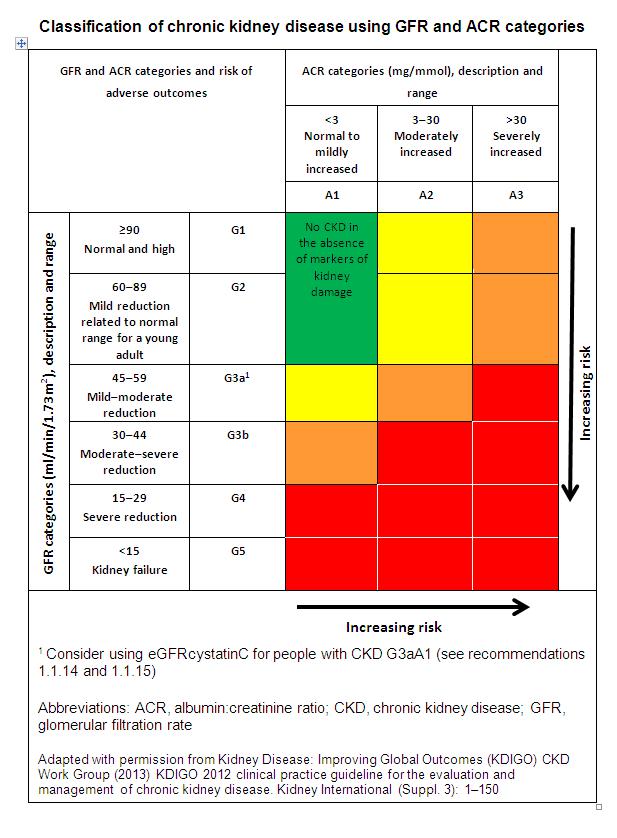
Chronic kidney disease (CKD) - damage to the kidneys or a decrease in their function for 3 months or more. This collective term, which can also be used as a separate diagnosis, was proposed by the US National Kidney Fund in 2002 and has become widespread. The introduction of this terminology is accompanied by a new classification into 5 stages, which differ in tactics of patient management and the risk of developing terminal renal failure and cardiovascular complications.
-
Table
5.1
91
5.1. TEST TASKS
(Choose one or more correct answers)
The most reliable sign of chronic renal failure is
1) arterial hypertension
2) hyperkalemia
3) increased blood creatinine
4) oliguria
5) anemia
What is the change in urine suspected of chronic renal failure
1) high specific gravity
2) massive proteinuria.
3) isohypostenuria
4) anuria
5) pallakiuria