Материал: BASIC CLINICAL SYNDROMES IN INTERNAL DESEASES CLINIC
Sick for about 2 years, at first I did not pay attention to weakness and fatigue, then there was muscle weakness, pain and numbness in the lower extremities, in connection with which I went to the doctor and was hospitalized. Objectively: a satisfactory condition, excess nutrition. The skin is pale with an icteric shade, sclera subicteric. Heart sounds are weakened, a quiet, systolic murmur is heard at the apex, on the jugular vein on the right is a ―top sound‖, pulse -107 per minute, rhythmic, soft. The tongue is moist, bright red in color, smooth - ―lacquered‖ (due to the pronounced smoothing of the papillae), there are isolated aphthae on the mucous membrane of the cheeks. The lower edge of the liver is palpated, protruding 2.0 cm from under the edge of the costal arch. The spleen is not palpable. When striking the sternum, ribs and tibia, the patient feels soreness.
Clinical blood test: erythrocytes - 2.1 x 10² / l, Hb - 48 g / l, color index - 1.4, reticulocytes - no, platelets - 95 x 109
l, white blood cells - 3.0 x 10⁹ / l, ESR - 35 mm / hour. Hyperchromia of red blood cells, pronounced anisocytosis (macrocytes, megalocytes), poikilocytosis, found Jolly bodies, Kebot rings, polysegmentation of neutrophils.
What pathology should the patient think about?
What research is needed to clarify the diagnosis and etiology of the disease?
Task 3
Patient A., 19 years old, went to the doctor with complaints of: sore throat when swallowing, fever up to 39 ° C with chills, profuse night sweats, bleeding gums, nosebleeds, severe weakness, bone pain. He fell ill acutely a week ago.
Objectively: a state of moderate severity. The skin and mucous membranes are pale, the skin is wet to the touch, on the skin of the trunk, forearms and hips there are multiple subcutaneous hemorrhages. Symptoms of a ―tourniquet‖ and ―pinch‖ are positive. The submandibular, cervical, axillary and inguinal lymph nodes are palpable, pea-sized, painless, not soldered together and with skin, soft-elastic consistency, the skin above them is not changed. Bad putrefactive breath. The pharynx is hyperemic, ulcerative necrotic changes in the mucous membrane are visible on the tonsils and posterior wall of the pharynx. Gums loose, bleed easily when touched with a spatula. The painless edge of the liver is palpated, protruding 3.0 cm from the costal arch, the edge is even and soft. With percussion, the length of the spleen is 12 cm, the diameter is 8 cm. The spleen is not palpable. Rattling along the flat and tubular bones is painful.
Clinical blood test: red blood cells - 2.8 x 10¹² / l, Hb - 70 g / l, color index - 0.9, platelets - 65 x 109 / l, white blood cells - 100 x 109 / l, myeloblasts - 75% , stab - 3%, segmented - 22%, eosinophils - no, basophils - no, ESR -
114
56 mm / hour.
What syndromes can be distinguished in a patient?
What disease can a patient think of?
What research is necessary for the patient to confirm the diagnosis?
Task 4
Patient B., 61 years old, was admitted to the clinic with complaints of: general weakness, fatigue, swelling in the neck and axillary areas, increased sweating, low-grade fever.
Over the past 5 years, during preventive medical examinations, attention has been paid to an increase in the number of lymphocytes in the blood up to 40-50% with a normal number of leukocytes. The patient notes that during this period he became ill with colds more often, they last longer and harder. In the last 6 months, the above complaints appeared, in connection with which he was hospitalized.
Objectively: the condition is satisfactory. Reduced nutrition. The skin is pale. Cervical, axillary and inguinal lymph nodes the size of a bean to walnut, mobile, not soldered together, elastic-test consistency, painless, skin integument above them is not changed. The liver protrudes from under the edge of the costal arch by 2.0 cm, the edge is smooth, of a dense consistency, painless. The length of the spleen is 11 cm, the diameter is 7 cm, the edge of a dense, smooth, painless spleen is palpated.
Clinical blood test: red blood cells - 3.7 x 10¹² / l, Нb - 90 g / l, color index - 0.95, white blood cells - 35 x 109 / l stab - 1%, segmented - 15%, eosinophils - 1%, lymphocytes - 80%, monocytes - 3%, ESR -35 mm / hour.
What syndromes can be distinguished in a patient according to a survey?
What research will clarify the diagnosis?
The presence of a symptom characteristic of this disease in a morphological study of peripheral blood? Task 5
Patient D., 52 years old, upon admission to the clinic complained of: severe general weakness, heaviness in the left hypochondrium, fever from 37.8 to 38.5 ° C with heavy sweats, and ―aches‖ in the bones.
Over the past 4 months, she had twice had a sore throat and acute respiratory illness. It was treated on an outpatient basis without significant improvement in general condition.
Objectively: a state of moderate severity. Temperature - 38.0 ° С. Reduced nutrition. The skin and visible mucous membranes are pale, on the skin of the forearms and hips there are many small bruises. Bad breath. When examining the oral cavity - the phenomenon of stomatitis and gingivitis. Axillary and inguinal lymph nodes the size of a pea, soft, mobile, painless. There is an asymmetry of the abdomen due to bulging in the left hypochondrium. The lower edge of the liver protrudes 4.0 cm from under the edge of the costal arch, smooth, painless. Percussion length of spleen - 16 cm, diameter - 10 cm, palpation of the spleen protrudes from the edge of the costal arch by 6 cm, smooth, dense, painless. Pressing and tapping on the flat and tubular bones is painful.
Clinical blood test: red blood cells - 2.5 x 10¹² / l, Нb - 60 g / l, color index - 0.85, white blood cells - 200 x 109 / l, myeloblasts - 6%, promyelocytes - 4%, myelocytes - 20%, metamyelocytes - 21%, stab - 13%, segmented - 11%, eosinophils - 6.5%, basophils - 4.5%, lymphocytes - 10%, monocytes - 3%, ESR - 50 mm / hour.
What syndromes should be distinguished in a patient?
What research is needed to clarify the diagnosis?
115
RHEUMATOLOGY AND ALLERGOLOGY
Urticaria syndrome
REASONS: one form of allergic reactions
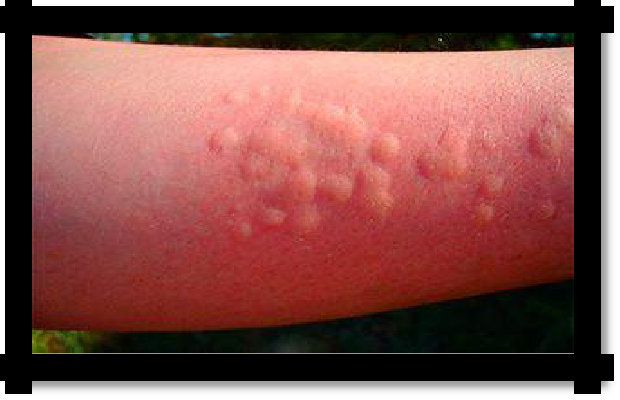
SYMPTOMS:
sudden appearance and disappearance of blisters on the skin, accompanied by skin itching
sometimes, individual blisters merge (giant urticaria)
when rash of blisters on the mucous membranes occurs: cough, stridor breathing, diarrhea, abdominal pain, arthralgia
often accompanied by headache, fever, a feeling of general malaise.
Pic 8.1 Urticaria
2. Quincke's angioedema
REASONS: one form of an allergic reaction
SYMPTOMS:
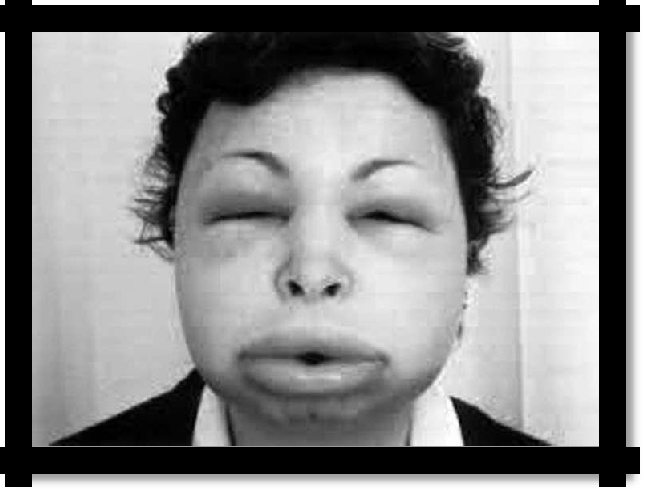
- develops sharply, sometimes after a few seconds from the onset of the action of the allergen in the form of a passing edema of the skin of the subcutaneous tissue and mucous membranes
- localized more often on the face (lips, cheeks, around the eyes)
- dangerous swelling of the larynx (asphyxia), mucous membranes of the gastrointestinal tract (picture of an acute abdomen)
- sizes are different, but rarely larger than the human palm
- Duration from several minutes to hours.
Pic 8.2 Quincke's edema
3. Anaphylactic shock
REASONS: the most severe form of allergic reaction of immediate type
SYMPTOMS:
1. forms:
extremely difficult (development speed - seconds, minutes)
heavy (minutes)
moderate (minutes, hours) (cardiac, cerebral, asthmatic, abdominal moderate) 2. phases: erectile and torpid (secrete only moderate in shock)
3. first signs:
dizziness, headache,
a sense of fear, anxiety,
-cold sweat,
116
shortness of breath
chest tightness, fever,
coughing fit
abdominal pain, diarrhea,
vomiting
cramps
may be accompanied by other signs of anaphylaxis: - urticaria,
- Quincke's edema, - bronchospasm,
- dermatitis
blood pressure, anuria progressively decreases, the picture of shock itself develops.
4. Joint syndrome
REASONS: inflammatory and degenerative diseases of the joints, synoviomas, arthropathy in
metabolic disorders.
SYMPTOMS:
pain
swelling (configuration)
deformation
increase in local temperature
restriction of movement in the joint
local hyperemia or other color changes. Features:
Feature of pain in inflammatory joint diseases:
inflammatory rhythm of pain - pain intensifies in the second half of the night and in the morning, accompanied by morning stiffness, possibly improving as a result of movement in the joints.
Feature of pain in degenerative joint diseases (deforming osteoarthritis):
the mechanical rhythm of pain - a clear connection with physical activity, pain intensifies in the evening after a hard day, in the first half of the night, unloading the joints gives relief.
Starting difficulties, pain when moving in the joints, passing through a short time (several minutes) - indicate the development of secondary synovitis with degenerative lesions of the joints.
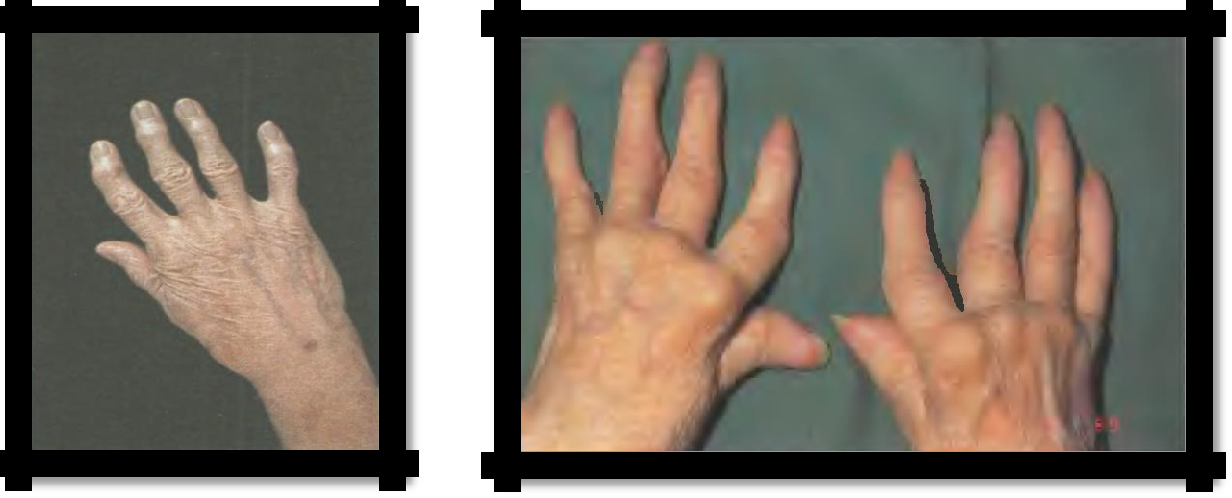
Pic 8.3 Deforming arthrosis-arthritis (Heberden Nodules)
Pic 8.4 Rheumatoid arthritis (walrus fins)
117
8.1 TEST TASKS
(Choose one or more correct answers)
The inflammatory nature of joint pain indicates
1) joint deformation, joint crunch
2) swelling of the joint, flushing of the skin
Signs characteristic of arthrosis
mechanical pain, crunch in the joint
increased skin temperature over the joints, swelling of the joints
In rheumatoid arthritis, joints are most affected.
1) ulnar
2) vertebrates
3) proximal interphalangeal and joints of the hands
4) knee
Heberden's nodules is
manifestation of deforming osteoarthrosis
the phenomenon accompanying rheumatoid arthritis
the manifestation of a special reaction of the body with bronchitis and bronchiectasis
Laboratory indicators inherent in osteoarthritis
1) anemia
2) leukocytosis
3) leukopenia
4) normal blood counts
5) thrombocytopenia
11
8.2. Clinical tasks for the section allergies, rheumatology
TASK № 1
Patient D., 26 years old, was taken to the emergency department of the BSMP in an unconscious state. Forty minutes ago, in the clinic, the patient was injected with penicillin (500,000 units) intramuscularly, 15 minutes after this, the patient felt a sharp weakness, lost consciousness.
Objectively: the skin is pale, hyperhidrosis. Respiration is frequent, shallow, BH - 23 per minute, heart sounds are muffled, tachycardia, heart rate - 110 per minute, filamentous pulse, blood pressure - 60/40 mm RT. Art.
Additional research methods:
General blood analysis. Er.- 4.2 x 10¹², Hb-130 g / l, color index - 1.0, White blood cells -9.3 x 10⁹, E -18, P - 3, S.- 50, L - 23, M - 6 , ESR - 18 mm / h.
General urine analysis. Yellow color. The reaction is acidic, Ud. density is 1023. Transparency is incomplete. Protein - no. Epit. cells - one. Lake - 0 - 1-3 in p / sp, Er. 1 - 0 in p / sp Blood glucose - 5.3 mmol / L.
Questions.
Highlight clinical syndromes.
Formulate a preliminary diagnosis.
Provide emergency care.
TASK № 2
The ambulance arrived on call to a patient of 18 years old, the patient is in a soporous state. From a survey of relatives it was established that a wasp bitten a girl 40 minutes ago. Objectively: a serious condition, severe swelling of the face and neck, the skin is hyperemic, tense, shiny. The breath is noisy, stridorous. The pulse is filiform, palpated only on the carotid arteries, 98 per minute, blood pressure - 40/0 mm Hg The abdomen is painful on palpation. Questions.
Highlight clinical syndromes.
Formulate a preliminary diagnosis
Provide emergency care.
9. The meaning of eponymous terms and syndromes in clinical medicine
From the history of medicine it is known that the profession of a doctor in various threads is associated with art, literature and other branches of human activity. This is confirmed by the frequent combination of medical and literary activities (F. Rabelais, F. Schiller, A. Kronin, A.P. Chekhov, V.V. Veresaev, M.A. Bulgakov, etc.). Introduction to clinical practice of clinical terms with the names of writers, poets, their literary characters, mythological heroes, etc. testifies to the broad outlook of doctors. Unfortunately, practical doctors are not familiar with eponymous clinical symptoms and syndromes. We will analyze only a small group of such terms in order to arouse interest in this issue among students, doctors of various specialties.
A number of medical terms bears the names of writers, artists, philosophers. The most famous among therapists is the symptom of Musset, named for the French poet Alfred Musset (1810 - 1858), who suffered from aortic valve insufficiency, which was accompanied by a shake of the head in the rhythm of heart contractions. Van Gogh's syndrome, which, suffering from a mental disorder, performed an amputation of the ear. The syndrome itself is a psychopathological symptom complex in which patients with an imaginary disease operate on their own or persistently require surgery from doctors.
In psychiatry, such terms as masochism are widely known - after the Austrian prose writer of the late 19th century Sacher-Masoch, whose works describe in detail sexual perversion with causing physical pain to a partner; sadism - associated with the name of the 18th century French writer Marquis de Sade; Safism - named after the ancient Greek poetess Safo, who lived on the island of Lesbos, identified with female homosexuality.
Stendhal's Syndrome (Henri Marie Beil, 1783 - 1842) characterizes impressionable natures, who, when ―sorting out‖ positive emotions, may experience loss of consciousness or even a shock state, which happened with Stendhal, who admires the artistic creations of painters in Florence.
The syndromes associated with the names of literary heroes are interesting. So, Pickwick’s syndrome is named after one of the heroes of the novel by C. Dickens, Notes of the Pickwick Club, a servant of Joe, who had hypoventilation of the lungs against the background of obesity, a sudden irresistible desire to fall asleep, shallow breathing, hypertension, shortness of breath. Munchhausen syndrome, in which patients usually present case histories with traits of implausibility and drama. Since 1955, Todd introduced into medical practice the syndrome ―Alice in Wonderland‖ (named after the heroine of the same book by the English writer L. Carroll, 1832–1898), which is characterized by depersonalization, derealization (with a distorted idea of space and time), and visual illusions, split personality. Since 1921, the term ―bovarism‖ was introduced, meaning a mixture of dreams and reality, dreamy distraction.
A large group of clinical terms associated with the names of the characters of legends, myths. So, the symptom of Buddha is a sign of weakness of the peripheral or central motor nerve, which imitates the classic pose of this person - God. Among radiologists, a concept such as two-faced Janus syndrome is used - by the name of the god of the ancient Romans (patron of doors, entry and exit, all principles). Janus syndrome is manifested by a clinical and radiological picture of unilateral lung ventilation disorders. Psychoanalysts consider the Oedipus complex ("family romance") as the sexual attraction of the child to their parents (the hero of ancient Greek mythology Oedipus married his mother). Such concepts are known as gambrinism - a pathological addiction to beer (Gambrinus - the legendary Flemish king, beer lover and patron of brewing), narcissism - sexual narcissism (the mythological young man Narcissus, who fell in love with his reflection in water), Othello syndrome - delirium of jealousy.
We hope that even this small part of the eponymous terms will expand the clinical horizons of students and doctors.