Материал: BASIC CLINICAL SYNDROMES IN INTERNAL DESEASES CLINIC
Skin disorders;
Neuropsychic manifestations;
Hemorrhagic diathesis.
13. Mesenchymal inflammatory syndrome
Mesenchymal inflammatory syndrome is a consequence of sensitization of immunocompetent cells and activation of the reticuloendotemial system in response to antigenic stimulation, is a complex biological response of an adaptive nature, aimed at eliminating the corresponding pathogenic effects.
REASONS: acute and active chronic liver diseases, connective tissue diseases, sepsis.
SYMPTOMS:
Pain in the upper abdomen, right hypochondrium;
An increase in the liver, jaundice;
Splenomegaly;
fever;
Leukocytosis (or leukopenia), eosinophilia, accelerated ESR;
Increase in the level of a2 - and gamma globulins in blood serum;
Change in protein-sedimentary samples (thymol, sublimate, etc.);
Increased levels of IgG, IgM, IgA, the appearance of nonspecific antibodies to DNA, mitochondria, smooth muscle fibers;
72
9. Polyarthralgia, vasculitis of the skin, kidneys, lungs.
4.3 SYNDROMES IN PREVENTION OF THE PANCREAS
1. Pancreatic pain syndrome
CAUSES:
sprain of the pancreatic capsule
increased pressure in the ducts (obstruction and stenosis)
irritation of the parietal sheet of the peritoneum covering the pancreas.
SYMPTOMS:
Pain in the epigastric region, radiating to the left hypochondrium, to the back, to the interscapular space, to the left shoulder blade, less often to the right hypochondrium / as with biliary colic /:
- constant without rhythm, without typical dependencies
- accompanied by nausea and vomiting in acute pancreatitis / necrosis /:
- often accompanied by collapse, can cause shock, lasts continuously for several days with chronic pancreatitis:
- moderate pain for several hours with pancreatic cancer:
- constant, progressive, forcing the patient to take a relieving position with an inclined anteriorly with cancer of the head of the pancreas:
- Often subhepatic jaundice syndrome.
On palpation of the abdomen, the following painful zones and points are determined:
• Shoffar zone - the area of projection of the head of the pancreas.
• Hubergrits-Skulsky zone - similar to the Shoffar zone, but located on the left. Soreness in this zone is characteristic for the localization of inflammation in the body area of the pancreas;
• Desjardins point - located 5-6 cm above the navel along the line connecting the navel to the right armpit.
Soreness at this point is characteristic for the localization of inflammation in the head of the pancreas;
• Hubergritsa (Kacha) point - similar to Desjardins point, but located on the left. Soreness at this point is observed with inflammation of the tail of the pancreas;
• Mayo-Robson point - located on the border of the outer and middle third of the line connecting the navel and the middle of the left costal arch. Soreness at this point is characteristic for inflammation of the tail of the pancreas;
• region of the rib-vertebral angle on the left - with inflammation of the body and tail of the pancreas.
• left-side phrenicus symptom - pain when pressed between the legs of the sternocleidomastoid muscle at the attachment to the medial edge of the clavicle.
73
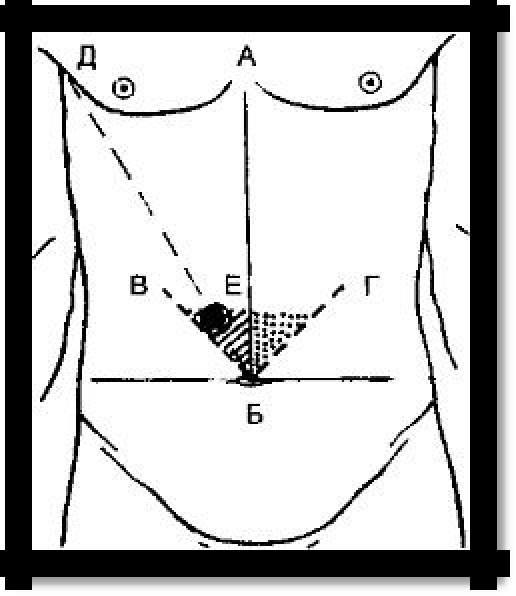
Pic 4.6 Pancreatic pain zones
1. The insufficiency of exocrine pancreatic function
CAUSES:
Acute and chronic pancreatitis.
Tumors of the pancreas.
Cystic fibrosis.
SYMPTOMS:
Fatty, fetid diarrhea. Oily stool with a yellowish, shiny hue, "poorly washed away, bloating, rumbling, intestinal colic. Progressive weight loss (untreated patients).
Laboratory data - a large amount of light putrefactive feces with a high content of fat (steatorrhea) and undigested intestinal fibers (creatorrhea), starch (amylorrhea).
Decrease in the level of pancreatic enzymes in the duodenal contents.
Syndrome of pancreatic incretory function.
It develops due to the endocrine function of the pancreas.
REASONS: diseases of the pancreas, tumor, autoimmune processes leading to dysfunction of tissues and cells producing hormonal substances.
In the islets of Langerhans (mainly in the tail) there are several types of cells producing hormones: alpha cells - glucagon; betta cells - insulin; Sigma cells - somatostatin. In addition, cells producing substances that affect the functioning of the gastrointestinal tract: vasoactive intestinal peptide, gastrointestinal peptide, gastrin, etc.
SYMPTOMS are caused by a violation of the production of certain hormones.
Most often, a violation of carbohydrate metabolism, up to the development of diabetes.
74
5. The syndrome of gastric pancreatic dyspepsia:
Combined (pathogenetically related) with pancreatic exocrine insufficiency syndrome. It is quite characteristic for CP, especially often expressed with exacerbation or severe course of the disease. Dyspeptic syndrome is manifested by increased salivation, belching of air or eaten food, nausea, vomiting, loss of appetite, aversion to fatty foods, bloating. Patients often experience nausea. It can be constant and painful, can be associated with the intake or nature of food. Fearing nausea, patients significantly reduce food intake or even refuse to eat. Along with nausea, some patients experience vomiting, which usually does not bring relief.
In the acute phase, patients complain of decreased appetite. A significant decrease in appetite, up to an aversion to food, is noted in severe cases of the disease.
Some symptoms of pancreatic damage:
Nidner's symptom - with palpation with the whole palm, pulsation of the aorta in the left hypochondrium is well defined due to the pressure on it of the pancreas.
Voskresensky symptom - lack of pulsation of the abdominal aorta. This simit is unfavorable, as it indicates a significant increase in the pancreas, which "covers" the aorta.
In many patients, a positive sign of the Grotto is determined - atrophy of the pancreas fatty tissue in the area of the projection of the pancreas on the anterior abdominal wall.
There may be a symptom of ―red droplets‖ (Tuzhilin's symptom) - the presence of red spots on the skin of the abdomen, chest, back, as well as a brownish coloration of the skin over the pancreas.
Fitz symptom - ―bulging‖ of the epigastrium due to duodenostenosis.
Edelmann syndrome - cachexia, follicular hyperkeratosis, thinning of the skin, its diffuse grayish pigmentation, paralysis of the eye muscles, vestibular disorders, polyneuritis, mental changes.
Barthelheimer's syndrome - pigmentation of the skin over the pancreas.
4.4. TEST TASKS
(Choose one or more correct answers)
Mendel’s symptom is most characteristic of
1) inflammation (irritation) of the peritoneum
2) perivisceritis of the stomach with gastric ulcer
3) acute inflammation of the gallbladder
Identification of pain around the navel indicates a lesion
1) small intestine
2) rectum
3) sigmoid colon
4) transverse colon
How abdominal auscultation data will change with enteritis
1) normal intestinal motility
2) sharply enhanced (violent) intestinal motility
3) weakening of intestinal motility
4) lack of intestinal motility
5) vascular murmur
The syndrome of endocrine dysfunction is characterized by the presence of
1) impaired carbohydrate tolerance
2) diabetes
3) pancreatitis
In typical cases, soreness in the Shoffar zone indicates
damage to the body of the stomach
damage to the pyloric part of the stomach
damage to the duodenum
damage to the duodenum and / or pyloric part of the stomach
damage to the pyloric part of the stomach, duodenum and / or pancreas head
Pancreatic dyspepsia is characterized
1) nausea
2) vomiting brings relief
3) vomiting that does not bring relief
4) flatulence
What is characteristic of the Courvoisier-Terrier symptom?
an enlarged, painless, flexible and mobile gall bladder in a patient with obstructive jaundice
enlarged, painless, elastic gall bladder, no jaundice
obstructive jaundice, the gall bladder is not enlarged, palpation is painful
parenchymal jaundice, the gall bladder is not enlarged, palpation is painful
A positive symptom of Obraztsov-Murphy occurs with:
1) pancreatitis
2) gastritis
3) cholecystitis
76
4) hepatitis
The indicators of cytolytic syndrome in liver diseases include an increase in the level of:
AsAT, AlAT
LDH, KFK
alkaline phosphatase, GGTP
For hepatocellular jaundice the most characteristic:
increasing the level of indirect bilirubin only
an increase in the level of direct bilirubin only
an increase in both fractions of bilirubin
77
4.5. Situational tasks for the section "Gastroenterology"
Task 1
Patient M., 29 years old. She got sick acutely, a week ago. Concerning: cramping pains in the lower left abdomen, decreasing after bowel movement, tenesmus. Stool up to 10 times a day with the release of a small amount of feces of liquid or gruel-like consistency mixed with mucus and blood. Notes weight loss, fever.
Objectively: the condition is satisfactory. Temperature - 37.6 ° C. Skin turgor reduced. Pulse - 100 beats per minute. HELL - 90 and 50 mm RT. Art. The abdomen on palpation is soft, there is pain and spastic contractions mainly of the left parts of the colon.
Coprological examination: feces: unformed, liquid, dark brown, a large amount of mucus, a positive reaction to blood, stercobilin - positive, muscle fibers that retained striation - +, lost striation - +, connective tissue - st., Neutral fat - exc., Fatty acids - exc., Soap - +, fiber digestible - +++, fiber non-digestible - +, starch intracellular - ++, extracellular - +, iodophilic flora - ++, white blood cells - 15-20 in n / a sp, red blood cells - 10-15 in s / sp, in the mucus of a cylindrical epithet tions.