Материал: 2501
администрат |
|
|
|
|
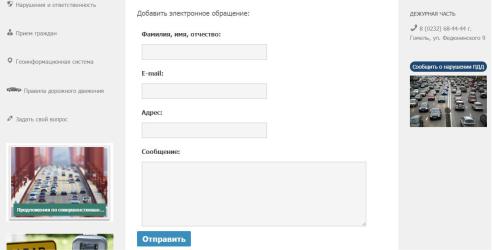
СР с. 3. Пр мер реализации раздела «Обращение граждан» |
||||
В разделе «Адм нистративные |
процедуры» |
предоставляется |
||
подробная |
быстрый |
проведения |
службой ГАИ |
|
нформац я о порядке |
||||
|
вных процедур: регистрация транспортных средств; |
|||
экзаменац онная деятельность; дополнительные услуги гражданам и |
||||
юридическ м л цам [8]. |
|
|
|
|
|
ГАИ |
|
||
В левой секции размещена ссылочная информация, позволяющая |
||||
осуществить |
переход на следующие вкладки: |
о нарушениях и |
||
ответственности в о ласти ДД; о времени приема граждан в ГАИ УВД |
||||
Гомельского облисполкома [9]; ГИС службы |
; Правила дорожного |
|||
движения; электронное обращение. |
|
|
|
|
ДД. Элемент «Сообщить о нарушенииДП » позволяет гражданам проинформировать службу ГАИ о правонарушении в сфере ДД с помощью заполнения соответствующей формы.
Виджет «Предложения по совершенствованию организации дорожного движения» позволяет организовать взаимодействие граждан со службой ГАИ Гомельской области. С его помощью любой пользователь может сообщить о несоответствиях и нарушениях в сфере организации
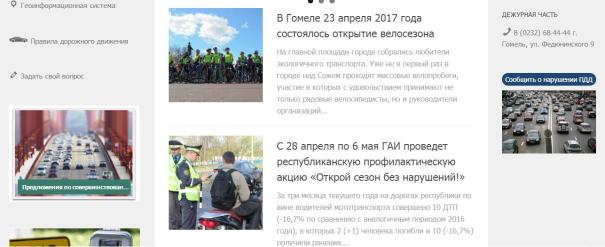
Под информационным слайдером размещена новостная лента событий, в которой описываются произошедшие за последний период
важные события, актуальные сведения в области ДД (рис. 4). |
||||
Данный сайт уже размещен, прошел предварительноеИтестирование и |
||||
получил положительную оценку пользователей и ГАИ города. Его |
||||
внедрение |
позволит |
значительно |
повысить |
эффективность |
информирования граждан и снизит существующую нагрузку на сотрудников службы ГАИ.
31
и |
|
|
|
|
|
|
|||
СР с. 4. Пр мер реализации новостной ленты событий |
|
|
|||||||
Информац я сайта может ыть использована как участниками ДД, |
|||||||||
так |
службами |
в целях анализа аварийности; |
|||||||
дорожными, |
городскими |
|
|
||||||
планирован я |
оценки эффективности |
|
проводимых |
мероприятий |
по |
||||
снижению авар йности. Инструментарий сайта дополняется новыми |
|||||||||
информац онными |
аналитическими |
возможностями на |
основании |
||||||
результатов |
научно-исследовательских |
|
работ авторов, |
кафедры |
|||||
«Управление автомо ильными перевозками и дорожным движением», в |
|||||||||
сотрудничестве с ГАИ г. Гомеля. |
Д |
|
|||||||
Библиографический список |
|
||||||||
1 |
|
|
|
|
|||||
Белорусская ассоциация экспертов и сюрвейеров на транспорте [Электронный |
|||||||||
ресурс] / Дорожное движениеА. – Гомель, 2017. – Режим доступа: http://www.baes.by. – |
|||||||||
Дата доступа: 15.04.2017. |
|
|
|
|
|
|
|||
2 |
Министерство транспорта Республики Грузия [Электронный ресурс] / Главная |
||||||||
страница. – Гомель, 2017. – Режим доступа: http:// http://police.ge/ge/ministry/about-the- |
|||||||||
ministry. – Дата доступа: 11.05.2017. |
|
|
|
|
|
|
|||
3 |
Полиция Республики Армения [Электронный ресурс] / Главная страница. – |
||||||||
Гомель, 2017. – Режим доступа: http://www.police.am. – ата доступа: 03.05.2017. |
|
||||||||
4 |
Сервис Госавтоинспекции Министерства внутренних дел Российской |
||||||||
Федерации [Электронный ресурс] / Госавтоинспекция. – Гомель, 2017. – Режим |
|||||||||
доступа: http://www.gibdd.ru/. – Дата доступа: 05.05.2017. |
|
|
|
||||||
5 |
Сервис Госавтоинспекции Министерства внутренних дел Азербаджанской |
||||||||
Республики [Электронный ресурс] / Главная страницаИ. – Гомель, 2017. – Режим |
|||||||||
доступа: http://mia.gov.az/?/ru/driverlicense/. – Дата доступа: 07.05.2017. |
|
|
|||||||
6 |
Singapore Government Directory [Электронный ресурс] / Главная страница. – |
||||||||
Гомель, 2017. – Режим доступа: https://www.gov.sg/sgdi/ministries/. – Дата доступа: |
|||||||||
08.05.2017. |
|
|
|
|
|
|
|
|
|
7 |
Экспертиза |
дорожно-транспортных |
|
происшествий |
с |
анализом |
и |
||
использованием специального программного обеспечения : учеб.-метод. пособие / В. Н. Галушко ; М-во образования Респ. Беларусь, Белорус. гос. ун-т трансп. – Гомель :
БелГУТ, 2014. –191 с.
32
8 Перечень государственных стандартов, устанавливающих требования к транспортным средствам и техническим средствам организации дорожного движения, реализующих положения Правил дорожного движения [Электронный ресурс] /
Госстандарт. – Гомель, 2017. – Режим доступа: http://gosstandart.gov.by. – Дата доступа: 23.03.2017.
9 УВД Гомельского облисполкома [Электронный ресурс] / Главная страница. –
Гомель, 2017. – Режим доступа: http://www.uvd.gomel.by. – Дата доступа: 08.05.2017. С(01.05.2017 г.).
UDC 656
APPLICATIONиOF PRINCIPLES OF LOGISTICS IN PASSENGER
TRANSPORTATION (on the example of Karagandacity)
бАD.K. Bakey, senior lecturer, Academician Y.A. Buketov Karaganda State University
Д.К. Бакей, ст. преподаватель,
«КарГУ м. Е.А. Букетова», г. Караганда, Республика Казахстан
Аннотация. В статье рассматривается эффективность использования подвижного состава и улучшение качества обслуживания пассажиров на базе рациональной организации пассажирских перевозок.
Abstract. The article examines theДefficiency of using rolling stock and improving the quality of passenger service based on the rational organization of passenger traffic.
Ключевые слова: городской пассажирский транспорт, логистика, транспортная система, логистические Ипринципы, пассажирская перевозка, транспортные предприятия.
Keywords: urban passenger transport, logistics, transport system, logistics principles, passenger transportation, transport enterprises.
High rates of urbanization and passenger transportation, welfare, cultural level and daily life of the people make increasing demands for the improvement of urban passenger transport. The social essence of man and production relations determine the need for information exchange and direct contacts of people in various spheres of their activities, which is associated with pedestrian and transport movements. Currently, there is a continuous increase in the volume of freight and passenger traffic, explained by the social division of labor and concentration of production, urbanization (the spread of urban
33
lifestyles and urban growth), socio-economic needs and the development of transport equipment.
Transport in the city plays the role of an indirect system of a living organism. It provides an opportunity for the life of the city as an integral system with its administrative, economic, cultural, educational and other functions. As the organization of the city grows, its demands for urban transport are
Сcontinuously growing, this stimulates the techniques of urban passenger transport. However, there is a gap between the technical capabilities of modern urban passenger transport and their real use. For example, a modern passenger car realizes the technical speed up to 200 km / h and above, and its real speed duringиpeak hours on the streets of cities does not sometimes exceed the pedestrian speed - 4-5 km / h. The speed of communication of land-based urban mass passenger transport, which is 15-18 km / h, is too small, which creates various difficulties and problems.
The mostбАimportant tool in improving the work of the company is now increasingly logistics, which covers all activities for the movement of products and information between participants in the supply chain. «Logistics is the planning, organization and control of all types of movement and storage activities that ensure the flow of material and associated information flows from the point of purchase of raw materials to the point of final consumption».
Urban passenger transport plays an important role in the economic and social life of the country. In Kazakhstan, at the beginning of the reforms, as in the period of the planned economy, urban passenger transport was a public service sector, always unprofitable, wasДunder the control of the state and local authorities and was subsidized from the budget.
With the transition to market relations, there are changes in the sphere of transport services, expressed by the reorientation of the market to the consumer. This necessitated the use of new management solutions in the organization of the operation of urban passenger transport systemsИ(GLP), required the creation of qualitatively new systems capable of responding flexibly to the constantly changing operating conditions and customer requirements. For a long time, logistics concepts in transport were applied only in the field of freight transportation. However, logistical principles can be useful for the systemic organization and management of passenger transportation, since there are many similarities in the organization of freight and passenger flows, although there are many differences.
The main difference is that the passenger is simultaneously not only the object of transportation, but also the consumer of transport services. The passenger plays an active role in the transportation: he chooses the route himself and can change it already during the trip. In a sense, we can assume that he participates in the organization and management of the transport process.
34
The choice of transportation options is influenced by a significant number of factors. Their list does not always coincide with what is taken into account during the development of the optimal delivery option. The passenger can take into account, for example, the comfort of the trip, the opportunity to drop on the
way to the points of interest and other circumstances that are completely irrelevant in the organization of freight traffic.
СThere are contradictions in the interests of passengers and carriers, one of which is that the carrier is interested in increasing the coefficient of shift, and
Each group of passengers has their preferences, based on which, they choose the route and time of the trip, the mode of transport, the place of transplantation, the method of payment. You can establish a hierarchy of these preferences and conduct a kind of segmentation of demand for transport
иThere are features when characterizing a passenger as a moving object. It is difficult to unambiguously characterize its dimensions, as the technical characteristics of the capacity of buses can be determined by several numerical
services.
the passenger is in direct and fast delivery to the destination.
The existingбАsystem of transportation organization, based on increasing the density of the route network and ensuring the regularity of traffic, does not always satisfy the emerging demand for transport services, especially during peak hours. In some situations it is necessary to organize the work of buses in
values (nominal capacity of the bus, capacity at «rush hour», etc.).
These differences, despite their importance, are not of principle nature, since in the case of freight and in the case of passenger traffic the main task of the system is the delivery of the moved object from the point of departure to the destination with the minimum aggregate costs at a specified level of
transportation quality.
such a way that in a limited period of time to realize mass passenger traffic in |
|
various directions. This task can be effectively solved using the principles of |
|
logistics. |
Д |
|
|
Logistic principles of the organization of passenger traffic are that the |
|
number of units of rolling stock, the mode of its operation and the routes of |
|
traffic |
guarantee the safety, reliability and unhindered delivery of passengers |
|
«from |
door to |
door» to the time they need. In modern science, several |
|
|
И |
categories of transportation are considered, to which the use of logistic |
||
technologies is |
possible: labor trips, night trips, trips connected with mass |
|
entertainment events.
The economy of the republic in modern conditions is connected with the transition from administrative management methods to economic ones. This transition to a market economy is accompanied by a number of negative phenomena, including a significant decline in production, depreciation of fixed
35