Материал: 2358

make it drive again. Many cars have five gears: first (or bottom), second, third, top and reverse.
When we stop the car and want it to stay in one place we put on the handbrake. To start the engine we switch on the ignition, press the starter, and the engine fires. We rev it up by pressing the accelerator pedal.
Sometimes in cold weather we need to use the choke to start the car. СибАДИ26 This gives us more petrol and less air, what is called a rion mixture.
At night we switch on our lights, but in town or when someone is coming they must be dipped. To do this we operate the dip switch – sometimes this is a hand switch near the steering wheel, sometimes a foot pedal. And lastly to change direction we signal with our indicators. Those are “controls” of the car. With our hands we steer with the steering wheel, change gear with the gear lever, and put on the handbrake. We also use the indicators as they can dip the lights. With our feet we accelerate by using the accelerator, stop by using the foot brake, change gear by using the clutch, and we can have a pedal dip switch. And that is about all inside the car except, of course, the mirror for seeing what is happening behind, the sun visors to shield our eyes against low sunshine, and, in England where they are compulsory, seat belts.
Задание 2. Выберите из текста названия частей автомобиля переведите их на русский язык.
Задание 3. Закончите следующие предложения, выбрав нужный вариант.
1. When we drive the car we steer with...
a) the wipers; b) the steering wheel; c) the final drive.
2. If there is someone in the way we stop the car with...
a) the brake; b) the horn; c) the clutch.
3. We have a foot pedal which is called...
a) the cycles; b) the spring; c) the clutch.
4. Many cars have five...
a) gears; b) strokes; c) axles.
5. To change direction we signal with our...
a) pedals; b) indicators; c) handbrakes.
Задание 4. Просмотрите видео «Understanding a Suspension System»
необходимое вам количество раз. Для чего используется эта систе- ма? Назовите 6 причин.
26
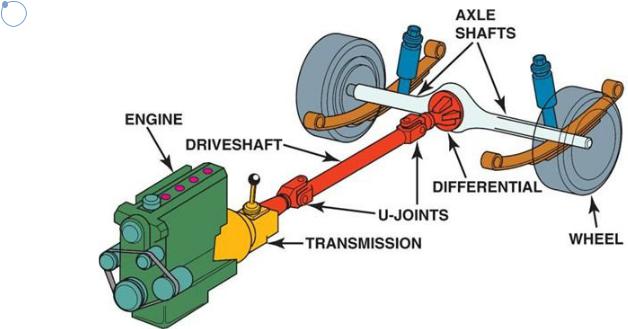
Задание 5. Пользуясь рисунком (fig. 4) и следующими сочетаниями слов, составьте и разыграйте диалог об управлении автомобилем.
The steering wheel, gear lever, to brake the car, a gear box, to switch on the ignition, press the starter, to switch on the lights.
СибАДИ27 Fig. 4. Moving the car
Текст 5
2-STROKE AND 4-STROKE ENGINES
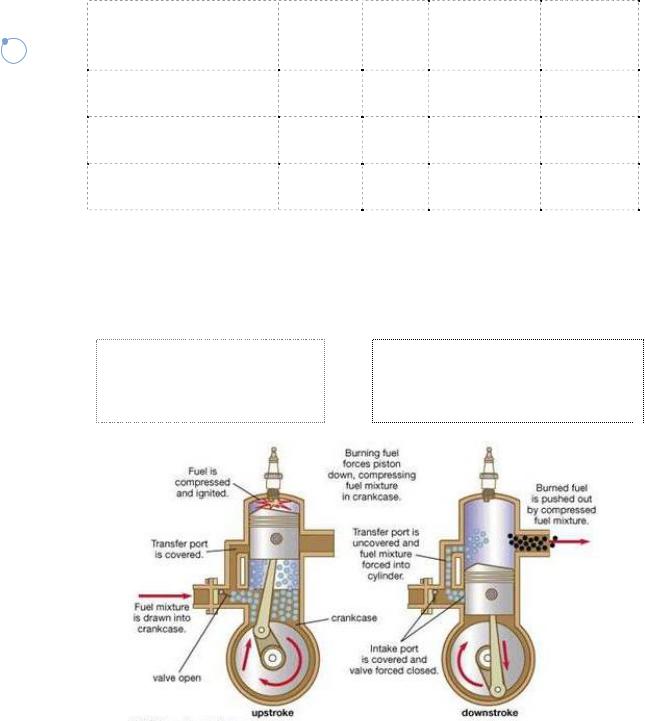
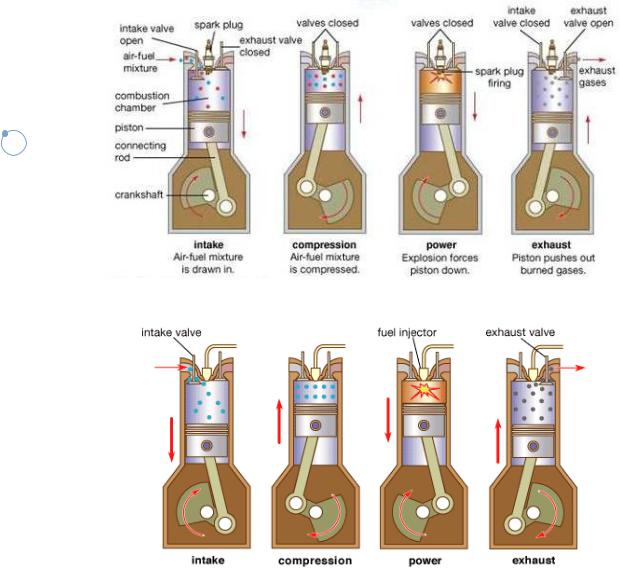
All motor vehicles have an engine. There are two types of engine. There are petrol engines and there are diesel engines. There are three engines in the picture. There is a 2-stroke petrol engine on the top of the page. There is a 4-stroke petrol engine in the middle and there is a 4-stroke diesel engine on the bottom of the page (fig. 5.1 – 5.3.).
There are spark plugs in both the petrol engines. There are spark plugs in all petrol engines. Diesel engines do not have spark plugs. They have fuel injectors. There are valves in both the 4-stroke engines. There are always valves in 4-stroke engines. There are no valves in the 2-stroke petrol engine. A 2-stroke petrol engine never has valves.
There is no oil sump in the 2-stroke engine. There is oil in the fuel. Both the 4-stroke engines have an oil sump. There is no oil in the fuel.
27
Задание 1. На основании информации текста заполните таблицу
(table 1).
Table 1
|
|
Types of Engine |
|
|
|
28 |
type of engine |
oil sump |
valves |
fuel injector |
spark plug |
СибАДИ |
|||||
|
2-stroke petrol engine |
- |
- |
- |
+ |
|
4-stroke petrol engine |
? |
+ |
? |
? |
|
4-stroke diesel engine |
? |
? |
? |
? |
Задан е 2. Пользуясь данными таблицы 1 рисунков (fig. 5.1 – 5.3), опишите 2-тактный ензиновый двигатель, 4-тактный бензиновый двигатель, 4-тактный дизельный двигатель. Используйте при этом следующ е модели:
|
a |
|
There is |
N + prep. N. |
There are (no) N +prep. N. |
|
no |
|
Fig. 5.1. A 2-stroke petrol engine
28
29
Fig. 5.2. A 4-stroke petrol engine
Fig. 5.3. A 4-stroke diesel engine
Задание 3. Опишите 2-тактный дизельный двигатель, дополнив следующие предложения. Учтите, что данные предложения означают одно то же.
A) There is a fuel injector in a 2-stroke diesel engine. B) A 2-stroke diesel engine has a fuel injector.
1. There is one valve in this engine. = This ……………………. valve. |
|
СибАДИ |
|
2. |
There is a fuel injector on all diesel engines. = All …………… injector. |
3. |
There is an oil sump in a 2-stroke diesel engine. = A ………….… . |
4. |
This engine has one port. = There ..................... . |
Задание 4. Просмотрите видео «The Differences Between Petrol and Diesel Engines» необходимое Вам количество раз. Ответье на вопрос: What is the difference between petrol and diesel engines?
29

Текст 6
Задание 1. Слушайте и повторяйте:
|
engine |
[′endʒin] |
двигатель |
|
mechanism |
[′mekənizm] |
механизм |
|
machine |
[mə′ʃI:n] |
машина |
30 |
energy |
[′enəʤi] |
энергия |
СибАДИ |
|||
|
combustion |
[kəm′bʌstʃən] |
сгорание |
|
fuel |
[′fju:əl] |
топливо |
|
cylinder |
[′silində] |
цилиндр |
|
automobile |
[′ɔ:təməbi:l] |
автомобиль |
|
equip |
[i′kwip] |
оборудовать |
|
source |
[sɔ:s] |
источник |
|
petroleum |
[pi′trouljəm] |
нефть |
|
gasoline |
[′gæsəli:n] |
бензин |
|
kerosene |
[′kerəsi:n] |
керосин |
|
installation |
[instə′leiʃən] |
установка |
Задан е 2. Найд те соответствующий вариант перевода каждого английского словосочетания.
A) Heat engine; to convert energy into mechanical work; internal combustion engine; to produce expansion; to generate steam for a steam engine; natural gas; source of motive power; to maintain a tiny flame in the pilot; power installations.
B) Превращать энергию в механическую работу; производить расширение; природный газ; двигатель внутреннего сгорания; источник движущей энергии; силовые установки; тепловой двигатель; поддерживать очень маленькое пламя во вспомогательном устройстве; вырабатывать пар для парового двигателя.
Задание 3. Употребите в качестве сказуемого глагол, данный в скобках, преобразовав его в нужную форму пассивного залога.
1. The fuel (to burn) inside the engine.
2. The automobile (to equip) with the engine.
3.The steam engine (to use) in locomotives.
4.Energy (to convert) into mechanical work in the engine.
5.Expansion (to produce) inside the cylinder.
30