Материал: 2358
the implementation of the Red Flag Act. This ruled that all forms of ‘road locomotives’ should have a man with a red flag walking ahead of them. This ridiculous law was not repealed until many years later.
С6 и
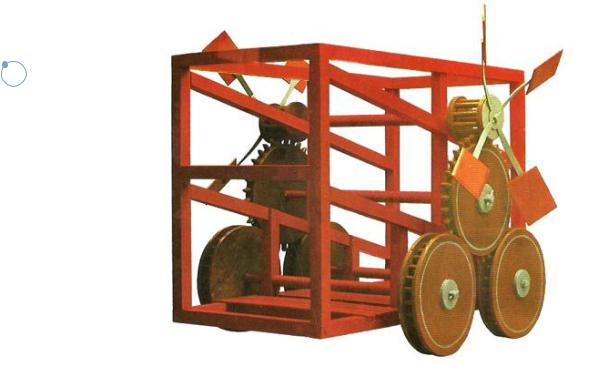
бАFig. 1. Wind-driven vehicle by Robert Valturio
Текст 2
THE POWERДSTRUGGLE
It was the development of the internal combustion engine from the mid-1800s onwards which spurred inventors on to develop ‘horseless carriages’. Nikolaus Otto is generally regarded as being the father of today’s petrol engine but its origins date back much further. The initial idea can be traced to the 1670s, from when there survive theИfirst descriptions of a piston sliding within the cylinder, powered by gun powder – in effect, a development of the cannon. This was put into practice by a number of engineers, one of whom was the Swiss, Francois Issac de Rivaz, who even used electricity to supply the ignition.
Arguments still rage today among automotive historians concerning the identity of the individual who created the first ‘true’ internal combustion engine. Etienne Lenior won the race to patent his design first in 1859, but the Italians Barsanti and Matteucci had working designs on display several years earlier. Lenior’s patent was more in line with the modern engine as we know it however, and was a spur to future innovators like Nickolaus Otto, Gottlieb Daimler and Karl Benz. Otto’s four-stroke engine
6
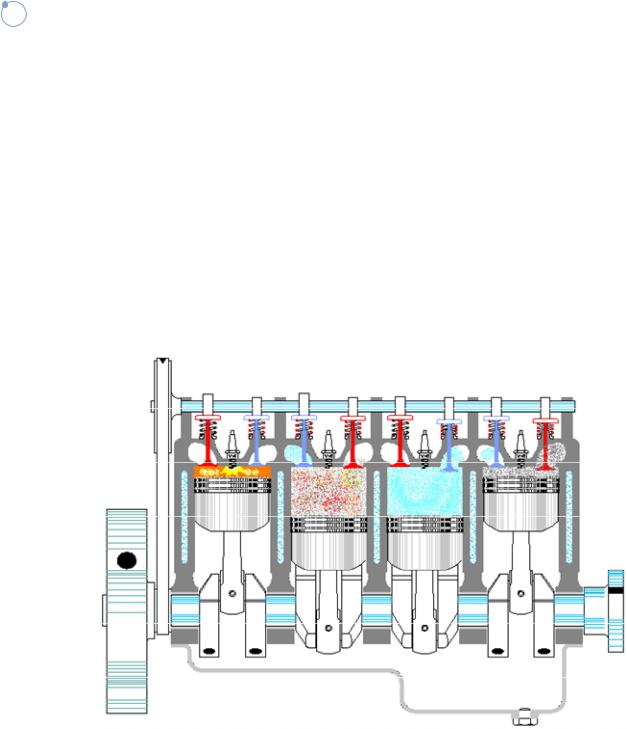
(the four ‘strokes’ of the cycle being: Induction, Compression, Ignition, Exhaust) was a refinement of Lenior’s idea, and provided the motive power for the motor car in more ways than one (fig. 2).
Otto had a though time realizing his vision. Having learned of Lenior’s gas engine, and being further inspired by seeing the Barsanti and
СMatteucci idea on a trip to England, he developed a similar unit designed
7
to run on liquid fuel. However, as the history of the automobile constantly shows, some of the greatest innovators had poor business minds. Otto needed future car enthusiast Eugen Langen to both help secure a patent and alsoиsee the venture through bleak times when technical problems halted sales for a while.
It is unfair to credit any one person with the creation of the car. Gottlieb Daimler, who worked with Otto until their differing views caused a fall-out, developedбАhis own engines. These were not solely for car use, but he did build the first four-wheel horseless carriage. Karl Benz, who lived less than 100 miles away, designed his advanced tricycle which proved to the first truly purpose-built machine. Amazingly, not only did the pair never meet, but were even unaware of each other s efforts as they worked on parallel designs.
By 1886 the motor car was definitely ready to roll.
Д И
Fig. 2. Otto’s internal combustion four-stroke cycle
7

Текст 3
THE DRIVE TO GAIN ACCEPTANCE
Germany received the credit for fathering the automobile but it was France which gave it the warmest welcome. Both Daimler and Benz came under strong criticism in their home country for their inventions, but the
СFrench, who already had a healthy road network to cater for their enthusi-
8
asm for bicycles, staged one of the most significant events designed to popularize the motor car, in 1889.
The Paris World Exhibition attracted 400,000 visitors, who poured through the doors to see the first car. Daimler and Benz enjoyed success at the event, while Peugeot gained the right to build cars with Daimler en-
и Lambert of бАOhio. Four years later the Duryea brothers established the first
gines. Despite opposition from some quarters, there was no turning back.
Across the Atlantic, the first automobile ran in 1891, built by John
car-manufacturing plant. The birth of the car in the US was a difficult one. George Baldwin Selwyn, a lawyer specializing in patents, had decided to monopolise the automobile by drawing up a definitive patent for the car. Any future fuel-powered designs would be an infringement upon it. His case was strengthened by ALAM – the Association of Licensed Automobile Manufacturers – and it took the courage of a certain Henry Ford, no less, to contest this judgement and win the case.
The absurd Red Flag Act in the UK stifled enthusiasm for the car un-
Automobile Club of Great Britain Дand Ireland staged a famous 1000-mile trial around the country. Some 65 cars took part to show the population – many of whom had never seen a car before – the future way to travel. The motor car had truly arrived.
til 1896 when it was finally scrapped. A speed limit of 12 mph was imposed in its place. To celebrate the occasion, which effectively marked the birth of the British car industry, a drive from the capital to Brighton was instigated. This annual London to Brighton run is still enjoyed today.
By the end of the century and while still the preserve of the elite, the И
Текст 4 FAST AND FURIOUS
Like so many inventions in the past, further development was easier once the initial blueprint was established. The action was fast and furious in the first years of the new century. Because many of the car manufacturers were being run by engineers and not businessmen, they had the authority, and the audacity, to build exactly what they wanted.
8

We may think that our fuel-injected, 16-valve, electronically-chipped and heavily-appointed cars of the 1990s represent the pinnacle of automotive design, but this is not the case. In fact, apart from the electronics, most of the concepts found in a typical modern car are little more than an advancement of an idea originally devised decades ago. Only the lack of suit-
able materials available to engineers at that time stifled inspired thought.
9
СибАДИAnother factor, of course, was the price. As the car’s popularity spread, so the demand for cheap, simple transport for the masses, epitomized by the Ford Model T By the mid-1920s nearly 700,000 cars were in daily use on British roads and more than ten million could be found in the USA. Things weren’t rosy for all vehicle manufacturers, however, with many small outfits floundering early-on. As the car became big business across the world only the strongest survived.
This was never more evident than in the aftermath of an economic slump in Europe in the early 1920s, followed several years later across the Atlantic during the Great Depression.
To help the British car industry survive in these though times, the government set up a special horsepower tax which penalized foreign imports. The idea was to tax cars on their power output. This basically sound idea was seriously hampered because the levy imposed (based on calculations performed by the Royal Automobile Club) was derived from a formula which would have baffled even Albert Einstein. Instead of it being related to engine size, it was bizarrely connected to the size of an engine’s pistons. Thus, ‘small-bore/long-stroke’ engines – the most inefficient design of all – achieved the lowest taxation. As a result, engine development in the UK was crippled for years. The tax was finally replaced in 1947 by a flat-rate charge better known today as the road fund license. Incidentally this coincided with the launch of the Standard Vanguard, with a ‘shortstroke’ engine aimed directly at export markets.
The 1930s saw a significant shift towards the affordable car, both in the US and in the UK. Ford’s Y Popular became the company’s first truly British car. It cost just 100 – easily within the realms of the ordinary worker, as contemporary advertisements at the time showed. With more than 1.5 million cars on the UK’s streets by this time, the car was fast being viewed as not simply a luxury, but more a necessity. Expectations rose too. Safety glass, proper windscreen wipers and better interiors were now standard even in the cheapest car.
The advent of World War II saw progress in aero-engine design which decades later would have an effect on the car. Multi-valve engines
9

were used by Rolls-Royce for extra power and superior high-octane fuels were introduced for added performance. One American fighter used an engine which made use of an embryonic variable valve-timing system – an innovation which is increasingly being seen on car engines 50 years later.
The immediate postwar years were bleak on the automotive front,
however, Britain car manufacturers were ordered by the government to ex- СибАДИ10 port, so half of all production was destined for overseas. There was a real shortage of cars, fuel and even tyres, and used-car prices soared to meet the
increasing demand. To stop any speculating and selling-on for an instant profit, new car buyers were forced to sign a pledge that stated that they would not sell the car for a minimum of two years.
While the countries of Europe tightened their collective belts with the continued imposition of rationing, the US car industry returned to its pre-war ways by offering unprecedented levels of refinement to potential car buyers. Fully automatic transmission, cruise control and powered brakes, seats and windows were all common fittings.
In the UK new car designs were scarce, with most postwar models being carry-overs from the 1930s. It was left to the humble, yet technically advanced Morris Minor and the stunning Jaguar XK120 to woo enthusiasts at the 1948 Motor Show in London.
That same year saw a remarkable car launched in America – the Tucker ‘48’. Preston Tucker was a flamboyant small-time car manufacturer who wanted to make it big with what was described at the time as the first completely new car for half a century. With features like a special passenger safety cage and standard seat belts, the Tucker was decades ahead of its rivals, but it flopped due to the company having little business acumen. Tucker made big claims and promises to raise the $12 million he required, and although later charged with fraud, his only crime was over-enthusiasm.
Preston Tucker thought the big car-makers were out to get him but his failure was due principally to being out of his depth and expecting too much too soon. Had the ‘48’ been a success, the progress of auto technology may have moved on much more rapidly.
The 1950s was a time when the car industry tried to shake off its postwar blues. Although these were still austere times, it turned out to be a golden age in motoring. American bosses of both Ford and Vauxhall became more involved in the designs of their UK satellites, while the sheer size of product output by parent companies in the US saw the demise of many superb, but small, European car-makers.
10