Материал: Атлас Ханц фениш

|
282 |
Brain |
|
|
|
|
|
||
|
|
|
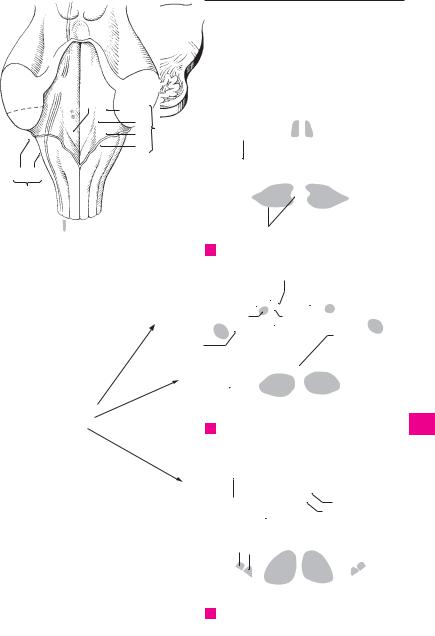
Olivospinal tract. Tractus olivospinalis. Ex- |
16 |
Cochlear nuclei. Nuclei cochleares. Mass of |
||||
1 |
|
1 |
|||||||
|
|
|
trapyramidal tract limited to the cervical cord. |
|
nerve cells situated below the lateral recess of |
||||
|
|
|
|
It influences head and hand movements. D |
|
the 4th ventricle, where it may form a slight |
|||
2 |
|
2 |
Spino-olivary tract. Tractus spino-olivaris. |
|
elevation, the tuberculum acusticum. A |
||||
|
|
|
|
Tract that extends throughout the entire spinal |
17 |
Anterior cochlear nucleus. Nucleus cochlearis |
|||
3 |
|
|
|
cord and provides information for the olive, |
|
anterior. Its fibers pass to the opposite side pri- |
|||
|
|
|
partly for its own needs, partly for those of the |
|
marily via the trapezoid body and join the |
||||
4 |
|
|
|
cerebellum. D |
|
lateral lemniscus. A |
|
|
|
|
3 |
Olivocerebellar tract. Tractus olivocerebellaris. |
18 |
Posterior |
cochlear |
nucleus. |
Nucleus |
||
|
|
|
|
It passes through the inferior cerebellar |
|
cochlearis posterior. Its fibers pass mostly to |
|||
5 |
|
|
|
peduncle from the olive to the cerebellum. B |
|
the midline just beneath the floor of the rhom- |
|||
|
|
4 Inferior cerebellar peduncle. Pedunculus cere- |
|
boid fossa, where they penetrate deeply in |
|||||
|
|
|
|
||||||
6 |
|
|
|
bellaris inferior. Inferior connection to the cere- |
|
order to join the trapezoid body. A |
|
||
|
|
|
bellum without a sharply defined boundary |
19 |
Commissural nucleus. Nucleus commissuralis. |
||||
|
|
|
|
from the middle cerebellar peduncle. It con- |
|
Little-known nucleus in the medulla oblongata. |
|||
7 |
|
|
|
tains fibers primarily from the spinocerebellar |
20 |
Nucleus |
ambiguus. |
Nucleus of |
origin for |
|
|
|
tract and olive. A B |
||||||
|
|
|
|
|
cranial nerves IX and X as well as the cranial |
||||
|
|
5 |
Nucleus of hypoglossal nerve (hypoglossal |
|
|||||
8 |
|
|
portion of XI. It is located behind the olive. C D |
||||||
|
|
|
nucleus). Nucleus nerve hypoglossi (nucleus |
21 Inferior salivary nucleus. Nucleus salivarius in- |
|||||
|
|
|
|
hypoglossalis). It is located below the floor of |
|||||
|
|
|
|
|
ferior. Autonomic nucleus for the parasympa- |
||||
9 |
|
|
|
the lower rhomboid fossa. C D |
|
||||
|
|
|
|
thetic fibers of the glossopharyngeal nerve. A C |
|||||
|
|
6 Posterior paramedian nucleus. Nucleus para- |
|
||||||
|
|
|
22 Arcuate nucleus. Nucleus arcuati. Located in |
||||||
|
|
|
|
medianus posterior. Cell group in the vicinity of |
|||||
10 |
|
|
|
|
front of and medial to the pyramidal tract. This |
||||
|
|
|
the hypoglossal nucleus that communicate |
|
|||||
|
|
|
|
group of nuclear cells gives origin to the exter- |
|||||
|
|
|
|
with the reticular formation. |
|
||||
11 |
|
7 |
|
nal arcuate fibers. It corresponds to caudally |
|||||
|
Dorsal nucleus of vagus nerve (dorsal vagal |
|
|||||||
|
|
displaced pontine nuclei. B |
|
||||||
|
|
|
|
nucleus). Nucleus dorsalis nervi vagi (nucleus |
23 Anterior external arcuate fibers. Fibrae ar- |
||||
|
|
|
|
vagalis dorsalis). Autonomic and sensory cell |
|||||
12 |
|
|
|
|
cuatae externae anteriores. Fibers from the ar- |
||||
|
|
|
group located lateral and caudal to the hypo- |
|
|||||
|
|
|
|
cuate nucleus which |
pass externally around |
||||
|
|
|
|
glossal nucleus. C D |
|
||||
13 |
|
|
|
|
and transversely across the olive into the cere- |
||||
|
8 |
Nucleus intercalatus. Nuclear group of un- |
|
||||||
|
|
bellar peduncles. C |
|
|
|||||
|
|
|
|
known function situated between the nucleus |
24 Posterior external arcuate fibers. Fibrae ar- |
||||
14 |
|
|
|
of the hypoglossal nerve and the dorsal nucleus |
|||||
|
|
|
|
cuatae externae posteriores. Fibers which pass |
|||||
|
|
|
of the vagus. C |
|
|||||
|
|
|
|
|
uncrossed from the lateral part of the arcuate |
||||
|
|
|
9 Tractus solitarius. Taste fibers of cranial nerves |
|
|||||
15 |
|
|
|
nucleus to the inferior cerebellar peduncle. |
|||||
|
|
|
V, VII, IX and X for the nucleus of the tractus |
|
They replace the posterior spinocerebellar tract |
||||
|
|
|
|
solitarius. C |
|
for the region above C8. The thoracic nucleus is |
|||
16 |
|
10 |
Nucleus solitarius. Row of cells for the tractus |
|
absent here. D |
|
|
||
|
|
|
|
solitarius extending from the middle of the |
25 |
Raphe of medulla oblongata. Raphe medullae |
|||
|
|
|
|
rhomboid fossa to the decussation of the py- |
|||||
17 |
|
|
|
|
oblongatae. Median line in the decussation of |
||||
|
|
|
ramids. C |
|
the lemniscus. C |
|
|
||
|
|
11 Nucleus parasolitarius. Dispersed cells ven- |
26 |
Nuclei raphae. Cells of the reticular structure |
|||||
|
|||||||||
18 |
|
|
|
trolateral to the nucleus solitarius with no |
|||||
|
|
|
|
located near the median plane. |
|
||||
|
|
|
|
known function. |
|
|
|
|
|
|
|
|
|
|
|
|
|
|
|
19 |
12 |
Vestibular nuclei. Nuclei vestibulares. Four ter- |
|
|
|
|
|
||
|
|
|
|
minal nuclei of the vestibular division. They |
|
|
|
|
|
|
|
|
|
have projections to the spinal cord, cerebellum |
|
|
|
|
|
20 |
|
|
|
|
|
|
|
|
|
|
|
|
and medial longitudinal fasciculus. A |
|
|
|
|
|
|
|
13 |
Inferior vestibular nucleus. Nucleus vestibu- |
|
|
|
|
|
||
|
|
|
|
|
|
||||
21laris inferior. Oblong nuclear group lying laterally beneath the medial nucleus with projections to the cerebellum and medial longitudi-
22nal fasciculus. A
14 Medial vestibular nucleus. Nucleus vestibular
23medialis. Group of nuclei lateral to the limiting sulcus with fibers of origin for the medial longitudinal fasciculus of both sides. A
2415 Lateral vestibular nucleus. Nucleus vestibularis lateralis. Smaller group of nuclei located
25toward the lateral recess with projections to the anterior horn of the spinal cord. A


|
284 |
Brain |
|
|
|
|
|
|
|
|||
|
|
|
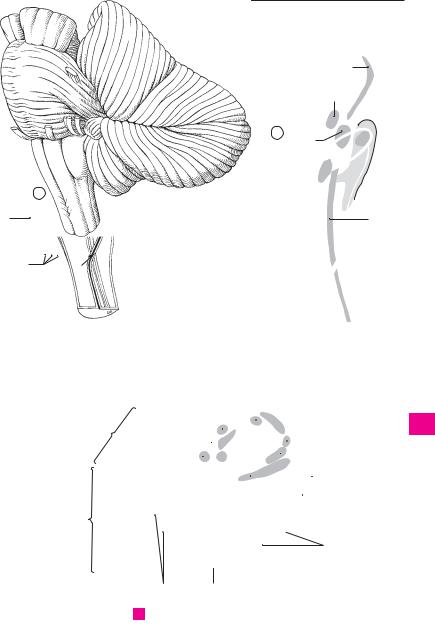
METENCEPHALON. Part of the rhomben19 |
Medial |
longitudinal |
fasciculus. |
Fasciculus |
|||||
1 |
|
1 |
||||||||||
|
|
|
cephalon consisting of the pons, cerebellum |
|
longitudinalis medialis. Tract that connects the |
|||||||
|
|
|
|
and tegmentum. |
|
|
nuclei of the ocular and neck muscles on one |
|||||
2 |
|
2 |
PONS. Located between the interpeduncular |
|
side and the vestibular organ on the other. C |
|||||||
|
|
|
|
fossa and pyramids. It consists mostly of cross- |
20 |
Posterior longitudinal |
fasciculus. Fasciculus |
|||||
3 |
|
|
|
ing fibers and cells of the cerebral, pontine and |
|
longitudinalis |
posterior [[Schütz]]. Reciprocal |
|||||
|
|
|
cerebellar tracts. A B |
|
|
connections between the hypothalamus and |
||||||
|
|
3 |
Bulbopontine (pontobulbar) |
sulcus. Sulcus |
|
the nuclei of cranial nerves III, V, VII, X; XII, the |
||||||
4 |
|
|
nucleus ambiguus, and the tractus solitarius |
|||||||||
|
|
|
bulbopontines. Limiting furrow between the |
|
||||||||
|
|
|
|
inferior margins of the medulla oblongata and |
|
and salivatorius in the mesencephalic central |
||||||
|
|
|
|
|
gray region. C |
|
|
|||||
5 |
|
|
|
pons. Site of exit of cranial nerves VI, VII and |
|
|
|
|||||
|
|
|
21 |
Medial lemniscus. Lemniscus medialis. De- |
||||||||
|
|
|
VIII. A |
|
||||||||
|
|
|
|
|
||||||||
|
|
|
4 Basilar sulcus of pons. Sulcus basilaris. Median |
|
cusssating connection between the nuclei of |
|||||||
6 |
|
|
|
the posterior funiculus and the thalamus lo- |
||||||||
|
|
|
groove produced by the pyramidal tract fibers |
|
||||||||
|
|
|
|
situated to the right and left of the midline. It is |
|
cated mainly medially but also laterally. C |
||||||
|
|
|
|
22 Tectospinal (spinotectal) tract. Tractus tec- |
||||||||
7 |
|
|
|
occupied by the basilar artery. A C |
||||||||
|
|
|
|
tospinalis. It begins in the superior colliculus, |
||||||||
|
|
|
5 Middle (pontine) cerebellar peduncle. Pedun- |
|
||||||||
|
|
|
|
crosses the opposite side and then lies ventral |
||||||||
8 |
|
|
|
culus cerebellaris medius (pontinus). Thick |
|
|||||||
|
|
|
|
to the medial longitudinal fasciculus. It is con- |
||||||||
|
|
|
middle peduncle containing the pontocerebel- |
|
||||||||
|
|
|
|
|
cerned with optic reflexes. C |
|
||||||
|
|
|
|
lar tract. A |
|
|
|
|||||
9 |
|
|
|
|
23 |
Reticular formation. Formatio reticularis. Lo- |
||||||
|
6 |
Pontocerebellar trigone. Trigonum pontocere- |
||||||||||
|
|
|
|
bellare. Clinically important angle between the |
|
cated in the posterior part of the pons; this long |
||||||
|
|
|
|
|
group of cells is permeated by nerve fibers and |
|||||||
10 |
|
|
|
pons, medulla oblongata and cerebellum. A |
|
|||||||
|
|
|
|
continues anterosuperiorly and caudally. It is |
||||||||
|
|
7 SECTIONS OF PONS. Senctiones pontis. |
|
|||||||||
|
|
|
|
concerned with the integration of visceral and |
||||||||
11 |
|
8 |
Anterior (balisar) part of pons. Pars anterior |
|
muscular functions. C |
|
|
|||||
|
|
|
|
|
|
|
||||||
|
|
|
|
(balisaris) pontis. Portion of pons consisting |
24 |
Spinal lemniscus. Lemniscus spinalis. Cranial |
||||||
12 |
|
|
|
mainly of fibers of the cerebropontocerebellar |
|
continuation of the lateral and anterior |
||||||
|
|
|
tract. C |
|
|
spinothalamic tracts. C |
|
|
||||
|
|
9 |
Longitudinal pontine fibers. Fibrae pontis |
25 |
Spinal tract of trigeminal nerve. Tractus spi- |
|||||||
13 |
|
|
|
longitudinales. Longitudinally |
coursing tracts |
|
nalis nervi trigeminalis. Trigeminal fibers de- |
|||||
|
|
|
|
of fibers described below. |
|
|
scending as far as C4 to join the nucleus of the |
|||||
14 |
|
10 |
Corticospinal fibers. Fibrae |
corticospinales. |
26 |
spinal tract of the trigeminal nerve. B |
||||||
|
|
|
Part of the pyramidal tract passing into the spi- |
Spinal (inferior) nucleus of trigeminal nerve. |
||||||||
|
|
|
|
|||||||||
15 |
|
|
|
nal cord. C |
|
|
Nucleus spinalis (inferior) nervi trigeminalis. |
|||||
|
11 |
Corticonuclear (corticobulbar) fibers. Fibrae |
|
Nucleus belonging to the spinal tract of the |
||||||||
|
|
|
|
corticonucleares. Fibers of the pyramidal tract |
|
trigeminal nerve. B |
|
|
||||
|
|
|
|
27 |
Pontine nucleus of trigeminal nerve. Nucleus |
|||||||
16 |
|
|
|
passing to the motor nuclei of cranial nerves. C |
||||||||
|
|
12 |
Corticoreticular fibers. Fibrae corticoreticu- |
|
pontinus nervi trigeminalis. Main nucleus of |
|||||||
|
|
|
trigeminal serving primarily for the sense of |
|||||||||
17 |
|
|
|
lares. Fibers passing from the cerebral cortex to |
|
|||||||
|
|
|
|
touch. B |
|
|
|
|
||||
|
|
|
the reticular formation. |
|
|
|
|
|
|
|||
|
|
|
|
|
28 |
Trigeminal |
lemniscus |
(trigeminothalamic |
||||
|
13 |
Corticopontine fibers. Fibrae corticopontinae. |
||||||||||
18 |
|
tract). Lemniscus trigeminalis (tractus trige- |
||||||||||
|
|
|
Fibers extending to the pontine nuclei from the |
|
||||||||
|
|
|
|
frontal, occipital and temporal lobes. C |
|
minothalamicus). Crossed fibers of the trigemi- |
||||||
|
|
|
|
|
||||||||
|
|
|
|
|
nal nucleus extending to the thalamus. C |
|||||||
19 |
|
|
|
|
||||||||
14 |
Transverse pontine fibers. Fibrae pontis trans- |
|
||||||||||
29 Mesencephalic tract of trigeminal nerve. Trac- |
||||||||||||
|
|
|
|
versae. Transversely coursing fibers of the cere- |
||||||||
|
|
|
|
|
tus mesencephalicus nervi trigeminalis (trac- |
|||||||
20 |
|
|
|
bropontocerebellar tract. C |
|
|
||||||
|
|
|
|
|
tus mesencephalicus trigeminalis). Trigeminal |
|||||||
15 |
Pontocerebellar fibers. Fibrae pontocerebel- |
|
||||||||||
|
fibers for the nucleus of the trigeminal nerve |
|||||||||||
|
|
|
|
lares. Fibers of the pontocerebellar tract pass- |
|
tract located lateral to the cerebral aqueduct |
||||||
21 |
|
|
|
|
||||||||
|
|
|
ing from the pons to the cerebellum. C |
|
and in the lateral part of the arch to the 4th ven- |
|||||||
|
16 |
Pontine nuclei. Nuclei pontis. Intercalary cells |
|
tricle. B C |
|
|
|
|||||
|
|
|
|
|
||||||||
22 |
|
|
|
of the cerebropontocerebellar tract situated in |
30 |
Mesencephalic nucleus of trigeminal nerve. |
||||||
|
|
|
|
the ventral part of the pons. C |
|
|
Nucleus |
mesencephalicus nervi |
trigeminalis |
|||
|
|
|
|
|
|
|||||||
23 |
17 |
Posterior part of pons (tegmentum of pons). |
|
[nucleus mesencephalicus trigeminalis]. Upper |
||||||||
|
sensory nucleus extending to the area below |
|||||||||||
|
|
|
|
Pars posterior pontis (tegmentum pontis). Part |
|
|||||||
24 |
|
|
|
of pons situated between the 4th ventricle and |
|
the tectal lamina. B |
|
|
||||
|
|
|
the transverse pontine fibers. C |
|
|
|
|
|
|
|||
18 Pontine raphe. Raphe pontis. Fibers from the
25trigeminal nucleus forming the midline of the pons. C
|
286 |
Brain |
|
|
|
|
|
|
|
|
|
|
|
|
||
|
|
|
Motor nucleus of trigeminal nerve. Nucleus |
|
16 |
Posterior nucleus of trapezoid body. Nucleus |
||||||||||
1 |
|
1 |
|
|||||||||||||
|
||||||||||||||||
|
|
|
motorius nervi trigeminalis [nucleus motorius |
|
|
corporis trapezoidei posterior. It lies behind the |
||||||||||
|
|
|
|
trigeminalis]. It is located near the exit of the |
|
|
anterior nucleus. D |
|
|
|||||||
2 |
|
|
|
trigeminal nerve. A B |
|
|
|
|
17 |
Lateral lemniscus. Lemniscus lateralis. Ascend- |
||||||
|
|
|
2 Nucleus of abducens nerve. Nucleus nervi ab- |
|
|
ing continuation of the trapezoid body. Part of |
||||||||||
3 |
|
|
|
ducentis |
[nucleus |
abducens]. |
It |
is |
found |
|
|
the hearing pathway. D |
|
|
||
|
|
|
beneath the facial colliculus. A B |
|
|
|
|
18 Nucleus of lateral lemniscus. Nuclei lemnisci |
||||||||
|
|
|
|
|
|
|
|
|||||||||
|
|
|
3 Nucleus of facial nerve. Nucleus nervi facialis |
|
||||||||||||
4 |
|
|
|
|
lateralis. Ganglion |
cells interspersed |
in the |
|||||||||
|
|
|
[nucleus facialis]. This motor nucleus lies later- |
|
|
lateral lemniscus. |
|
|
|
|||||||
|
|
|
|
|
|
|
|
|
||||||||
5 |
|
|
|
ally below the nucleus of the abducens. A B |
|
19 Fourth ventricle. Ventriculus quartus. Dilata- |
||||||||||
|
4 |
Genu of facial nerve. Genu nervi facialis. Arch |
|
|||||||||||||
|
|
|
tion of the lumen of the embryonic neural tube |
|||||||||||||
|
|
|
|
formed by fibers of facial nerve below the facial |
|
|
in the rhombencephalon. D |
|
|
|||||||
6 |
|
|
|
colliculus and above the nucleus of the abdu- |
|
20 |
Rhomboid fossa. Fossa rhomboidea. Floor of |
|||||||||
|
|
|
|
cens. B |
|
|
|
|
|
|
|
4th ventricle. A C |
|
|
|
|
7 |
|
5 |
Superior salivary |
(salivatory) |
nucleus. Nu- |
|
|
|
|
|
||||||
|
|
21 |
Lateral |
recess. |
Recessus |
lateralis. |
Lateral |
|||||||||
|
|
|
cleus salivarius superior. Autonomic nucleus |
|
||||||||||||
|
|
|
|
|
|
corner |
of the 4th |
ventricle |
ending with the |
|||||||
|
|
|
|
for the |
parasympathetic fibers |
of |
the |
facial |
|
|
||||||
8 |
|
|
|
|
|
lateral aperture. C D |
|
|
||||||||
|
|
|
nerve. It supplies preganglionic fibers for the |
|
|
|
|
|||||||||
|
|
|
|
22 |
Median sulcus. Sulcus medianus. Median fur- |
|||||||||||
|
|
|
|
pterygopalatine and submandibular ganglia. A |
|
|||||||||||
9 |
|
|
|
B |
|
|
|
|
|
|
|
row passing through the rhomboid fossa. C |
||||
|
6 |
Lacrimal nucleus. Nucleus lacrimalis. Auton- |
|
23 |
Medial eminence. Eminentia medialis. Oblong |
|||||||||||
|
|
|
||||||||||||||
10 |
|
|
|
omic cells lying beside the superior salivary nu- |
|
|
elevation located between the median sulcus |
|||||||||
|
|
|
cleus for the control of lacrimal secretion. A B |
|
|
and the sulcus limitans. C |
|
|
||||||||
11 |
|
7 |
Superior olivary nucleus. Nucleus olivaris su- |
|
24 |
Facial colliculus. Colliculus facialis. Promi- |
||||||||||
|
|
|
perioris. It lies lateral to the trapezoid body, |
|
|
nence above the medullary striae produced by |
||||||||||
|
|
|
|
contains fibers from the cochlear nuclei and in- |
|
|
the genu of the facial nerve and the nucleus of |
|||||||||
12 |
|
|
|
tegrates hearing via the olivocochlear tract. D |
|
|
the abducens nerve. C |
|
|
|||||||
|
8 |
Olivocochlear tract. Tractus olivocochlearis. |
|
25 |
Limiting sulcus. Sulcus limitans. Shallow fur- |
|||||||||||
|
|
|
||||||||||||||
13 |
|
|
|
Tract from the superior olivary nucleus to the |
|
|
row situated lateral to the medial eminence. C |
|||||||||
|
|
|
hair cells of the ear. |
|
|
|
|
26 |
Vestibular area. Area vestibularis. Field above |
|||||||
|
|
|
|
|
|
|
|
|||||||||
|
|
|
9 Vestibular nuclei. Nuclei vestibulares. Four ter- |
|
||||||||||||
14 |
|
|
|
|
the vestibular nuclei and lateral to the limiting |
|||||||||||
|
|
|
minal nuclei of the vestibular division with |
|
|
sulcus at the beginning of the lateral recess. C |
||||||||||
|
|
|
|
|
|
|||||||||||
|
|
|
|
projections to the spinal cord, cerebellum and |
|
27 |
Superior fovea. Fovea superior. Pit situated |
|||||||||
15 |
|
|
|
medial longitudinal fasciculus. A B |
|
|
|
|||||||||
|
|
|
|
|
|
|
lateral to the facial colliculus. C |
|
||||||||
|
|
10 Medial vestibular |
nucleus. Nucleus vestibu- |
|
28 |
Locus ceruleus. Locus caeruleus. Elongated |
||||||||||
16 |
|
|
|
laris medialis. Nucleus of nerve cells that lies |
|
|||||||||||
|
|
|
|
|
group of bluish cells located in the lateral wall |
|||||||||||
|
|
|
|
lateral to the sulcus limitans and gives attach- |
|
|
of the 4th ventricle and under it. C |
|
||||||||
|
|
|
|
ment to the medial longitudinal fasciculus of |
|
|
|
|||||||||
17 |
|
|
|
|
29 |
Inferior fovea. Fovea inferior. Pit at the apex of |
||||||||||
|
|
|
both sides. A D |
|
|
|
|
|
||||||||
|
|
11 Lateral vestibular nucleus. Nucleus vestibu- |
|
|
the trigone of the vagus nerve. C |
|
||||||||||
|
|
|
|
|
||||||||||||
18 |
|
|
30 |
Medullary striae. Striae medullares. Strongly |
||||||||||||
|
|
|
laris lateralis. Smaller nucleus of nerve cells sit- |
|
||||||||||||
|
|
|
|
uated near the lateral recess with projections to |
|
|
myelinated transverse nerve bundles from the |
|||||||||
19 |
|
|
|
the anterior horn of the spinal cord. A D |
|
|
|
arcuate nucleus to the cerebellum. C |
|
|||||||
|
12 |
Superior vestibular nucleus. Nucleus vestibu- |
|
31 |
Trigone of hypoglossal nerve. Trigonum |
|||||||||||
|
|
|
||||||||||||||
20 |
|
|
|
laris superior. Nucleus located above the lateral |
|
|
nervi hypoglossi (t. hypoglossale). Triangular |
|||||||||
|
|
|
nucleus with projections to the medial longi- |
|
|
bulge over the nucleus of the hypoglossal nerve |
||||||||||
|
|
|
|
tudinal fasciculus and cerebellum. A D |
|
|
|
located between the median sulcus and the sul- |
||||||||
21 |
|
13 |
Cochlear nuclei. Nuclei cochleares. Dorsal and |
|
|
cus limitans. C |
|
|
|
|||||||
|
|
|
|
ventral terminal nuclei of the cochlear division |
|
32 |
Funiculus separans. Transparent strip of |
|||||||||
22 |
|
|
|
of the vestibulocochlear nerve. Both lie below |
|
|
ependyma between the trigone of the vagus |
|||||||||
|
|
|
the lateral recess. A D |
|
|
|
|
|
nerve and the area postrema. C |
|
||||||
|
|
|
|
|
|
|
|
|
|
|||||||
23 |
|
14 |
Trapezoid body. Corpus trapezoideum. Mass of |
|
33 |
Trigone of vagus nerve. Trigonum nervi vagi |
||||||||||
|
|
|
|
fibers arising from the cochlear nuclei that |
|
|
(t. vagale). Triangle over the dorsal nucleus of |
|||||||||
|
|
|
|
forms part of the auditoy pathway. D |
|
|
|
the vagus nerve caudal to the trigone of hypo- |
||||||||
24 |
|
15 |
Anterior nucleus of trapezoid body. Nucleus |
|
|
glossal nerve. C |
|
|
|
|||||||
|
|
|
|
corporis trapezoidei anterior. Smaller nucleus |
|
34 |
Area postrema. A triangular field caudal to the |
|||||||||
25 |
|
|
|
situated posterolaterally in the trapezoid body. |
|
|
trigone of the vagus with highly vascularized, |
|||||||||
|
|
|
|
D |
|
|
|
|
|
|
|
glia-rich tissue. C |
|
|
|
|
|
|
|
|
|
|
|
|
|
|
|
|
|
|
|
|
|