Материал: Russian Journal of Building Construction and Architecture
Issue № 3 (43), 2019 |
ISSN 2542-0526 |
The least original aggregate phases are in composition № 3: the content of Ca3SiO5 drops by 1.66 times, the content of Ca2SiO4 α-Ca2SiO4 by 1.47 times, which indicates a more complete cement hydration. In the composition № 3 there is a 23 % increase in the content of the crystal phase compared to the composition № 2.
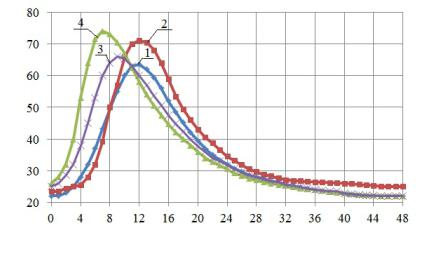
An increase in the compression strength limit of the investigated compositions particularly during the first days of hardening is due to that in the specific surface of the cement powder samples and a drop in the average size of the cement particles. In order to determine the nature of cement hydration of the investigated samples a test was conducted to identify the kinetics of heat emission of the cement paste by means of the thermal calorimetry method (Fig. 5).
Temperature, ° C
Length of hydration, hours
Fig. 5. Kinetics of heat emission of the cement paste.
Numbers of the compositions correspond to those in Table 1
Fig. 5 shows that hydromechanochemical cement activation increases the hydration temperature by 20––25 °С accompanied with a 4––5 hour shift of the temperature maximum to the left, which makes cement hydration more intense. As Relamix Т-2 is introduced, the hydration of the cement paste slows down in the first hours (composition № 2) accompanied by a 2 hour shift of the temperature maximum.
Conclusions
1.Hydromechanical activation of cement in pulsed rotary equipment with the superplasticizer Relamix T-2 causes a dramatiс increase in the compression strength limit of concrete particularly in the first days of hardening.
2.The specific surface of the cement samples and aggregate minerals obtained following hydromechanochemical activation increases by 29 % compared to the control composition,
55

Russian Journal of Building Construction and Architecture
the average size decreases, the amount of cement particles and aggregate minerals sized less than 20 mkm increases by 1.34 times.
3.The frost resistance of heavy concrete obtained by means of hydromechanochemical activation of cement increases by a few steps (to grade F600), which is due to a 39 % decrease in the total porosity, a 74.8 % decrease in the proportion of the open capillary pores and a 53 % increase in the proportion of the closed pores. The sulfate resistance coefficient of the cement and sand solution increases by 40 %, which indicates an increase in the strength of a cement compostion obtained by means of the method including hydromechanochemical activation of cement.
4.The phase composition of the cement stone obtained following hydromechanochemical activation is characterized by a high content of the ettringite (Ca6Al2(SO4)3(OH)12∙26H2O) and a low content of the original phases of the Portland cement.
5.Obtaining rapid-hardening concrete by means of the method including hydromelchanochemical activation of cement in pulsed rotary equipment allows one to reduce resource and energy costs due to shorter hardening times in timbering of concrete foundations in monolith construction or shorter thermal treatment of concrete structures at ferroconcrete plants.
References
1.Avvakumov E. G., Gusev A. A. Mekhanicheskie metody aktivatsii v pererabotke prirodnogo i technogennogo syr'ya [Mechanical methods of activation in the processing of natural and man-made raw materials]. Novosibirsk, Geo publishers Publ., 2009. 155 p.
2.Bazhenov Yu. M. Tekhnologiya betona [Concrete technology]. Moscow, ASV Publ., 2002. 500 p.
3.Gorn K. S., Viktorov A. V. Osobennosti gidratatsii tsementnoi kompozitsii, aktivirovannoi v rotornopul'satsionnom apparate [Features of hydration of the cement composition activated in the rotor-pulsation apparatus]. Polzunovskii Vestnik, 2011, no. 1, pp. 56––58.
4.Mukhametrakhimov R. Kh., Galautdinov A. R. Mekhanoaktivirovannoe gipsotsementno-putstsolanovoe vyazhushchee na osnove modifitsirovannogo nizkomarochnogo syr'ya [Mechanoactivated gypsum cementpozzolan binder based on modified low-grade raw materials]. Izvestiya Kazanskogo gosudarstvennogo arkhitekturno-stroitel'nogo universiteta, 2018, no. 1 (43), pp. 187––195.
5.Naidenov Yu. A., Veprinyak I. A. Innovatsionnaya tekhnologiya aktivirovaniya betonov, osnovannaya na yavlenii kavitatsii [Innovative technology of concrete activation based on the cavitation phenomenon]. Nauka XXI vek, 2013, no. 4. Available at: http://nauka21vek.ru/archives/48707.
6.Izotov V. S., Ibragimov R. A., Pimenov S. I., Galiullin R. R. Sposob prigotovleniya betonnoi smesi [Method of preparation of concrete mix]. Pat. RF, № 2559236, 2015.
7.Pimenov S. I., Ibragimov R. A., Izotov V. S. Vliyanie gidromekhanokhimicheskoi aktivatsii tsementnoi suspenzii na fiziko-mekhanicheskie svoistva tyazhelogo betona [Effect of hydro-mechanochemical activation of cement slurry on the physical and mechanical properties of heavy concrete]. Izvestiya vuzov. Stroitel'stvo, 2014, no. 11 (671), pp. 16––21.
56
Issue № 3 (43), 2019 |
ISSN 2542-0526 |
8.Pimenov S. I., Ibragimov R. A. Ispytaniya besproparochnogo sposoba proizvodstva sbornogo zhelezobetona [Testing of non-welded method of production of precast concrete]. Bezopasnost' zhiznedeyatel'nosti, 2017, no. 5 (197), pp. 32––35.
9.Prokopets V. S. Vliyanie mekhanicheskogo vozdeistviya na aktivnost' vyazhushchego veshchestva [Effect of mechanical action on the activity of the binder]. Stroitel'nye materialy, 2003, no. 9, pp. 28––29.
10.Ahmad S., Shah A., Ali K. Effect of water reducing concrete admixtures on the properties of concrete. 29th Conference on our world in concrete structures. Singapore, 2004. – Available at: https://www.researchgate.net/publication/260226968_Effect_of_water_reducing_concrete_admixtures_on_the_properties_of_concrete.
11.Alsadey S. Effect of Superplasticizer on Fresh and Hardened Properties of Concrete. Journal of Agricultural Science and Engineering, 2015, vol. 1, no. 2, pp. 70––74.
12.Alsadey S. Effects of Super Plasticizing and Retarding Admixtures on Properties of Concrete. International Conference on Innovations in Engineering and Technology. Bangkok, 2013. Available at: http://iieng.org/images/proceedings_pdf/9117E1213607.pdf.
13.Arjunan P., Silsbee M. R., Roy D. M. Chemical activation of low calcium fly ash: Part 1. Identification of suitable activators and their dosage. 2001 International ash utilization symposium. Kentucky, 2001. P. 342––349.
14.Assaad J. J., Asseily S. E. Use of water reducers to improve grindability and performance of Portland cement clinker. ACI Materials Journal, 2011, vol. 108, no. 6, pp. 619––627.
15.Barabash I. V. The mechanical activation of mineral binder. Odessa, Astroprint Publ., 2002. 100 p.
16.Bids V. A., Kutugin V. A. Physical and chemical processes in the activation of cement-sand mixture in a centrifugal mixer. Proc. of the universities. Physics, 2011, vol. 54, no. 11/3, pp. 346––349.
17.Do Q. H. Modelling properties of cement paste from microstructure: porosity, mechanical properties, creep and shrinkage: Thèse № 5881. Suisse, 2013. 163 p.
18.Fathollah S. Applied Activation Techniques on Cement-Slag Mortars and Concretes. Activation techniques, 2012. 301 p.
19.Fathollah S. Mechanical activation of cement-slag mortars. Construction and Building Materials, 2012, no. 26 (1-1), pp. 41––48.
20.Heller T., Müller T., Honert D. Cement additives based on PCE. ZKG International, 2011, no. 2, pp. 40––48.
21.Ibragimov R. A., Pimenov S. I., Kyamov I. e. a. Comparison of the effect of superplasticizing admixtures on the processes of cement hydration during mechanochemical activation. Eastern-European Journal of Enterprise Technologies, 2016, no. 6 (82), pp. 56––63.
22.Justs J., Shakhmenko G., Mironovs V., Kara P. Cavitation treatment of nano and micro filler and its effect on the properties of UHPC. Ultra-High Performance concrete and nanotechnology in construction, 2012, no. 19. Available at: https://www.researchgate.net/publication/321026193_Cavitation_treatment_of_nano_and_micro_filler_and_its_effect_on_the_properties_of_UHPC.
23.Katsioti M. e. a. Characterization of various cement grinding aids and their impact on grindability and cement performance. Construction Building Materials, 2009, vol. 23, no. 5, pp. 1954––1959.
24.Kennedy D. P. A study to determine and quantify the benefits of using power ultrasound technology in a precast concrete manufacturing environment. Ireland, Trinity College Dublin, 2012.
25.Kriskova L., Pontikes Y., Zhang F. e. a. Influence of mechanical and chemical activation on the hydraulic properties of gamma dicalciumsilicate. Cement and Concrete Research, 2014, vol. 55, pp. 59––68.
57

Russian Journal of Building Construction and Architecture
26.Kumar S. e. a. Mechanical activation of granulated blast furnace slag and its effect on the properties and structure of Portland slag cement. Cement & Concrete Composites, 2008, vol. 30, no. 8, pp. 679––685.
27.Masoero E., Thomas J. J., Jennings H. M. A reaction zone hypothesis for the effects of particle size and wa- ter-to-cement ratio on the early hydration kinetics of C3S. Journal of the American Ceramic Society, 2014, no. 97, pp. 967––975.
28.Mishra R. K., Heinz H., Müller T. e. a. Understanding the Effectiveness of Polycarboxylates as Grinding Aids. American Concrete Institute Symposium Series, 2012, vol. 288, pp. 235––251.
29.Mukhametrakhimov R. Kh., Galautdinov A. R., Lukmanova L. V. Influence of active mineral additives on the basic properties of the gypsum cement-pozzolan binder for the manufacture of building products. MATEC Web of Conferences, 2017, no. 106, pp. 1––6.
30.Plotnikov V.V. Improvement of cement composition mechanochemical activation effectiveness in the aquatic environment: Thesis. Moscow, 2000. – 427 p.
31.Pohl M., Obry S., Zysk K.-H. Operating experience with a vertical roller mill for grinding blastfurnace slag and composite cements. Cement international, 2012, vol. 10, no. 2, pp. 56––69.
32.Sayer S. M., Dahlin A. Propagation of ultrasound through hydrating cement parts at early times. Advance cement based materials, 1993, no. 1, pp. 12––21.
33.Sekulic Z. e. a. Mechanical activation of cement with addition of fly ash. Materials Letters, 1999, vol. 39, no. 2, pp. 115––121.
34.Sobolev K. Mechano-chemical modification of cement with high volumes of blast furnace slag. Cement & Concrete Composites, 2005, no. 27, pp. 848––853.
35.Souria A., Kazemi-KamyabbH., SnellingsbR., NaghizadehaR., Golestani-FardaF., Scrivenerb K. Pozzolanic activity of mechanochemically and thermally activated kaolins in cement. Cement and Concrete Research, 2015, vol. 77, pp. 47––59.
36.Temuujin J., Mackenzie K. J. D., Schmucker M. e. a. Phase evolution in mechanically treated mixtures of kaolinite and alumina hydrates (gibbsite and boemite). J. Europe Ceram. Soc., 2000, vol. 20, pp. 413––421.
37.Teoreanu I., Guslicov G. Mechanisms and effects of additives from the dihydroxy-compound class on Portland cement grinding. Cement and Concrete Research, 1999, vol. 29, pp. 9––15.
38.Weibel M., Ratan K. M. Comprehensive understanding of grinding aids. ZKG International, 2014, no. 6, pp. 28––39.
39.Yamada K. e. a. A summary of important characteristics of cement and superplasticizers. Ninth ACI International Conference on Superplasticizers and Other Chemical Admixtures in Concrete. Seville, 2009. P. 153––164.
40.Zhang Y. M., Napier-Munn T. J. Effects of particle size distribution, surface area and chemical composition on Portland cement strength. Powder Technology, 1993, no. 83, pp. 245––252.
58

Issue № 3 (43), 2019 |
ISSN 2542-0526 |
DOI 10.25987/VSTU.2019.3.43.005
UDC 691.32
M. L. K. Khouadjia1,C. Belebchouche2, L. BensacI-Chibane3
CHARACTERIZATION OF RECOVERY FILLER FROM HOT-MIX ASPHALT PLANTS AND ITS EFFECT ON THE WORKABILITY AND COMPRESSIVE STRENGTH OF CONCRETE
University of Constantine 11, 2, 3
Constantine, Algeria
1D. Sc. in Civil Engineering. Assoc. Prof., tel. (213)559-333-376, e-mail: lyes.khouadjia@umc.edu.dz
2D. Sc. in Civil Engineering. Assoc. Prof., tel. (213)661-456-371, e-mail: belebchouche.cherif@gmail.com 3PhD in Civil Engineering. Assoc. Prof., tel. (213)550-323-867, e-mail: chibanelamria@gmail.com
Statement of the problem. The production of building materials in Algeria and the rest of the world is accompanied by the production of waste that can potentially pollute the environment. While there is an urgent need for recycling in developing countries, many waste products are not being recycled yet. Among these materials is recovery filler (RF), an abundant byproduct in the manufacturing of road bitumen mix. The principal objective of this study is to validate the use of recovery filler (RF) in ordinary concrete.
Results. The slump and compressive strength of concrete both before and after freeze-thaw cycles were examined. Recovery filler (RF) was scanned using scanning electron microscopy (SEM) to develop an advanced characterization of RF from HMA plants using two software packages: Aphelion Lab 4.4 and Astra 1.6.
Conclusions. The results showed that it is possible to obtain good workability and compressive strength when replacing cement with a 10% of recovery filler from hot-mix asphalt plants providing that superplasticizer is used.
Keywords: recovery filler, road bitumen mix, concrete slump, compressive strength, freeze-thaw cycles, Aphelion Lab 4.4, Astra 1.6.
Introduction. Currently, concrete is the most common material used in the construction industry. Due to the environmental and economic challenges that arise from its use, it is necessary to carry out research on the reuse and recycling of materials. Important types of waste and unused materials that have been used to improve the behavior and durability of concrete and asphalt concrete include dune and river sands, filler, fly ash, slag, metakaolin, pozzolan, silica fume and shungite [1––6].
© Khouadjia M. L. K.,Belebchouche C., BensacI-Chibane L., 2019
59