Материал: Russian Journal of Building Construction and Architecture
Issue № 3 (43), 2019 |
ISSN 2542-0526 |
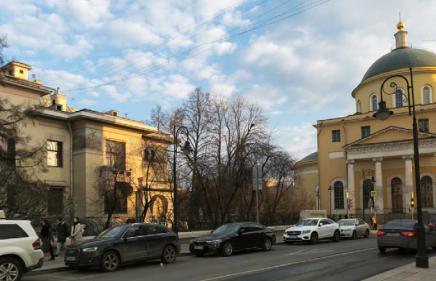
The repetitively shaped main volume of the building but a significantly small cube of the front porch generates a certain resonance between the whole and its part. Simultaneously, being remote from the façade plane, it allows one to mentally step aside towards the Ascension Cathedral across the road while bringing together the mansion of Ryabushnksiy and one of the main buildings in its architectural space (Fig. 8).
In a sense the Ascension Cathedral can be considered a dominant starting point that F. Schechtel relied on while designing Ryabushinkiy’s house. Proportional ratios between the main parts of the buildings and some details are distinct: e.g., the cube shape is basic for the mansion as well as the cathedral. Their height (without the dome and glass pyramid) is almost identical. The proportional ratios and correspondence of the shape of the lower windows of the cathedral and the first floor of the house also suggest their inner similarity. Therefore the existing mutual rhythmic connection between the building of the Ascension Cathedral and the mansion of S.P. Ryabushinskiy allows the new building of the private mansion to easily “fit in” into the existing urban construction fabric.
Fig. 8. Facades of the mansion of S. Ryabusinskiy and the Ascension Cathedral. Photo by L. V. Podolskaya
A similar connection is also found in the neighbouring construction group dating back to the 17th century, i. e. the Granatny Court. As it overlooks a different, non-front façade of Ryabushinskiy’s house (even though for the modern architecture this division is rather conditional), the mutual connection is at the level of architectural details: the correspondence of the window shape (narrow ones with arches at the end) that are placed in the stairway diagonal leading into the third floor, into the prayer room as well as the balcony by association resembling balconies
115

Russian Journal of Building Construction and Architecture
characteristic of the ancient Russian architecture [17, 19]. It would be of interest to compare the balcony image from the façade overlooking Spiridonovka. The former has something universal in its image which we associate with the “blown by the winds of time” ruins of the ancient Greek cathedrals with a low-hanging web of the “net” of the framing and is naturally viewed along with the thin column rows of the classicism portico of the Ascension Cathedral. The latter, which is somewhat heavy with a lavishly crude shape, the balcony opposite the Granatny Court follows the national architectural tradition. Therefore there is not only a rhythmic connection of architectural parts of the whole but also the entirety of the associative layers.
Simultaneously, a basic ornamental system determines not only the way a building is connected with the surroundings but is also indicative of an internal struggle of what seems to be an inert wall mass with the dynamics of the surroundings. Two remote porches of the house have a power, a viscous density of the walls which only in places cracks under the impact of spatial movements. The shape and character of the holes “washed out” in the thickness of the walls are proportional to the washing out of the “fabric” of the house itself: the front porch of the house is more remote from the main volume, i.e. mass resistance is much more intense, the contrast between the wall and openings is smaller, the mass dominates the space. The angular porch is almost part of the house. Its openings are considerably smaller and the massive porch columns have more distinct resistance plastics making a visual impression of “swelled muscles” of the pillar columns. There is a whole different story with the balconies: the “ancient” one above the front porch is very open with the “hanging” framing taking central stage in its structure as if remains of the former expressive glory of the façade. What is referred to as an ancient Russian balcony across the road is so solid, dense and clings to the main part of the building so tightly that it seems about to merge with it, which is triumph of tangible corporality, incredible clarity of the bearing and auxiliary elements [20, 21, 22].
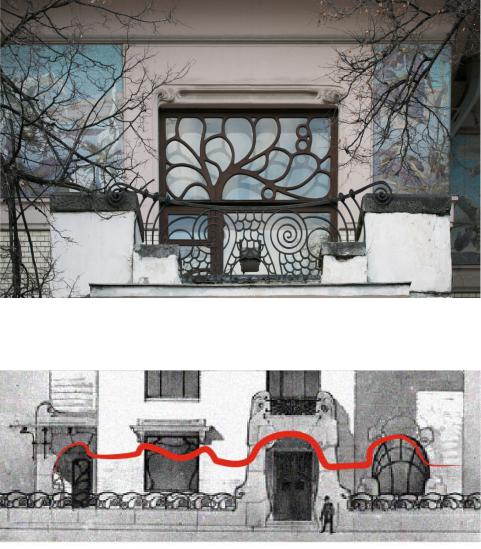
The finishing touch of the general rhythmic motive of the existing architectural composition is put with a play of shades in the curves and holes of the wall surface emerging due to a remote roof and a multi-layer ledge above it. A play of shades generates an extra juicy emphasis in the overall dynamics and brings a whole host of semitones into the game. The window apertures have a similar effect on the internal structure of the house creating the second row of rhythmic organization of the building being part of the façade plane. It is softer but is also more “detailed”, which allows it to serve as an intermediate link from the basic ornamental scheme to the particular one. Apart from the general shape, the window apertures have an internal cross graphics which is part of the already particular system and serves to manifest and emphasize the compositional nodes (Fig. 9, 10).
116
Issue № 3 (43), 2019 |
ISSN 2542-0526 |
Fig. 9. Window crosses. Photo by L. V. Podolskaya
Fig. 10. Row of the windows of the main façade of the first floor (the photo of the washing in the 20th century)
Overall, what is referred to as a particular ornamental system manifests a tectonic structure not only in the building interior but also plays a certain role in the external image of the structure. This is most graphic in the composition of the window apertures, balcony framing, porch rails and floor framing. Metaphorically speaking, these fine “veins” “stitch” the “falling apart” wall fabric while also fixing the most strained spots. E. g., the window apertures of the first floor are mostly vertically bent taking on an almost arch shape, which is associated with resistance to the powerful pressure of the upper floors (Fig. 10).
Conversely, the window crosses in the second floor of the building are more free due to the graphics resembling blooming trees, the upper part of the house seems “in bloom” when the fabric is “blooming” trying to rejuvenate and break into blossom. The pressure of the flooring and the wall mass is hardly felt, the vertical seems to be setting free from the horizontal grip
117

Russian Journal of Building Construction and Architecture
reaching out for light. The flower petals “part” the window apertures seeking to merge into the blooming irises in the mosaic frieze.
The picturesque mosaic-style frieze (see Fig. 6) needs a special mention as it is largely part of the general ornamental system of the building and it thus has the internal definition, selfsufficiency characteristic of easel and monumental arts. The picturesque band almost along the entirety of the building is one of the highlights of the house which lends it uniqueness and edge. The compositional role the frieze plays is that it emphasizes the boundaries of the main part of the building, fixes the vertical structure of the house setting it apart from its natural environment where the sky colour blends with the blue shimmering of the mosaic. The frieze horizontal repeats itself in the form of a narrow matt band in the mansion façade overlooking the court as well as in the wide ledge over the roof itself. Due to distinctly emphasized horizontals, the architectural composition acquires definition and tectonic credibility.
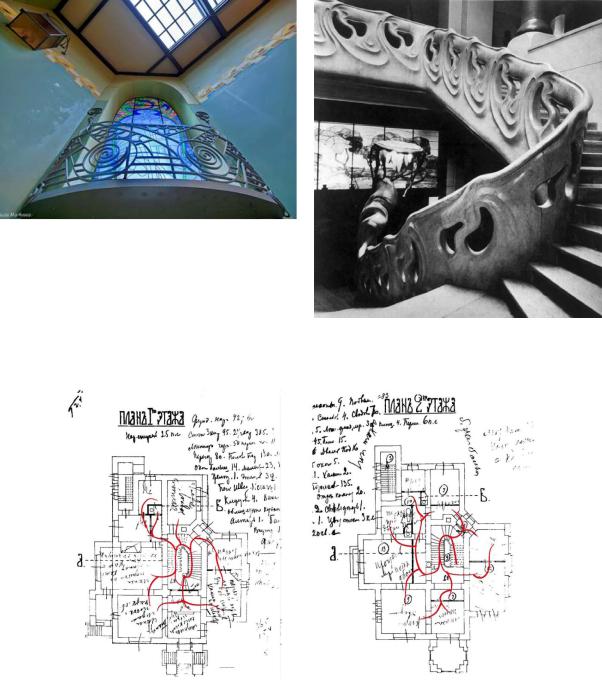
3. Ornament in the interior of the mansion of S. P. Ryabushinkiy. The compositional role of the ornamental system of the mansion of Ryabushinkiy is not limited to manifestation and emphasis of the internal structure of the building in its exterior: a significant role is played by the décor in the interior as well. The same systems as in the building façade can conditionally be identified in the interior ornament, i.e. the general and particular ones. The general ornamental scheme in the interior is the principle of the distribution of the ornament in the mansion space and its presence in each individual room. The particular ornamental scheme looks at the character of individual decorative nodes manifesting the compositional features of the architecture. In practice the analysis of the compositional role of the ornamental schemes is the same as for the external image of the building except the face that the interior contains some decorative compositions that serve not only the decorative function but are also constructive elements with a particular functional load. They are the rails of the front staircase or the inner balcony framing (Fig. 11, 12).
At the entrance of the mansion of Ryabushinksiy one is struck by the abundance and variety of decorative motives that do not normally retain their practical function and blend into the house structure. Considering the general principles of the distribution of the ornament in the house by determining its rhythmic system, it is a lot easier to move on to its individual elements.
On closer examination, the original impression of decorative overload of the building interior is gone as not each premise is identically ornamented [16]. The house has its own “pulsation” where the guestroom, master’s study and staircase hall is more ornamented than the front hall or the study’s lounge. This is primarily due to a more secular nature of the first floor overall as well
118
Issue № 3 (43), 2019 |
ISSN 2542-0526 |
as the functional features of the above premises. The staircase hall is the axis of the architectural composition of the house around which thereare rooms “growing” like tree branches (Fig. 13).
Fig. 11. Inner balcony in the staircase hall (photo by O. Maleev)
Fig. 12. Staircase (photo from the early 20th century)
Fig. 13. Plan of the 1st and 2nd floors of the building. The movement directions in space mimicking the development of a tree trunk in the plan are marked in red
The second floor of the building is more private, chamber-like as it is less decoratively loaded; almost no interior furnishing was retained. It is also due to a varying degree of decora-
119