Материал: Russian Journal of Building Construction and Architecture
Russian Journal of Building Construction and Architecture
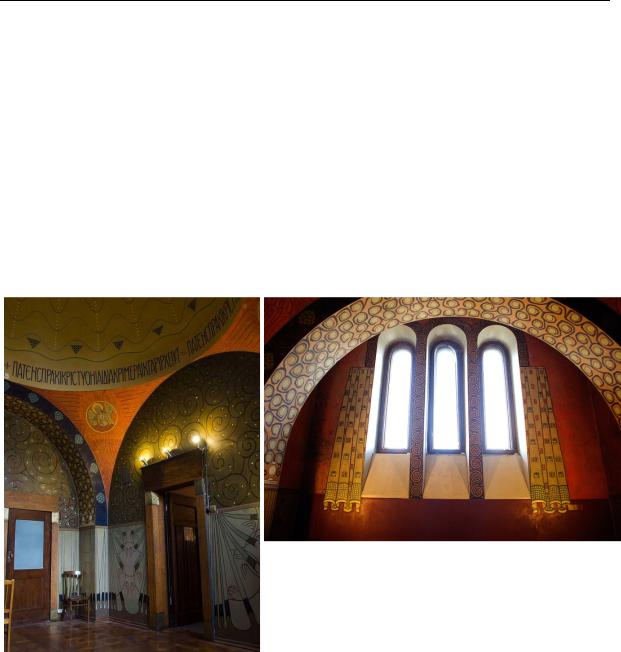
tiveness in the interior of the mansion of Ryabushinskiy that the internal composition of the building is easily “comprehensible” that is of interest not only in terms of functional solution but also as a symbol conveying certain ideas of the author and probably of the customer. The house has a three-level division in the vertical, which is manifested in the “movement” and richness of the ornament: from the first to the third floor there is a gradual reduction in the number of decorative motives as well as their emergence [7, 8]. If there is a lot of ornament in the first floor that “rips” the walls from the plane and it is “independent”, in the second and third floor the décor gradually “flows” along the surface becoming a picturesque painting (e. g., see the interior of the prayer room in the third floor) (Fig. 14).
Fig. 14. Interior of the prayer room.
Photo by L. V. Podolskaya
Along with the vertical there is also a horizontal rhythmic organization that was mentioned above (“pulsation” of the décor) resulting in the spiral movement in the house gravitating towards the front staircase. The character of the ornament position allows the movement system of the house to be identified as well as the laws of the development of architectural composition to be determined with individual nodes emphasizing the structure.
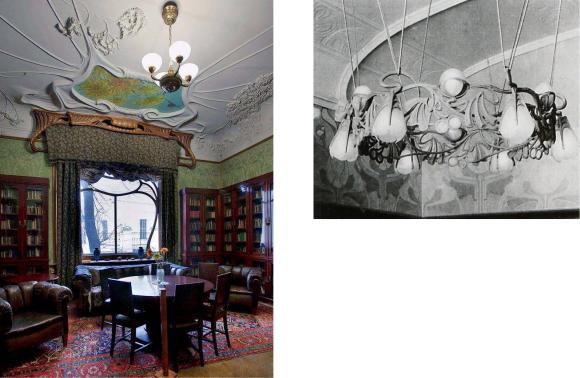
Hence the system of the flooring beams on the ceiling surface in the front, staircase hall as well as the master’s study as well as their dark colouring add to the emphasis of the building structure with a focus on the structure of the auxiliary and bearing parts. These are decorative elements that lend definition. They can be small spirals at the joints of beams with the bearing
120
Issue № 3 (43), 2019 |
ISSN 2542-0526 |
wall in the front hall or this is putting the whole ceiling into an extraordinary “flowing” dark mahogany frame as in the master’s study (Fig. 15, 16).
Fig. 16. Fragment of the dining-room ceiling (photo from the early 20th century)
Fig. 15. Guestroom. Photo by O. Maleev
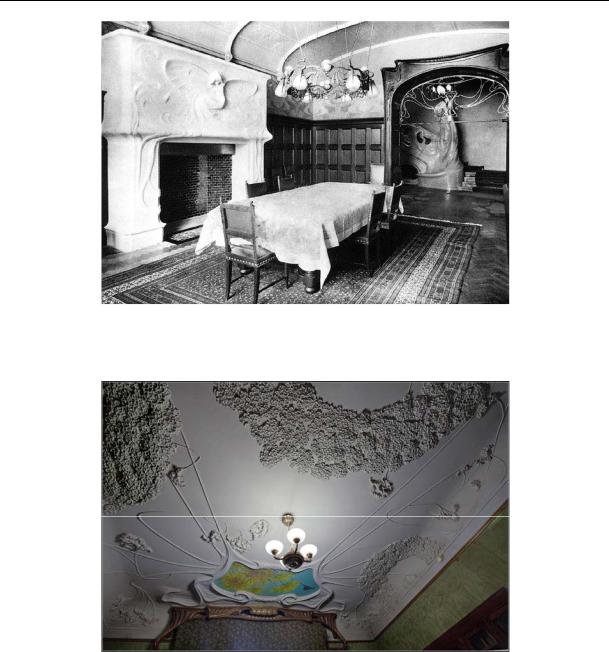
Something similar takes place in the dining room: first, the ceiling here has a slightly curved dome with peculiar “ribs” that the flooring beams transformed into. This allows the general emphasis of the interior furnishing to be shifted to the unusual ceiling solution. “Rigidity ribs” of the ceiling are crossed with longitudinal ornamental weighs to allow the effect of a “bare structure” to be mediated and lends the surface an extra edge (Fig. 17).
Nevertheless a genuinely upscale ceiling solution can only be found in the guestroom or in the so-called women’s part: abundance of the relief and a picturesque insertion is mind-blowing. The entire ceiling surface starts “vibrating” stopping the gaze from fixing on anything in particular. The panel in a cartouche-like frame ruins the entirety of the plane generating the illusion of shooting into the sky. The structure is completely hidden with not much left of it except long relief plant tubes that “hold” the ceiling stopping it from completely “floating” as they act as the “rigidity ribs” as in the dining room. This has to be the only room in the house where the ornamental scheme is not designed to manifest the structure but rather to hide it. Nevertheless the vertical plane is rigidly fixed not by the decor but the angles and boundaries between the vertical and horizontal are marked by fine wooden strips (Fig. 18).
121
Russian Journal of Building Construction and Architecture
Fig. 17. Dining room (fireplace and frieze were not retained). Photo from the early 20th century
Fig. 18. Ceiling in the guestroom. Photo by O. Maleev
It should be noted that the compositional role of the ornament is only associated with the character of the ceiling plane solution as well as the front staircase which is actually part of the structure. In this case plastic staircase rails are purely functional. All the other fragments of the ornamental scheme (floor and door ornament, window frames, door portals) as well as the objects with their own image (lamps, lights, column chapiter, stained glass) play a functional role while being “guides” in the mansion emphasizing their direction in the interior, its nature. Being a self-sufficient sign system, they contribute to the image of the mansion. However, they ultimately form symbolic schemes that require a separate analysis [24].
122
Issue № 3 (43), 2019 |
ISSN 2542-0526 |
Conclusions. The detailed analysis of the ornamental and decorative system of the mansion of S. P. Ryabushinskiy conducted in the paper shows a totally unique approach to the organization of the composition and interior of the building in particular and the architectural environment overall using ornament that starts playing the organizing and constructive role in this context emphasizing the main compositional nodes in a way “putting together” the building and encapsulating it into the existing fabric of urban construction. Ornament sort of acquires a spatial character. It is not only part of a building but it is also capable of existing outside it breaking into space and “capturing” it.
The ornamental system of the mansion divided into two décor schemes: a basic and particular one running through the entire space from the façade to the building interior. The general ornamental scheme includes the principle of the ornament organization, its distribution in space. The second particular scheme exists inside the first one and is a system of decorative elements identifying the compositional nodes, compositional features of the architecture. This kind of analysis appears to be paramount and most instrumental in understanding a building composition and its essence as intended by the architect. The principle of such an analysis are discussed using the example of the mansion of S. P. Ryabushinskiy.
References
1.Aks I. Sovremennaya Moskva. Arkhitekturno-kriticheskie ocherki [Contemporary Moscow. Architecturalcritical essays]. Saint-Petersburg, 1904. 43 p.
2.Antonova E. A. Novyi natsional'nyi stil' v russkom moderne [New national style in Russian art Nouveau].
Izvestiya Volgogradskogo gosudarstvennogo pedagogicheskogo universiteta, 2012, no. 3 (67), pp. 81––85.
3.Borisova E. A., Sternin G. Yu. Russkii modern [Russian modern]. Moscow, Sovetskii khudozhnik Publ., 1990. 359 p.
4.Borodina S., Bulgakova A. Eksperiment s normoi: stil' modern v arkhitekture i prikladnom iskusstve [Experiment with the norm: art Nouveau in architecture and applied art]. Mir iskusstv: vestnik Mezhdunarodnogo instituta antikvariata, 2014, no. 3 (07), pp. 116––125.
5.Bykova E. N., Kirichenko O. M. Kontseptsii tvorcheskogo formoobrazovaniya v stile modern [Concepts of creative shaping in the art Nouveau style]. Vestnik Khar'kovskoi gosudarstvennoi akademii dizaina i iskusstv, 2014, no. 2, pp. 56––60.
6.Gerchuk Yu. Chto takoe ornament? [What is the pattern?]. Moscow, Galart Publ., 1998. 327 p.
7.Davydova I. I. Smyslovaya perspektiva i organizatsiya arkhitekturnogo prostranstva v kul'ture rannego moskovskogo moderna [Semantic perspective and organization of architectural space in the culture of early Moscow art Nouveau]. Vestnik slavyanskikh kul'tur, 2012, vol. 24, iss. 2, pp. 84––91
8.Davydova I. I. Simvol kak soteriologicheskaya kategoriya v russkoi porubezhnoi kul'ture moderna. Osobnyak S. P. Ryabushinskogo. Diss. kand. kul'turologi [Symbol as a soteriological category in the Russian culture of modernity. S. P. Ryabushinsky's Mansion. Cultural studies diss.]. Moscow, 2012. 274 p.
123

Russian Journal of Building Construction and Architecture
9.Dzhandzhugazova E. A. Arkhitekturnye sokrovishcha Moskvy: osobnyak Ryabushinskogo [Architectural treasures of Moscow:Ryabushinsky mansion].Sovremennye problemy servisa i turizma,2014,vol.8,no.2,pp.93––101.
10.Kirillov V. V. Arkhitektura russkogo moderna: Opyt formologicheskogo analiza [The architecture of Russian modernism: the Experience formological analysis]. Moscow, Izd-vo MGU, 1979. 213 p.
11.Kirichenko E. Arkhitekturnoe nasledie Fedora Shekhtelya v Moskve [Architectural heritage of Fyodor Shekhtel in Moscow]. Moscow, ID Rudentsovykh Publ., 2011. 316 p.
12.Kirichenko E. I. Inter'er russkogo moderna (1900––1910 gg.) [Interior of Russian art Nouveau (1900–– 1910)]. Dekorativnoe iskusstvo SSSR, 1971, no. 10, pp. 40––47.
13.Kirichenko E. I. Russkaya arkhitektura 1830––1910-kh godov [Russian architecture 1830––1910 of years]. Moscow, Iskusstvo Publ., 1978. 399 p.
14.Kirichenko E. I. F. O. Shekhtel'. Zhizn'. Obrazy. Idei [F. O. Shekhtel. Life. Images. Ideas]. Moscow, Pro- gress-Traditsiya Publ., 2011. 360 p.
15.Kosterina M. G. Stil' modern kak zavershayushchii etap razvitiya epokhi romantizma [Art Nouveau as the final stage of development of the era of romanticism]. Vestnik Altaiskoi gosudarstvennoi pedagogicheskoi akademii, 2010, no. 4, pp. 16––19.
16.Kosterina M. G. [Aesthetic contradictions of art Nouveau at the turn of XIX––XX centuries]. Trudy "Problemy gumanitarnogo znaniya v nauke i obrazovanii" [Proc. "Problems of humanitarian knowledge in science and education"]. Problemy gumanitarnogo znaniya v nauke i obrazovanii]. Barnaul, 2010, pp. 178––184.
17.Kuz'min M. A. Modern v grazhdanskom stroitel'stve Moskvy kontsa XIX nachala XX vv. [Modern in the civil construction of Moscow late XIX early XX centuries.]. Vestnik slavyanskikh kul'tur, 2011, vol. XXII, iss. 4, pp. 30––34.
18.Man'kovskaya N. Estetika postmodernizma [Aesthetics of postmodernism]. Mocsow — Saint-Petersburg, Tsentr gumanitarnykh initsiativ Publ., 2016. 494 p.
19.Nashchokina M. V. Moskovskii modern. Izd. 3-e, peresm., ispr. i dop. [Moscow art Nouveau. 3еd.]. SaintPetersburg, Kolo Publ., 2011. 822 p.
20.Nashchokina M. V. Tvorchestvo Frantsa Shekhtelya i evropeiskii modern: osobennosti tvorcheskoi individual'nosti [Creativity of Franz Schechtel and European art Nouveau: features of creative individuality]. Academia. Arkhitektura i stroitel'stvo, 2010, no. 1, pp. 31––40.
21.Roshchenya D. A. Modern v russkoi arkhitekture nachala XX v. [Modern in Russian architecture of the early XX century.]. Novyi istoricheskii vestnik, 2001, no. 3 (5), pp. 75––82.
22.Geidor T. I. F. O. Shekhtel' i problemy istorii russkoi arkhitektury kontsa XIX –– nachala XX veka: sb. nauch. tr. [Proc. F. O. "Shekhtel and problems of history of Russian architecture of the late XIX –– early XX century"]. Moscow, TsNIIPgradostroitel'stva Publ., 1988. 113 p.
23.Filicheva N. V. Modern (k voprosu o probleme stilya) [Modern (on the problem of style)]. Nauchnotekhnicheskii vestnik Sankt-peterburgskogo gosudarstvennogo instituta tochnoi mekhaniki i optiki (tekhnicheskogo universiteta), 2003, no. 8, pp. 194––208.
24.Shevelenko I. Modernizm kak arkhaizm: natsionalizm i poiski modernistskoi estetiki v Rossii [Modernism as archaism: nationalism and the search for modernist aesthetics in Russia]. Moscow, Novoe literaturnoe obozrenie Publ., 2017. 336 p.
25.Bonta J. Architecture and its Interpretation: a Study of Expressive Systems in Architecture. New York, Rizzoli, 1979. 271 p.
124