Материал: Russian Journal of Building Construction and Architecture
Russian Journal of Building Construction and Architecture
An ornamentally decorative system of the famous mansion owned by S. P. Ryabushinskiy designed by F. Schechtel is unique in the following way: while being independent and sufficient, it is also an essential part of the building composition serving as a sort of an external manifestation of functional links.
In order to prove that, it is necessary that a scheme of ornamental compositions is analyzed both from outside and inside the mansion.
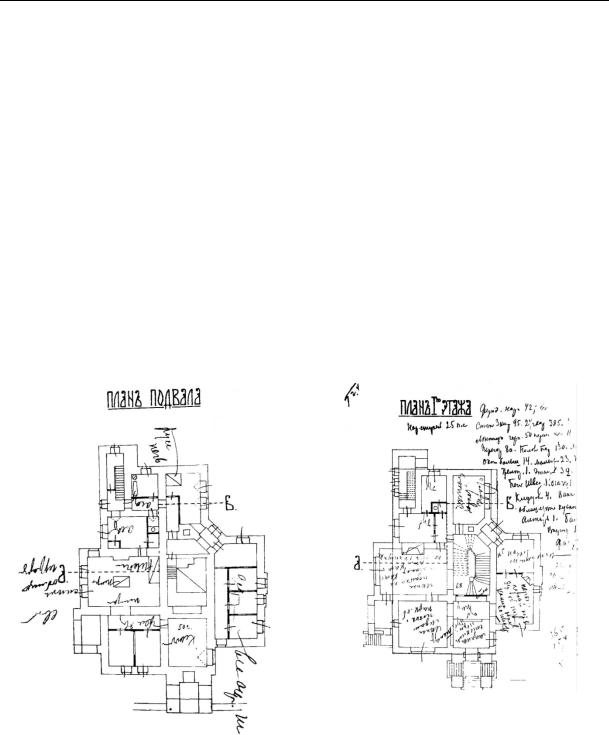
1. Ornamental system of the mansion of S. P. Ryabushinskiy. What has to be noted is that for F. Schechtel a rhythmic, “classic” ornament scheme is characteristic which is designed based on the principle of a certain (identical) repetitive motive (rapport) as well as an ornament designed as a white poem where repetitive motives are not identical but are nevertheless of a similar nature. This applies to a basic ornamental system associated with a façade composition and planning (Fig. 1––4).
Fig. 1. Cellar plan |
Fig. 2. First floor plan |
(source:http://places.arch-grafika.ru/news/2009-05-12-6) |
(source:http://places.arch-grafika.ru/news/2009-05-12-6) |
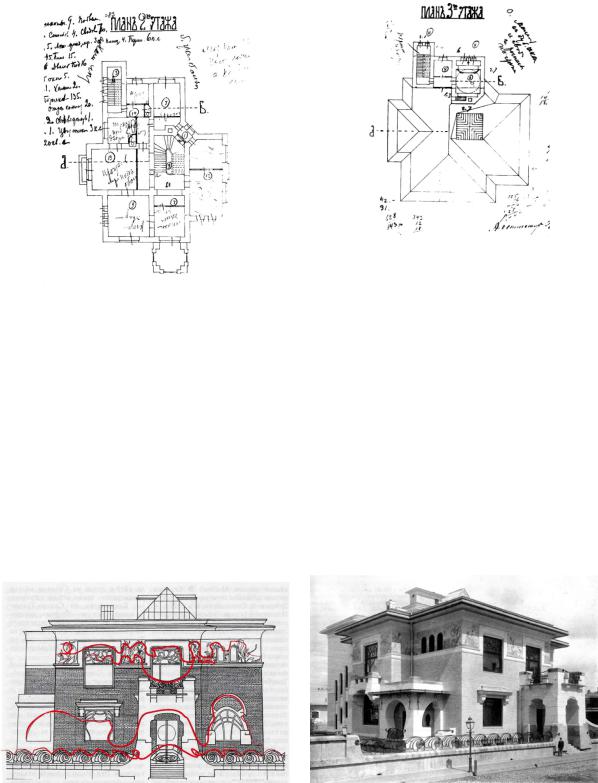
When it comes to the character of the ornament position in the facades (Fig. 5), it is also important to point out two décor schemes where one, i.e. the basic one, belongs to the façade space organization principle. The other one, which is an essential part of the first one, is a system of decorative emphasis manifesting compositional links, i.e. the first one is connected
110
Issue № 3 (43), 2019 |
ISSN 2542-0526 |
with the rhythmic position of architectural details while the second one exists inside the composition owing itself to the first one.
Fig. 3. Second floor plan |
Fig. 4. Third floor (prayer room) plan |
(source:http://places.arch-grafika.ru/news/2009-05-12-6) |
(source:http://places.arch-grafika.ru/news/2009-05-12-6) |
In the mansion of Ryabushinskiy some ornamentation underpins the entire approach to the architectural and decorative composition of the building as well as mediated opposition of various traditions, i. e. plastic (such as the front porch, the shape of the balconies, gates and stairways) and geometric (the main part of the building) ones [5, 10]. A play of shades owes itself to alternating external and buried composition elements with the interaction of the plastic high-maintenance doorway pattern (back and front porch) generating an extra rhythmic unit (Fig. 6).
Fig. 5. Main façade. Photo from the early 20th century
111
Russian Journal of Building Construction and Architecture
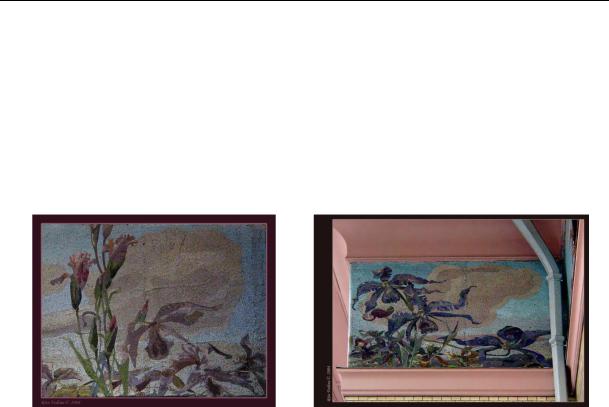
The building façade forms a single pulsing chain that is only seen while in motion. Nevertheless there is no talking about the existing rhythm as a literal ornament system. Ornament in the modern period gains a spatial character. It is during this period that new relationships between ornament and space emerge when the former no longer just belongs to the latter but is capable of existing beyond it breaking through into space [2––4, 25]. Ornament sometimes becomes a finite composition with an environment of its own (Fig. 6).
Fig. 6. Fragment of a mosaic panel depicting irises. Photo by M. Fedin
An example of these ornament transformations in the mansion of Ryabushinskiy could be fencing, balcony frames as well as window frames with their own composition which for the frames in particular is no longer part of the plane but that of the common rhythmic scheme. Typical spires in the enclosing gate can be found in the balcony frames as well. Curved plant tubes and stylized leaves and flowers, which serve as window crosses, are alike and form a continuous rhythmic composition. Thus despite various forms it contains, the building is seen as an entity and seems as if it was a living being. I. e. apart from the functional factors, the architectural details such as the arched windows, similarly-shaped rectangular balconies and the front driveway comply with a certain internal compositional rhythm that contributes to a basic ornamental scheme. Like a band, it circles the “main” cubic part of the house.
As was mentioned above, a system of strictly rhythmic ornaments in the building facades is part of the basic scheme. It includes a famous mosaic frieze with irises (see Fig. 6), ornamental system inside each frame composition (balcony, fencing) as well as smaller ornamental compositions in the front door.
In terms of the interiors of the mansion of Ryabushinkiy, the ornament position is so complex that everything centers around the ornamental rhythm: from a door handle to massive portals above the windows and doors as well as furniture details and drapery [14, 18].
112
Issue № 3 (43), 2019 |
ISSN 2542-0526 |
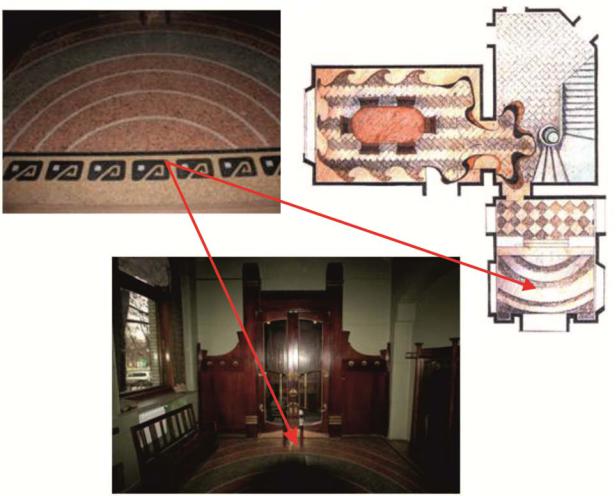
First of all, special attention should be paid to the abundance of ornamental motives on the floor, which can be encountered as early as at the entrance where “diverging” semi-circles resembling a trace of a little stone falling into water are located. Further mosaic arches are fixed with an ornament band resembling a classic Greek meander which is not exactly that (there is a degree of associative freedom). The existing parquet floor has a certain “fluidity” which might be due to that fact that the ornament pattern resembles a free wave movement. Wavy lines have a fairly free rhythm and are not rigidly connected with wall verticals as was the mosaic floor in the main hallway (Fig. 7).
Fig. 7. Main entrance (photo: www.mosantico.ru)
When it comes to the main traditional location of ornament, i.e. walls, it is possible to analyze only the first floor of the mansion of Ryabushinskiy and the hall walls where there is a staircase for two floors as the original furnishing was not retained. On the first floor: the dining room originally had a decorative frieze at the ceiling (it was not retained); in the staircase hall
113

Russian Journal of Building Construction and Architecture
at the conditional boundary between the first and second floor there is a fresco-style frieze along the entire perimeter including the second floor hall. It should also be noted that ornamental compositions in the doorways as well as the portals above them and the windows including stained-glass compositions and inner balcony framing facing the staircase [9, 11, 13]. One of the most fascinating surfaces in the mansion of Ryabushinskiy decorated with ornaments has to be the ceiling spaces. Most (and the most plastically distinguished) of the ornamental system is connected with the flooring planes and beams it is connected with tectonically. However, the ceiling décor is not identical throughout the house building: there are particularly lavish areas such as, e.g., the guestroom ceiling (or what can also be referred to as the women’s part), the dining-room flooring displaying a clear tendency toward “texturing” of the ornamental system. Few in number but intensely expressive “nodes” of the decorative system can also be found in the distinct flooring beams of the front hall and the master study. These are commonly small self-sufficient motives found at the beam-wall joints. Decorative motives in their own right are rails of the famous wavy staircase with its lights.
Generally the ornament position scheme is such that it suggests an attention-arresting effect on the interiors and spatial “nodes” in the house. The decorative motives fix almost all the construction links in the building architecture metaphorically manifesting moments of “muscular” tension or relaxation of the building structure.
2. Architectural environment of the building: a constructive role of the ornamental system. The ornamental system of the mansion of Ryabushinskiy serves not only the decorative function but is also a graphic indication of the main links in the building “skeleton” emphasizing the major moments of the constructive role of the ornamental system.
The ornamental system of the mansion of Ryabushinksiy can be divided into two parts: the basic system central to the general rhythmic feeling of the architectural composition as well as the particular one which seems to be inside the basic one. The particular system is crucial to the building composition.
The main motives of the basic ornamental system are architectural parts of the building: windows, balconies, porch and floor framing as they are also essential to the architectural composition. Therefore large blocks of the rhythmic building scheme can be employed in order to identify the way the house is connected with the existing architectural environment as well as the mass is internally connected with the interior space. Owing to the distinct geometric volume of the building, a system of curves and embeddings is clearly seen that corresponds with the basic cube. The “pulsing” rhythm of the architectural details that “breathes life” into the volume and connects it with the surroundings [1, 23].
114