Материал: Russian Journal of Building Construction and Architecture
Issue № 3 (43), 2019 |
ISSN 2542-0526 |
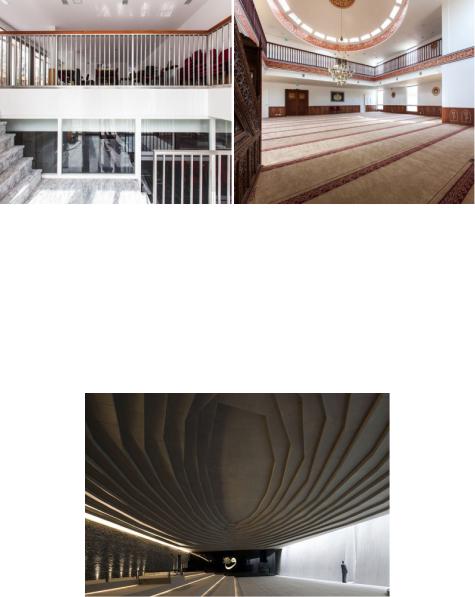
gram, which are separated by a colonnade serving as a traffic zone. The vertical articulation of the facade is a guide to the sky and makes the building seem taller. The brickwork facades in the original bond are referred to as Islamic floral patterns. The desired elements such as identity and recognition can be experienced from the perspective of both cultures [Fig. 4].
Fig. 4. Turkish Cultural Center in the Netherlands (the interior) (© Milad Pallesh)
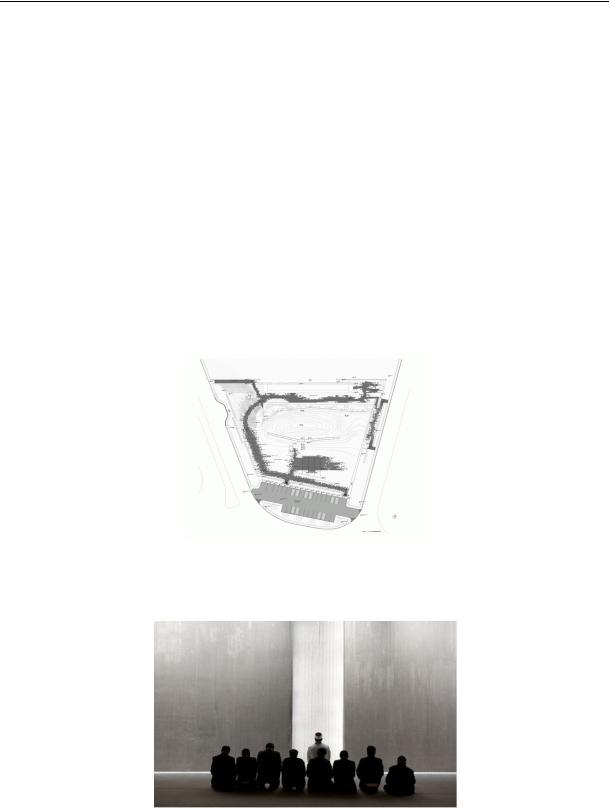
Case Study Two: The Sancaklar Mosque in Turkey. Architects: Emre Arolat Architects. Location: Istanbul, Turkey. Architect in Charge: Emre Arolat. Area: 700.0 sq. m. Year: 2012. Photographs: Thomas Mayer – (© www.archdaily.com).
Fig. 5. Sancaklar Mosque (the interior) (© Thomas Mayer)
The Sancaklar Mosque located in Buyukçekmece, a suburban neighbourhood in the outskirts of Istanbul, aims to address the fundamental issues of designing a mosque by distancing itself from the current architectural discussions based on the form and focus solely on the essence of religious spaces.
105
Russian Journal of Building Construction and Architecture
The project site is located in a prairie landscape which is separated from the surrounding suburban gated communities by a busy highway. The high walls surrounding the park on the upper courtyard of the mosque depict a clear boundary between the chaotic world outside and the calm atmosphere of the public park. The long canopy stretching out from the park becomes the only architectural element visible from the outside. The building is located below this canopy and can be accessed from a path from the upper courtyard through the park. The building blends in completely with the topography and the world outside is left behind as one moves through the landscape, down the hill and in between the walls to enter the mosque. The interior of the mosque, a simple cave resembling a space, becomes a dramatic and awe-inspiring place to pray and be alone with God. The slits and fractures along the Kiblah wall enhances the directionality of the prayer space and allows the daylight to filter into the prayer hall [Fig. 6 and 7].
Fig. 6. Sancaklar Mosque (site plan) (© Thomas Mayer)
Fig. 7. Sancaklar Mosque (the interior) (© Thomas Mayer)
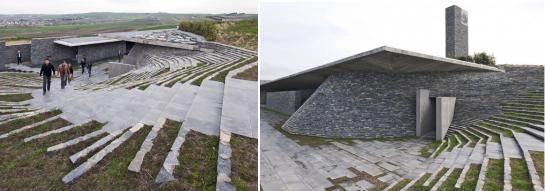
The project constantly plays off the tension between man-made and natural and tradition and modernity. The contrast between the natural stone stairs following the natural slope of the
106
Issue № 3 (43), 2019 |
ISSN 2542-0526 |
landscape and the thin reinforced concrete slab spanning over 6 meters to form the canopy helps enhance this dual relationship. On the other hand, the interior design and Islamic traditional symbols are mixed with modern space and geometry [Fig. 8].
Fig. 8. Sancaklar Mosque (the exterior) (© Thomas Mayer)
Conclusion. In this paper, first we reviewed the main descriptions of tradition and modernity which were presented in relevant theories. Then, we focused on the combination of tradition and modernity in the architecture of some Islamic countries in the East and some Western countries in Europe. Next, by reviewing the contemporary history, culture and society of Turkey and its architecture, the assortments of its contemporary architecture have become clear to us. The sixth and the last assortment looked for new models and styles of architecture and according to the needs of nationality and modernity as well as religious traditions two different case studies in two different locations and styles were chosen. The results of the research show that Turkey as a modern country trying to keep its traditions usually seeks to insert the physical symbols of two styles together as well as to preserve the semantic and conceptual meanings of tradition and modernity beside each other.
References
1.Jahanbegloo. R. The Fourth Wave. Ney Publication. Tehran, 2003.
2.Behnam. J. Civilization and Modernity: The Interview with Ramin Jahanbegloo. Markaz Publication. Tehran, 2003.
3.Sariolghalam. M. Rationality and Development. The Scientific and Cultural Publication. Tehran, 1997.
4.Ghaffari. G. Sociology of Social Changes, Looye Publication. Tehran, 2008.
5.Suzankar. M. The Challenge between Tradition and Modernity in Familial Movies in Iran Cinema During 2001––2010. Islamic Azad University Tehran Central Branch. Tehran, 2014.
6.Ahmadi. B. Modern Architecture. Markaz Publication. Tehran, 2001.
107

Russian Journal of Building Construction and Architecture
7.Nozari. H. Modernity and Modernism. Naghshe Jahan. Tehran, 2001.
8.Ashoori. D. We and Modernity. Serat Cultural Publication. Tehran, 1998.
9.Behnam. J. Iranian and The Modernity Thought. Foroozan Rooz Research and Publication. Tehran, 2007.
10.Sariolghalam. M. The Contrast of Liberalism and Islam in Identity in Iran. Jahade Daneshgahi, 2007.
11.Ghamari. D. The Mutation of Nationalism in Iran, Markaz Asnad Enghelab Eslami Publication. Tehran, 2001.
12.Balamir. A. Architecture and Identity: The Culture of Building Construction in Modern Turkey. Abadi Architecture and Urban Design. Tehran, 2003, no. 38.
13.Bayat. K. Pan Turkism and Iran, Shirazeh Research and Publication. Tehran, 2008.
14.Holod. R. Modern Turkish Architecture. Chamber of Architects of Turkey. Ankara, 2005.
15.Naz. N. Contribution of Turkish Architects to the National Architecture of Pakistan: Vedat Dalokoy, JFA, METU. Ankara, 2005. p. 22.
16.Aytac. H. The International Diffusion of Planning Ideas: The Case of Istanbul. Journal of Planning History, Istanbul, 2007, p. 114. Batur. A. A Concise History: Architecture in Turkey during 20th Century, Chamber of Architects of Turkey. Ankara, 2005.
17.Bozdogan. S. and Kasaba. R. Rethinking Modernity and Identity in Turkey. University of Washington Press, Washington, 1997.
18.Majedi. H. and Soheili. J. Modernism in the Architecture of Turkey and Its Contrast with National Architecture Movement. The Journal of City Identity. Tehran, 2011, no. 9, pp. 49––58.
108

Issue № 3 (43), 2019 |
ISSN 2542-0526 |
DOI10.25987/VSTU.2019.3.43.009
UDC7.036 : 747.012 : 72.036
L. V. Podolskaya1, 2
ROLE AND PLACE OF ORNAMENTS IN THE COMPOSITION OF FACADES
AND INTERIORS OF PRIVATE RESIDENCES
USING THE EXAMPLE OF S. P. RYABUSHINSKIY’S MANSION
Moscow State Academy of Arts and Industry Named after S. G. Stroganov1 Russia, Moscow
Аrchitectural Bureau DE-CITY2
Russia, Moscow
1PhD student of the Dept. of History of Arts, e-mail: ecodorvrn@mail.ru, aurora09.72@mail.ru 2Interior and Equipment Designer
Statement of the problem. The role of a system of ornaments and decorations in the composition of buildings is discussed using the example of S. P. Ryabushinskiy’s mansion.
Results. The ornamental system of the mansion is analyzed in detail whose location suggests that construction links as well as spatial nods are of primary importance to the visual perception of the building. The significance of the decorations and its contribution to the architectural environment of the building is shown: a rhythmical connection of the mansion with the composition of the Ascension Cathedral as a starting as well as a reference point of the architectural ideal and association links with the Granate Palace using the play on architectural detail and spatial solutions.
Conclusions. The ornamental system of S.P. Ryabushinskiy’s mansion does not only serve the decorative function but it also provides a graphical indication of the main connections in the “core” of the building by emphasizing the major points of maximum strains in the structure and plays an organizing and constructing role as well.
Keywords: ornament, ornamental and decorative system, S.P. Ryabushinskiy’s mansion, F. Schechtel, interior, architectural environment, Russian modernism.
Introduction. An image of a building is seen both through its plastic, construction solution and its decorative system which tends to be the most easily perceived association scheme shaping a particular architectural entity. It is décor that lends a house a plastic definition and a system of comprehensive emphasis allowing for the most compositionally fascinating angles [6, 12, 15].
© Podolskaya L. V., 2019
109