Материал: Russian Journal of Building Construction and Architecture

Russian Journal of Building Construction and Architecture
The concrete mix was prepared in the following steps:
1)50 % of the design amount of the cement was preliminarily mixed with the hydration water containing the superplasticizer “Relamix Т-2”;
2)the resulting slurry was loaded into a PRE bunker and exposed to hydromechanochemical activation for 2 min;
3)then the resulting cement slurry was loaded into PRE, the remainder of the cement was added as well as large and fine fillers;
4)the components of the concrete mix were mixed into a concrete mixer for 5 min [6].
The cube samples sized 10 × 10 × 10 сm were prepared from the concrete mixes. After 1, 3, 7 and 28 days of normal humidity hardening the samples were exposed to mechanical testing. The strength of the samples was identified in accordance with the GOST (ГОСТ) 18105-2010. Frost resistance of heavy concrete was identified in accordance with the GOST (ГОСТ) 10060-2012 harmonized in compliance with EN 12390-9:2006. The indices of the porous structure were identified in accordance with the GOST (ГОСТ) 12730.4-78.
Sulfate resistance of the cement composition s was identified using sample beams sized 4 × 4 × 16 cm prepared from a cement and sand solution with the cement : sand ratio = 1 : 3. The sulfate resistance coefficient Кс was identified by means of comparing the composition s solidified in water environment with those solidified in a 5 % Na2SO4 solution. The experiment was conducted for 180 days. The kinetics of heat emission of the cement paste was identified using a temperature logger Thermochron DS1921G.
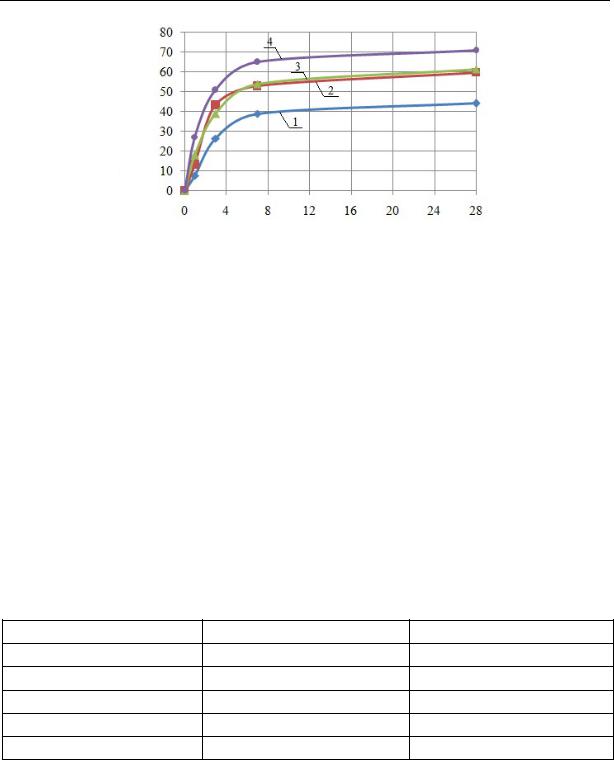
3. Results and discussion. The results of the effect of the mix, hydromechanoactivation of the cement slurry on the kinetics of hardening of heavy concrete are shown in Fig. 1. The investigated composition s are 1 is control one; 2 is the composition modified using the supplement Relamix Т-2”; 3 is the composition exposed to hydromechanical activation with no superplasticizer; 4 is the composition obtained by means of hydromechanoactivation of the cement slurry with Relamix Т-2.
Fig. 1 suggests that the largest amount of the compression strength limit was observed throughout the entire hardening of cement in the composition № 4 (by 60––249 % compared with the control one) particularly on the first day of hardening.
Hydromechanoactivation of cement (composition № 3) causes a significant increase in the concrete strength compared to the composition № 2 modified with the superplasticizer.
In this respect the authors [34] argue that hydromechanochemical activation leads to a 30 to 100 % increase in the strength of cement somposites on the first day of hardening, from 0 to 70 % after 28 days.
50
Issue № 3 (43), 2019 ISSN 2542-0526
MPa
Compression strength limit,
Length of hardening, days
Fig. 1. Kinetics of hardening of heavy concrete.
Compositions: 1 is a control one; 2 is the composition modified with Relamix Т-2; 3 is the composition exposed to hydromechanical activation with no superplasticizer;
4 is the composition obtained following hydromechanoactivation of the cement with Relamix T-2
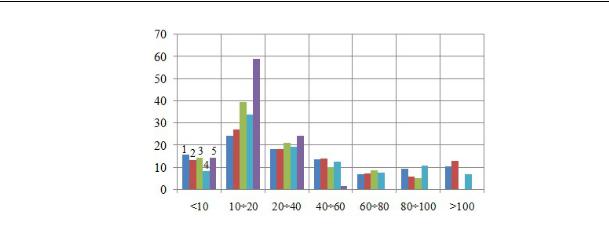
Acceleration of cement hydration during hydromechanochemical activation of cement might by due to particle dispersion. In order to determine the specific surface and dispersion composition of the cement samples and aggregate minerals, the following compositions were investigated: 1 is the original Portland cement; 2 is the composition without the supplement and hydromechanoactivation; 3 is the composition exposed to hydromechanoactivation; 4 is the composition with Relamix T-2; 5 is the composition exposed to hydromechanochemical activation with Relamix T-2. The results of the experiment are presented in Table 1 and Fig. 2.
Таble 1
Average size of the particles and specific surface of the investigated samples
Number of the composition |
Average size, mkm |
Specific surface, m2/kg |
1 |
48.47 |
298.33 |
2 |
45.87 |
324.66 |
3 |
38.35 |
356.35 |
4 |
42.25 |
331.62 |
5 |
17.10 |
427.84 |
Table 1 suggests that the specific surface of the cement samples and aggregate minerals exposed to hydromechanoactivation (composition № 3) increased by 10 % compared to the composition with no activation (composition № 2). Due to hydromechanoactivation of cement with Relamix T-2 (composition № 5) the specific surface of the cement and aggregate minerals increased by 29 % compared to the composition obtained simply with the use of Relamix T-2 (composition № 4).
51
Russian Journal of Building Construction and Architecture
Fraction size, mkm
Fraction size, mkm
Fig. 2. Granulometric composition of the investigated samples. Compositions: 1 is the original Portland cement;
2 is the composition with and without hydromechanoactivation;
3 is the composition exposed to hydromechanoactivation; 4 is the composition with Relamix T-2; 5 is the composition exposed to hydromechanochemical activation with Relamix T-2
The average size of the particles of the original Portland cement (composition № 1) is 1.26 times larger than the cement and aggregate mineral particles exposed to hydromechanoactivation (composition № 3) and 2.8 times larger than that of the particles exposed to hydromechanoactivation (composition № 5).
As seen from Fig. 2, the fractions of less than 10 mkm in all the investigated compositions is not significantly different. Following hydromechanoactivation of cement the fraction output from 10 to 20 mkm increased by 1.62 times compared to the original Portland cement. During hydromechanoactivation of the binder the fraction output from 10 to 20 mkm increases by 2.43 times compared to the original Portland cement. Following hydromechanoactivation there were no powder particles larger than 60 mkm.
In [3] using the PRE equipment the cement was ground to the average of 28.7 mkm. A varying dispersion is associated with different types of Portland cement and treatment time.
An increase in the strength of the cement compositions is of research interest and can be employed to enhance the durability of the investigated compositions. In order to evaluate the effect of hydromechanoactivation of cement on the durability of the cement compositions the frost resistance and indices of the porous structure of heavy concrete was determined (Table 2) as well as sulfate resistance of the cement and sand solution (Table 3). The numbers of the compositions in Table 2 and Table 3 are given according to Fig. 1.
According to Table 2, hydromechanoactivation of cement causes a dramatic increase in the frost resistance of heavy concrete (to grade F600), which is due to a 39 % drop in the total porosity, a 74.8 % drop in the capillary porosity and a 53 % increase in the proportion of the closed pores.
52

Issue № 3 (43), 2019 |
ISSN 2542-0526 |
|
|
|
|
|
|
|
|
|
|
|
|
|
|
|
Таble 2 |
|
|
|
|
Indices of the porous structure and frost |
resistance of heavy concrete |
|
|
||||||||
|
|
|
|
|
|
|
|
|
|
|
|
|
|||
compositiontheofNumber |
Water absorption according |
Homogeneity sizeporetheof |
sizeAverage pores,theof (*100) |
volumeTotal porestheof |
theofVolume capillaryopen pores |
theofVolume |
capillaryclosed pores |
Microporosity index |
resistanceFrostgrade F |
||||||
min15 |
|
min30 |
|
hour1 |
hour24 |
||||||||||
|
|
to the mass, %, after |
|
|
Indices of the porous structure |
|
|
||||||||
|
|
|
|
|
|
|
|
|
|
|
|
|
|
|
|
1 |
2.5 |
|
3.2 |
|
3.5 |
|
4.5 |
0.34 |
55.4 |
14.4 |
12.7 |
|
1.7 |
2.0 |
200 |
|
|
|
|
|
|
|
|
|
|
|
|
|
|
|
|
2 |
1.9 |
|
2.3 |
|
3.0 |
|
3.6 |
0.62 |
34.2 |
9.4 |
7.4 |
|
2.0 |
1.6 |
300 |
|
|
|
|
|
|
|
|
|
|
|
|
|
|
|
|
3 |
1.1 |
|
1.8 |
|
2.6 |
|
3.4 |
0.66 |
31.8 |
8.1 |
5.8 |
|
2.3 |
1.5 |
400 |
|
|
|
|
|
|
|
|
|
|
|
|
|
|
|
|
4 |
0.8 |
|
1.5 |
|
1.9 |
|
3.1 |
0.72 |
25.5 |
5.8 |
3.2 |
|
2.6 |
0.8 |
600 |
|
|
|
|
|
|
|
|
|
|
|
|
|
|
|
|
Table 3 suggests that hydromechanoactivation of the binder causes a 40 % increase in the sulfate resistance of the cement solution compared to the control composition (composition 1) and a 10 % one compared to the composition 2 modified with Relamix T-2 and thus an increase in the frost resistance in corrosive environments.
An increase in the physical and mechanical properties of the cement composites is associated with morphology changes and hydrate growth of the cement stone.
Number of the composition
1
2
3
4
|
|
|
|
|
|
|
|
Таble 3 |
|
|
Sulfate resistance test of the cement and sand solution |
|
|
|
|||||
Average density |
|
|
Bending strength limit, МPа |
|
Compression strength limit, |
|
|
||
|
|
|
|
|
|||||
|
|
|
|
|
МPа |
|
|
||
of the cement and |
|
Water/ |
|
|
|
|
|
|
|
|
In the 5 % |
|
|
In the 5 % |
|
Кс |
|||
sand solution, |
|
Cement |
|
solution |
|
|
solution |
|
|
|
In the water |
|
In the water |
|
|
||||
kg/m3 |
|
|
of the natrium |
|
of the natrium |
|
|
||
|
|
|
|
sulfate |
|
|
sulfate |
|
|
2343 |
|
0.50 |
7.03 |
4.78 |
52.2 |
35.5 |
|
0.68 |
|
2365 |
|
0.355 |
8.05 |
6.92 |
66.8 |
57.5 |
|
0.86 |
|
2374 |
|
0.50 |
7.44 |
6.70 |
67.2 |
60.5 |
|
0.90 |
|
2389 |
|
0.355 |
8.73 |
8.29 |
71.2 |
67.6 |
|
0.95 |
|
|
|
|
|
|
|
|
|
|
|
In order to determine the nature of the hydrate growth X-ray phase analysis of the investigated samples from 1 to 28 days was conducted. According to the X-ray phase analysis results using the Rietveld method Table 4 was composed where the mineral composition of the investigated samples from 1 to 28 days is shown.
53

Russian Journal of Building Construction and Architecture
|
|
|
|
|
|
|
|
|
|
|
Таble 4 |
|
|
|
Mineral composition of the investigated samples |
|
|
|
|||||
|
|
|
|
|
|
|
|
|
|
|
|
theofNumbercomposition* |
|
|
|
|
Mineral composition, % |
|
|
|
|
||
theofAgesample, days |
|
|
|
|
|
|
|
|
|
Total,% |
|
SiO |
Ca |
Ca |
|
Ca |
Ca(OH) |
Ca |
CaCO |
Ca |
|||
|
|
|
O |
|
|
|
|
|
|
|
|
|
|
|
2 |
|
|
|
|
|
|
|
|
|
|
2 |
∙ 26H |
4 |
|
2 |
2 |
SiO |
3 |
O |
|
|
|
3 |
Ca2SiO - α |
|
Fe |
4 |
|
||||
|
|
|
|
|
|
5 |
|
|
|
|
|
|
|
|
12 |
|
|
O |
|
|
|
2 |
|
|
|
|
|
|
) |
|
|
|
|
||
|
|
|
(OH) |
4 |
|
+3 |
|
5 |
|
∙2H |
|
|
|
|
4 |
|
(Al, |
|
3 |
|
SO |
|
|
|
|
|
) |
SiO |
|
|
|
|
|
|
|
|
|
|
(SO |
|
2 |
|
|
|
2 |
|
|
|
|
|
2 |
2 |
|
|
|
|
|
|
|
|
|
|
Al |
|
|
|
|
|
|
|
|
|
|
|
6 |
|
|
|
|
|
|
|
|
|
|
|
|
|
|
|
|
|
|
|
|
1 |
1 |
2.41 |
9.07 |
13.00 |
|
13.83 |
8.64 |
53.05 |
– |
– |
100 |
|
|
|
|
|
|
|
|
|
|
|
|
28 |
2.78 |
8.90 |
11.33 |
|
15.75 |
11.69 |
34.45 |
15.10 |
– |
100 |
|
|
|
||||||||||
|
|
|
|
|
|
|
|
|
|
|
|
2 |
1 |
3.73 |
9.41 |
10.34 |
|
14.38 |
3.30 |
55.66 |
– |
3.18 |
100 |
|
|
|
|
|
|
|
|
|
|
|
|
28 |
2.57 |
10.77 |
11.74 |
|
15.77 |
23.74 |
25.69 |
9.72 |
– |
100 |
|
|
|
||||||||||
|
|
|
|
|
|
|
|
|
|
|
|
3 |
1 |
4.91 |
10.12 |
16.85 |
|
13.78 |
9.52 |
44.82 |
– |
– |
100 |
|
|
|
|
|
|
|
|
|
|
|
|
28 |
2.61 |
8.91 |
11.56 |
|
19.91 |
17.88 |
27.04 |
12.09 |
– |
100 |
|
|
|
||||||||||
|
|
|
|
|
|
|
|
|
|
|
|
Note: *1 is the control composition; 2 is the composition with Relamix Т-2; 3 is the composition following hydromechanoactivation with Relamix Т-2.
According to Table 4, the largest amount of the ettringite (Ca6Al2(SO4)3(OH)12∙26H2O) is formed in the composition № 3, which is 12 % more compared to the control composition (composition № 1). It is known that in the saturated solution Са(ОН)2 the ettringite is first released in the colloid fine-dispersion state precipitating on the surface of the particles 3СаО-А12О3, slows down their hydration and enhances cementation [17].
In the composition № 3 exposed to hydromechanoactivation there is the least original alit mineral (Ca3SiO5), which is 16 % less compared to the control composition, which indicates a more complete cement hydration and causes a larger compression strength of heavy concrete in the first days of hardening.
An increase in the calcium hydroxide (Ca(OH)2) in the solidifying stone composition, which is the hydrolysis product of the original materials, indicates faster cement hydration. In the composition № 3 there is the most calcium hydroxide. According to the results of the quantitative analysis, the content of Ca(OH)2 in the composition № 3 is 10 % larger compared to the composition № 1 and 2.88 times compared to the composition № 2. At the grade age of the investigated samples there is an increase in the calcium hydroxide (Ca(OH)2) with the most calcium hydroxide in the composition № 2 and the least in the composition № 1.
54