Материал: Russian Journal of Building Construction and Architecture
Issue № 3 (43), 2019 |
ISSN 2542-0526 |
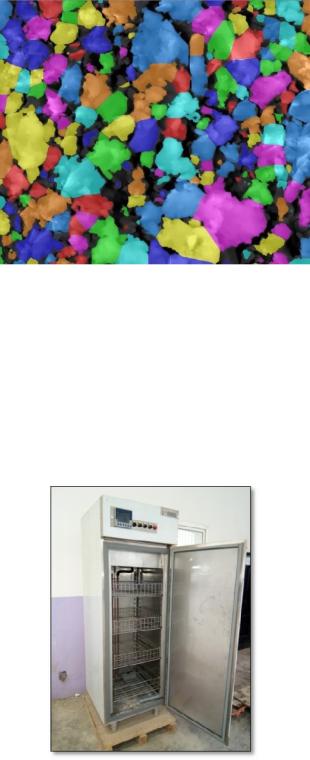
Fig.6. Segmentation obtained with the Astra 1.6 software package
4. Mix proportions. Three samples were then subjected to 50 freezing and thawing cycles using a Controls Group 10-D1429/A climatic chamber conforming to Russian National State Standard (GOST) 10060-2012 [26]. The temperature in the climatic test chamber varied from −15 °C to 15 °C, as shown in Fig. 7. The curve is a stair-step shape [27] ascent, part of which is the time when the temperature dropped from 15 °C to −15 °C and then remained at −15 °C, and the horizontal part is when the temperature rose from −15 °C to 15 °Cand then remained at 15 °C.
Fig. 7.Climatic test chamber (Controls Group 10 D1429/A)
The method of B. Scramtaiv [1, 28] was used for all concrete mixtures. Three aspects must be considered: water/cement ratio, incorporation ratio of the RF, and the effect of superplasticizer. The concrete compositions are reported in Table 6.
65

Russian Journal of Building Construction and Architecture
|
|
|
|
|
|
|
|
|
Table 6 |
|
|
Compositions of concretes |
|
|
|
|
|||
|
|
|
|
|
|
|
|
|
|
|
|
|
W/C |
Cement |
Water |
S |
RF |
G (8/16) |
SP |
Compositions |
Concrete type |
|
G (16/25) |
||||||
|
|
3 |
3 |
3 |
3 |
3 |
|||
|
|
|
ratio |
(kg/m ) |
(l/m ) |
(kg/m ) |
(kg/m ) |
(kg/m3) |
(l/m ) |
|
C1 |
|
0.5 |
350 |
175 |
1169.05 |
/ |
1356.85 |
/ |
Concretes without |
|
|
|
|
|
|
|
|
|
C2 |
|
0.6 |
300 |
180 |
1169.05 |
/ |
1356.85 |
/ |
|
RF and SP |
|
|
|
|
|
|
|
|
|
C3 |
|
0.6 |
350 |
210 |
1195.49 |
/ |
1329.78 |
/ |
|
|
|
|
|
|
|
|
|
|
|
|
C4 |
|
0.6 |
400 |
240 |
1220.86 |
/ |
1303.78 |
/ |
|
|
|
|
|
|
|
|
|
|
|
C1 + a 10 % RF |
|
0.5 |
315 |
157.5 |
1169.05 |
35 |
1356.85 |
/ |
|
|
|
|
|
|
|
|
|
|
Concretes with |
C2 + a 10 % RF |
|
0.6 |
270 |
162 |
1169.05 |
30 |
1356.85 |
/ |
A 10 % RF |
|
|
|
|
|
|
|
|
|
C3 + a 10 % RF |
|
0.6 |
315 |
189 |
1195.49 |
35 |
1329.78 |
/ |
|
|
|
|
|
|
|
|
|
|
|
|
C4 + a 10 % RF |
|
0.6 |
360 |
216 |
1220.86 |
40 |
1303.78 |
/ |
|
|
|
|
|
|
|
|
|
|
Concretes with |
C5 + a 15 % RF |
|
0.5 |
297.5 |
148.75 |
1169.05 |
52.5 |
1356.85 |
/ |
|
|
|
|
|
|
|
|
|
|
C6 + a 20 % RF |
|
0.5 |
280 |
140 |
1169.05 |
70 |
1356.85 |
/ |
|
a 15 % RF and |
|
||||||||
|
|
|
|
|
|
|
|
|
|
C7 + a 15 % RF |
|
0.6 |
297.5 |
178.5 |
1195.49 |
52.5 |
1329.78 |
/ |
|
a 20 % RF |
|
||||||||
|
|
|
|
|
|
|
|
|
|
C8 + a 20 % RF |
|
0.6 |
280 |
168 |
1195.49 |
70 |
1329.78 |
/ |
|
|
|
||||||||
|
|
|
|
|
|
|
|
|
|
|
C1 + a SP1.6 % |
|
0.5 |
350 |
169.4 |
1169.05 |
/ |
1356.85 |
5.6 |
|
|
|
|
|
|
|
|
|
|
|
C1 + a 10%RF + |
|
0.5 |
315 |
152.46 |
1169.05 |
35 |
1356.85 |
5.04 |
Concretes with a |
+ a SP1.6% |
|
|||||||
|
|
|
|
|
|
|
|
||
|
|
|
|
|
|
|
|
|
|
10 % RF+ a 1.6%SP |
C3 + a SP1.6 % |
|
0.6 |
350 |
204.4 |
1195.49 |
/ |
1329.78 |
5.6 |
|
|
|
|
|
|
|
|
|
|
|
C3 + a 10%RF + |
|
0.6 |
315 |
183.96 |
1195.49 |
35 |
1329.78 |
5.04 |
|
+ a SP1.6% |
|
|||||||
|
|
|
|
|
|
|
|
|
|
|
|
|
|
|
|
|
|
|
|
C1: Concrete without a recovery filler (RF) and a superplasticizer: 0.5 (350) C2: Concrete without a recovery filler (RF) and a superplasticizer: 0.6 (300) C3: Concrete without a recovery filler (RF) and a superplasticizer: 0.6 (350) C4: Concrete without a recovery filler (RF) and a superplasticizer: 0.6 (400)
C1 + 10 % RF: Concrete with a 10% recovery filler (RF) and without a superplasticizer : 0.5 (315) C2 + 10 % RF: Concrete with a 10% Recovery filler (RF) and without a superplasticizer : 0.6 (270) C3 + 10 % RF: Concrete with a 10% recovery filler (RF) and without a superplasticizer : 0.6 (315) C4 + 10 % RF: Concrete with a 10% recovery filler (RF) and without a superplasticizer : 0.6 (360) C5 + 15 % RF: Concrete with a 15% recovery filler (RF) and without a superplasticizer : 0.5 (297.5) C6 + 20 % RF: Concrete with a 20% recovery filler (RF) and without a superplasticizer : 0.5 (280) C7 + 15 % RF: Concrete with a 15% recovery filler (RF) and without a superplasticizer : 0.6 (297.5) C8 + 20 % RF: Concrete with a 20% recovery filler (RF) and without a superplasticizer :0.6 (380)
C1 + SP1.6 % : Concrete without recovery filler (RF) and with a superplasticizer : 0.5 (350)
C1 + 10 % RF + SP1.6 %: Concrete with 10% recovery filler (RF) and with a 1.6% superplasticizer : 0.5 (315) C3 + SP1.6 %: Concrete without recovery filler (RF) and with a superplasticizer : 0.6 (350)
C3 + 10 % RF + SP1.6 %: Concrete with a 10% recovery filler (RF) and with a 1.6% superplasticizer : 0.6 (315)
66
Issue № 3 (43), 2019 |
ISSN 2542-0526 |
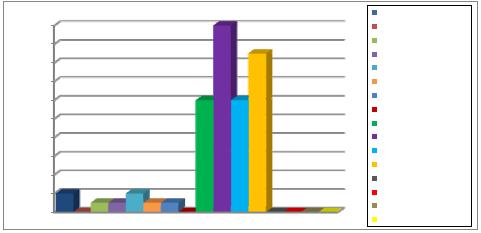
5. Results of concrete slump. A concrete slump test was performed according to the standard NF P 18-451 using an Abrams cone. The results obtained are shown in Fig. 8.
Fig. 8.Concrete slump of mixtures without modification and modified with a recovery filler (RF) and a superplasticizer
The results shown in Fig. 8 indicate that better values of concrete slump were obtained with superplasticizers due to the stabilities of ettringite, which confirms the studies in [20––22]. We note that in the case of a W/C ratio of 0.6, the workability increases. However, when a RF is used as a cement replacement in concrete, workability decreases. This decrease was 15 % for concrete C3 + 10 % RF + 1.6 % SP. This can be explained by the fact that RF increases water absorption and decreases concrete slump. Indeed, the morphological aspect of RF, with a low coefficient of elongation of 0.463, does not allow for a high workability.
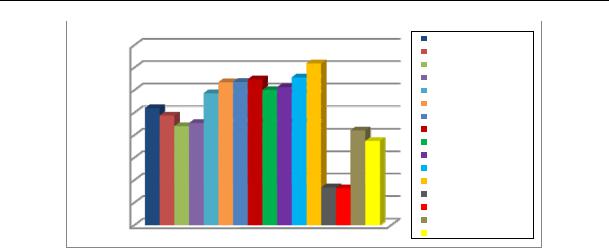
6. Results of compressive strength. The compressive strength test was performed in accordance with standard NF P 18-406. The compressive strengths were estimated on the 10 × 20 mm samples using a universal press (Controls Group Digimax Plus 70-C0019/B) over 28 days. The obtained results are illustrated in Fig. 9.
The experimental results in Fig. 9 indicate that after 28 days the greatest compressive strength was obtained for a concrete mixture with 10 % RF, 1.6 % superplasticizer, and a W/C ratio of 0.6. Despite the RF having a good fill ratio (0.670) and a small diameter (1.22 μm), its use beyond 10 % in concrete mixtures causes a decrease in the compressive strength. This can be explained due to the percentage of zinc in RF of 52.64 mg/l. Indeed, these results confirm those of [29] regarding the increase in the percentage of zinc in concrete which decreased the compressive strength.
67
Russian Journal of Building Construction and Architecture
Fig. 9. Compressive strength of all mixtures without modification and modified with a recovery filler (RF) and a superplasticizer
We can, therefore, infer that 10 % of RF should be considered optimal. Indeed, a large amount of RF (up to 67 %) reduces the stiffness of the granular skeleton and hence the compressive strength of concrete.
On the other hand, we can see that the compressive strength of concrete decreases at the lower W/C ratio of 0.5. But when we use a W/C ratio of 0.6, an increase in the compressive strength is noted (until 32 %). The higher is the quantity of cement in concrete, the greater is the compressive strength. These results were attributed to the small particle size of cement compared to RF filler (1.22 μm), which confirms the results of [30] regarding the relationship between particle size and compressive strength. Finally, we can say that the compressive strength of concrete with RF is significantly dependent on the W/C ratio.
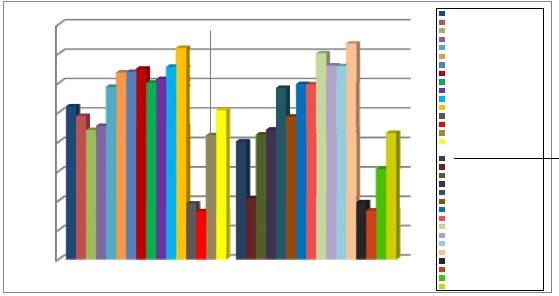
7. Results of compressive Strength after Freeze-Thaw Cycling. After demolding at 24 hours, the samples were water cured for 28 days. Then three samples were subjected to 50 freeze-thaw cycles using a Controls Group 10-D1429/A climatic chamber conforming to the Russian National State Standard (GOST) 10060-2012 [26].The obtained results are illustrated in Fig. 10.
The results from Fig. 10 clearly demonstrate that 50 cycles of freezing and thawing decreased the compressive strength when a superplasticizer was not used. The decrease for concrete C1 + 10 % RF was 57 %.This can be explained by the fact that the RF increased water absorption, and therefore the freeze-thaw cycles generated microcracks and deterioration of the concrete. As a superplasticizer decreases the water consumption, the compressive strength is improved. The increase for concrete without a RF and with a superplasticizer was 16.59 % (C1 + SP 1.6 %) and 7.54 % (C3 + SP 1.6 %). On the other hand, the increase for concrete with both a RF and a superplasticizer was 0.3 % (C1 + 10 % RF + SP 1.6 %) and 2.08 %
68
Issue № 3 (43), 2019 |
ISSN 2542-0526 |
(C3 + 10 % RF + SP 1.6 %).These results demonstrate that the freeze-thaw resistance of concrete with RF is affected by several parameters, including the percentage of RF, water content, cement content, and the use of a superplasticizer.
Fig. 10. Compressive strength of concrete mixtures without modification and modified with recovery filler (RF) and superplasticizer after freeze-thaw cycles
8. Conclusions. The main conclusions of this study can be summarized as follows.
––An increase in the content of RF increases water absorption and decreases concrete slump.
––The morphological aspect of RF with its low coefficient of elongation does not allow for good concrete workability.
––Despite the RF’s good fill ratio a threshold of 10 %RF is considered optimal. Beyond this percentage, the amount of zinc in the concrete reaches a point where the compressive strength decreases.
––The use of RF provides a positive effect on the compressive strength if the W/C ratio is optimized. In this study, we found concrete C4 with 10 % RF and without SP (W/C ratio = 0.6).
––The experimental results confirm that superplasticizer reduces the water consumption while improving the workability and the compressive strength of concrete.
––The freeze-thaw resistance of concrete with RF is affected by several parameters such as the percentage of RF, W/C ratio, and the use of a superplasticizer.
––Therefore it is possible to use RF from HMA plants, especially when limited to 10 % and accompanied by the use of a superplasticizer.
69