Материал: Mekhanika_Ch2
6. Analyse the experimental results and draw the conclusion.
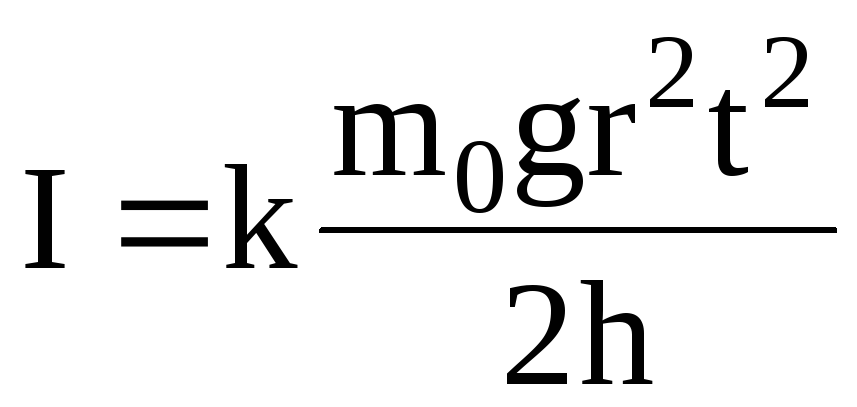
m0 = 0,5 kg; m(I) = 0,592 kg; m(II) = 0,59 kg; m(III) = 0,575 kg;
m(IV) = 0,592 kg; I0 = 4,5˙10-2 kg˙m2
15.5 Task 5.4
THE AIM is to determine the angular accelerations and moments of inertia of the pendulum when the load masses at the shafts are changed and the moment of force is constant.
1. Put down the data of measurements in table 15.7.
Table 15.7
-
№
T,s
s
The middle
mass of the
load
 ,
kg
,
kgr,
m
h,
m
R,
m
ε0,
s-2
I, kg·m2
1/I,
kg-1·m-2
Note
1
Measurement with the first set of loads
2
3
4
5
6
…with the second set of loads.
7
…with the third set of loads.
8
…with the fourth set of loads.
9
…with the set of loads.
2. Calculate angular acceleration defined by
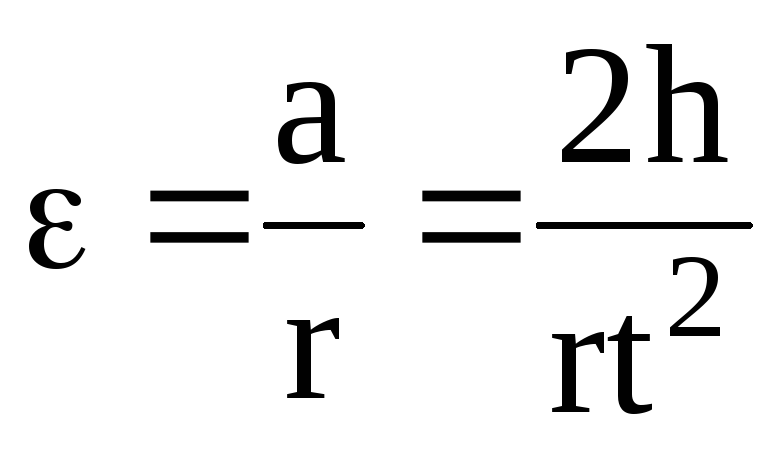 .
.
3. Calculate moments of inertia given by
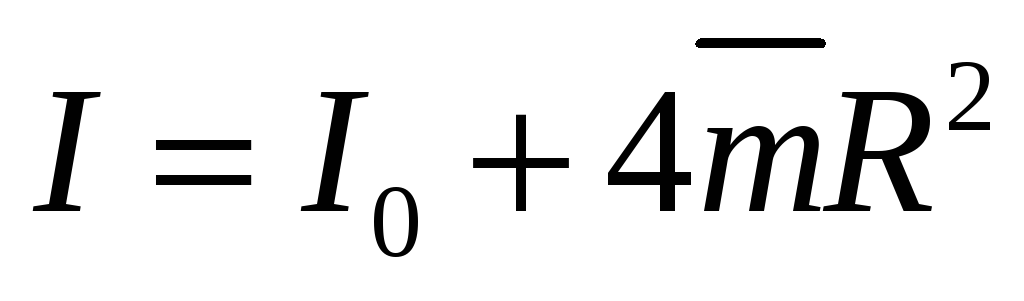 ,
,
where I0 is the moment of inertia of the pendulum without loads (I0 = 4,610-2 кg/m2); m is the mean mass of four loads at the shafts; R is the distance between the axis of revolution and the centre if gravity loads.
4.
Calculate
 and Δε
for five measurements. Calculate the half-width of the confidence
interval for r and h using the main errors of measurements. Calculate
the half-width of the trust interval for t using five measurements.
and Δε
for five measurements. Calculate the half-width of the confidence
interval for r and h using the main errors of measurements. Calculate
the half-width of the trust interval for t using five measurements.
5. Results of calculation carry in the table 15.8.
Table 15.8
|
№ |
ti, s |
Δt, s |
Δti2, s2 |
Half-width of the trust interval |
|
|||
|
Δt, s |
Δh, m |
Δr, m |
Δε, s-2 |
|||||
|
1 |
|
|
|
|
|
|||
|
2 |
|
|
|
|
|
|||
|
3 |
|
|
|
|
|
|||
|
4 |
|
|
|
|
|
|||
|
5 |
|
|
|
|
|
|||

∑ ti
=
∑Δ ti2=
 =
=
6. Make analysis of the experiment results.
15.6 Task 5.5
THE AIM is to determine the angular accelerations and moments of inertia of the pendulum with changed distance of the loads at the shafts and a moment of force is constant.
1. Measure t and h for five different distances of the loads at the shafts.
2. Put down the data of measurements in table 15.9.
Table 15.9
|
№ |
r, m |
h, m |
kg |
t, s |
R, m |
R2, m2 |
ε, s-2 |
I, kg·m2 |
Note |
|
1 |
|
|
|
|
|
|
|
|
The measurementon the arrangement of the loads the first position. |
|
2 |
|
||||||||
|
3 |
|
||||||||
|
4 |
|
||||||||
|
5 |
|
||||||||
|
6 |
|
|
|
|
|
The measurement on the next position. |
|||
|
7 |
|
|
|
|
|
||||
|
8 |
|
|
|
|
|
||||
|
9 |
|
|
|
|
|
 ,
,
3. Calculate angular acceleration defined by
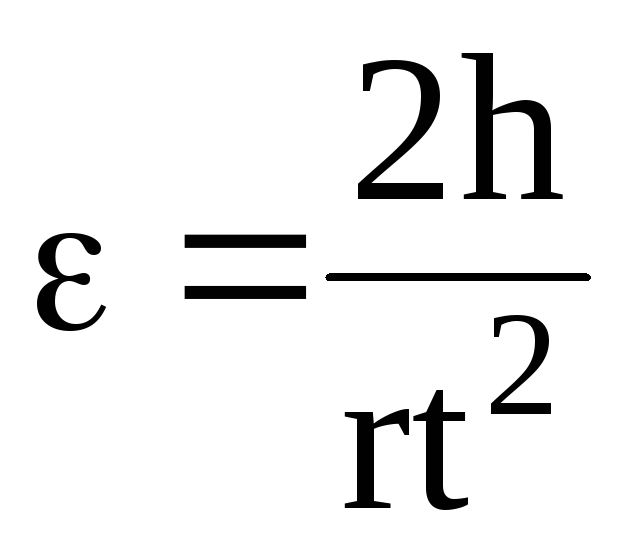 .
.
4. Calculate moment of inertia given by
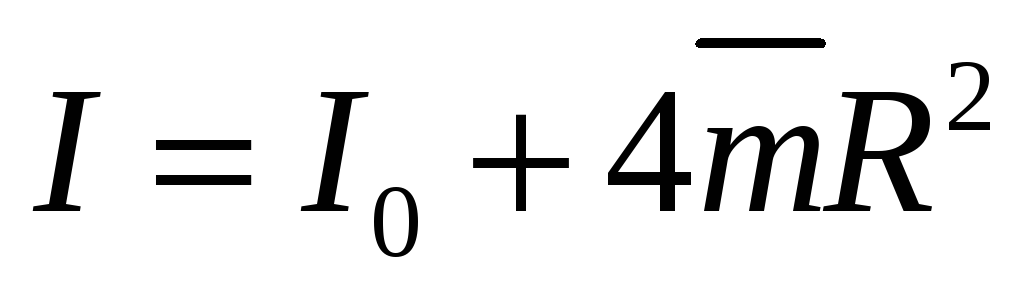 ,
,
where
I0
is the moment of inertia of the pendulum without loads ( )
kg m2;
m
is the mean mass of four loads at the shafts; R
is the distance between the axis of revolution and centre of gravity
loads.
)
kg m2;
m
is the mean mass of four loads at the shafts; R
is the distance between the axis of revolution and centre of gravity
loads.
5.
Calculate ΔI
and
 for one measurement. Calculate the half-width of the confidence
interval for R
to use main errors of measurements, and m
is the table values; ΔI0
=
for one measurement. Calculate the half-width of the confidence
interval for R
to use main errors of measurements, and m
is the table values; ΔI0
=
6. Put down the results of calculations in table 15.10.
Table 15.10
|
№ |
ti, s |
Δti. s |
Δti2, s2 |
Half-width of the trust interval |
|
||||
|
Δt, s |
ΔR, m |
Δm, kg |
Δ I0, kg·m2 |
Δ I,kg·m2 |
|||||
|
1 |
|
|
|
|
|
|
|
|
|
|
2 |
|
|
|
|
|
|
|
|
|
|
3 |
|
|
|
|
|
|
|
|
|
|
4 |
|
|
|
|
|
|
|
|
|
|
5 |
|
|
|
|
|
|
|
|
|

∑ ti
=
∑Δ ti2=
 =
=
7. Put I versus R2 on the graph.
8. Put I versus ε on the graph.
9. Make analysis of the experimental results.
15.7 Task 5.6
THE AIM is to determine moment of inertia of the pendulum with dynamics and theoretical methods.
NSTRUMENTATION AND APPLIANCES: cross-shaped pendulum, seconds counter, set of loads
1. Put down the data of measurement in table 15.11.
Table 15.11
|
№ |
t,s |
s |
m0. kg |
r, m |
h, m |
R, m |
kg |
l, m |
R1, m |
I, kg·m2 |
I’, kg·m2 |
|
1 |
|
|
|
|
|
|
|
|
|
|
|
|
2 |
|
||||||||||
|
3 |
|
||||||||||
|
4 |
|
||||||||||
|
5 |
|
 ,
, ,
,
2. Determine the moment of inertia of the pendulum by with the dynamics method