Материал: 2358

The management at the Wolfsburg headquarters was not convinced and would not sanction work on what it saw as an uncommercial product. So, a dedicated band of technicians developed a rather special version of the Golf in their spare time, until the management finally liked what they saw and gave the project the green light.
СThis was destined to become the GTI. The most important changes
141
happened under the bonnet. The largest engine in the intended Golf line-up was a 1588cc unit, due for launch in August 1975. It was to this unit (which
developed 75 bhp in standard tune) that the engineers turned. They installed Bosch K-Jetronic fuel injection and boosted the power up to 110 bhp. The engineers also tweaked the suspension, adding a front anti-roll bar to stiffen it tip, while fat wheels and tyres were specified to sharpen grip.
и ple clean-cutбАlines of the Giugiaro original were left unmolested, only a
The marketing department decided on an understated style: the sim-
deep chin spoiler, discreet side stripes, a little bit of red trim around the grille and an unassuming ‘СТI’ badge made the car stand out.
Quite simply, the Golf GTI swept all before it when it was launched in August 1975. It caused a sensation with the motoring public who thronged, to own one, even though it took almost a year for deliveries to begin.
In the first four years of the model’s life, more than 100,000 were supplied to customers on the continent. In Britain the GTI was only sold to special order, in left-hand form, for four years. It was not until 1979 that
Moreover, this power was deliveredДsmoothly and reliably. Then there was the handling: it was pin-sharp, predictable and a revelation to a
the GTI became available in right-hand drive, by which time the original four-speed gearbox had been replaced by a five-speeder.
British customers soon realised what they’d been missing. The GTI was a genuine firebomb, capable of over 110 mph and 0-60 mph in well
under ten seconds. |
И |
|
generation of drivers brought up on the Morris Marina or the Ford Capri. It immediately established a cult following. Other manufacturers
could not ignore the rich business VW was doing and soon a swathe of ‘hot hatches’ came chasing at the GTI’s heels: the Ford Escort XR3, Opel/Vauxhall Astra GTE, Fiat Strada Abarth and a dozen others. None of them ever quite matched the magic of the original Golf GTI and those three letters came to be synonymous with the new driving subculture: the hot hatch brigade.
Another significant newcomer in 1979 was the Golf Cabriolet. This was actually another brave and pioneering move, for at that time converti-
141

bles were very much out of fashion. The engineering and construction work was done by the acknowledged masters of the convertible art, Karmann of Osnabruck. Their chop-top was typically Germanic in execution: there was a roll-over bar and a high-stacked hood, to keep as much boot space as possible, although both luggage space and room in the rear
Сseats was at a premium. There was a GTI version of the Cabriolet, which
142
shared the dazzling dynamics of its hot-hatch brother, though the slightly compromised structure was not as rigid.
Another important derivative of the Golf was the Scirocco, Volkswagen’s coupe which shared the Golf platform. Naturally there was a GTI version of this too, mimicking the specification of the Golf but adding performance through lighter weight and better aerodynamics, as well as of-
feringиattractive coupe styling.
A largerбА1760cc engine became standard for the Golf GTI in 1982, which boosted power slightly to 112 bhp. More importantly, the engine had nearly ten per cent more torque available much lower down the rev band. This made the GTI a much more tractable – and a less ‘peaky’ – car to drive than many high-revving rivals. A hotter 139 bhp 16-valve version further cemented its desirability.
The Mark 1 Golf was replaced in 1983 by the second generation, and that in turn by the current Golf in 1991. All the time the GTI badge remained a stubbornly popular component of the Golf family. Amazingly,
16-valve ‘four’ to bring the fun back.Д
the original Golf Mark I bodyshell lasted right up until 1992 in convertible form, when it was finally replaced by the current Golf Cabriolet.
The Mark II is regarded as the best all-rounder, the latest Mk III was criticised for being too fat and heavy – the very opposite to the original. It
needed the launch of a V6 engine in the sensational Golf VR6 and a new И
Few would deny that the Golf GTI has passed seamlessly from being the founder and benchmark of the hot hatch school to a widely-accepted classic. Even today it is still entertaining new generations with its delights.
Thousands were imported to Britain, which is good news for the bar-
gain hunter today. The Golf was so well built that many cars lasted the distance where other, more fragile performance cars bit the dust. Today, the GTI has a wide following and many examples have been restored. All models are desirable but it is the special edition Mk I Campaign model made after August 1983 which is currently the most sought after GTI. Those with simpler needs should head for the Mk II.
142

Текст 13 AUSTIN HEALEY 100 & 3000
Donald Healey was a Cornishman who set up his own marque immediately after World War II to make a series of handsome Riley-engined sports cars, convertibles and saloons. Considering they were fresh designs
Сin troubled times, they were amazingly advanced. In fact, the Healey was
143
the world’s fastest four-seater in its day, capable of over 110 mph.
In 1949, while travelling to America on the Queen Elizabeth, Healey chanced to meet George Romney, general manager of US car-maker Nash. Theyиgot on so well that a deal was struck, with Healey supplying complete body and chassis units to Nash, which would install its own engines to create the Nash-Healey sports car. This collaboration for the American market only did not prove to be a great sales success. So in 1951, Donald Healey and his son GeoffreyбАbegan work on a new, cheaper sports car, still with a firm eve on the American market. For his engine, Healey turned to another car which was British-built but plainly intended for American buyers, the Austin Atlantic. The Atlantic saloon and convertible had not been a great success either, but its four-cylinder, 2.6-litre engine appealed to Healey.
Geoffrey Healey and Barry Bilbie designed the chassis, while exRootes man Gerry Coker styled the bodywork. This was an undoubted work of genius; an elegantly curvaceous shape with a purposefully low stance and a lack of any unnecessary adornment.
Its essential tightness was Дproven when virtually nothing was changed for the subsequent production version.
The prototype appeared at the 1952 London Motor Show, where it was displayed as the Healey Hundred – it had a top speed of over 100 mph, as proven by a run of 106 mph at the famous straight Belgian road at Jabbeke. Donald Healey was unhappy about the stylingИof the grille, so he put the nose up against a pillar at the show but that did not stop the crowds thronging around it. The Healey was the undoubted star of the show and the salesmen on the stand took no less than 3,000 orders.
Austin's chief Leonard Lord had found out about the Healey before its show-stealing debut, but seeing this warm reception it got there clinched the matter for him. Donald Healey was obviously not in a position to manufacture enough cars to meet demand and Lord saw an ideal opportunity for Austin. The car was rebadged Austin-Healey even while it sat on the motor show stand and Healey was engaged as a consultant on a 20-year contract.
143
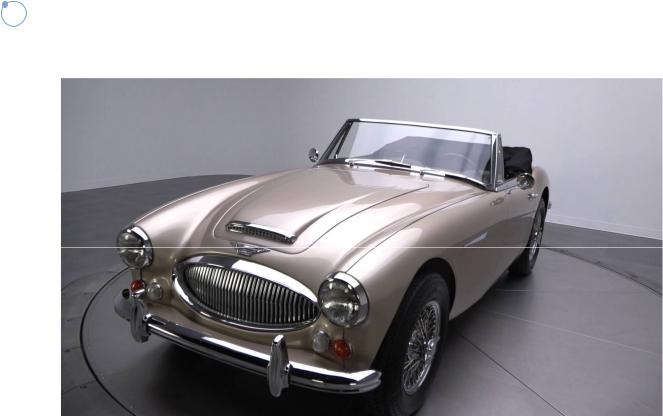
The prototype was then whisked off to America for a round of shows. At the 1953 New York Show, it was voted International Show Car of the Year. Meanwhile coachbuilders Tickford built a batch of 20 preproduction cars in aluminium, though production bodies would be built in steel by another motoring legend, Jensen.
СThe Austin factory at Longbridge began assembling the Austin-
144
Healey (Fig. 21) 100 in May 1953. Changes over the prototype included slightly raised headlamps and a revised grill (though still the recognisable Healey kite shape).
и бА
Fig. 21. AustinД-Healey
Mechanically, the Healey used the standardИAustin Atlantic engine, a lumbering but torque all-iron four-pot unit which developed 90 bhp. The Healey also took its four-speed gearbox from the Austin, though the bottom gear was blanked off to turn it into a three-speeder and there was overdrive on the top two
Since it weighed less than a ton (2015 lb/914 kg), performance was excellent. The top speed was 103 mph and 0-60 mph took a little over ten seconds.
The Healey cost $3,000 (or £730) new, so Austin could boast that this was the cheapest 100 mph car on the market.
Even better performance was available from 1954, when the 100S was launched. This lightweight competition variant had a 132 bhp lightalloy cylinder head engine modified by Weslake. It had mostly aluminium
144

bodywork and was the first production sports car to have four-wheel disc brakes. Each example was highspeed tested by the factory and was easily identified by its shallow perspex wind deflector, oval air intake and knockon wire wheels. The close-ratio four-speed gearbox allowed 0~60 mph in just 7.8 sees. Only 55 were made and, unsurprisingly, the 100S is a highly
Сprized collector’s car today.
145
A less expensive way to get better performance arrived in 1955 when the 100M were launched. This was a high-compression 110 bhp version with front anti-roll bar and bonnet straps.
и car to accommodateбАit. He added two inches to the wheelbase, changed the
By this stage the old Atlantic engine was definitely looking long-in- the-tooth. The Atlantic saloon had actually finished its production run in 1952 and its successors were a range of BMC saloons using a newly developed 2639cc six-cylinder engine. Healey was asked to modify his sports
grille to a prettier oval shape and installed a pair of rather marginal rear seats for children.
The result was the 100/6, first seen in 1956. It got a cool reception from buyers, who now regarded it as more ‘touring’ than Sports’. Certainly, it was heavier and slower than the old 100, despite an increase in power to 102 bhp. This was not addressed until 1957, when a six-port head boosted power to 117 bhp and returned performance more to the original level, Leonard Lord chose the 1959 New York Motor Show to launch the new
curved screen. Д
Austin-Healey 3000, with its 2912cc engine. This brought the new 3000 the nickname ‘Big Healey’. Standard front disc brakes featured on this more powerful (124 bhp) version, although overdrive was optional. The
Mark II, from 1961, had triple SU carbs, a new gearbox and a vertically
slatted grille, while the Mk IIa got twin carbs, wind-up windows and a И
The final Mk III of 1963 was the most powerful and the fastest of all Healeys, with 148 bhp to play with. Although the Healey had really developed very little over its life, the car’s death in 1968 was probably premature. Officially it occurred because of creeping US safety and emissions
laws. That meant a prototype 4.0-litre Rolls-Royce engined Healey (to be called the 4000) never reached fruition. The vast majority of the 72,000 cars built over the model’s 14-year lifespan were exported to the United States.
Although the Big Healey never had much competition success and was, in its day, viewed more as a good-value tourer than a full-blooded sports car, it is today widely appreciated as one of the great classics. It has
145