Материал: 2358

The so-called Series 3 also looked very different: the nose incorporated a controversial ‘cheese grater’ grille, the wheels and arches were much wider and all models (roadster and fixed head coupe) now came on the long wheelbase of the 2 + 2. Some 80 percent of Series 3 cars were exported to the USA, where the qualities of the E-Type were well appreciat-
Сed, especially as it was now available with air conditioning.
136
The demise of the E-Type came in 1975. The very last 50 cars were painted black and included a special commemorative plaque signed by Sir
William Lyons. The model was replaced by a very different creature, the XJ-S, which was far more of a grand tourer and less of a genuine sports car. That made the E-Type the last great Jaguar sports car.
и its forbearer.бА
A brand new sports model the XK8 was launched in 1996 and it took many of its cues from the E-Type. The XK8 became an instant hit, just like
As a classic, the E-Type is perhaps one of only half-a-dozen cars, which are truly enduring and legendary. In the heady classic car boom years of the late 1980s, examples were changing hands for over £ 100,000, today they are much more affordable. The survival rate is quite high, since their classic status was recognised long ago, and many examples have been restored to outstanding condition. The E-Type’s enduring popularity has also meant that the choice is surprisingly wide. An E-Type may not be the most economical classic.
up garage, he was always ahead of theДgame. He developed an unsurpassed reputation for designing race-winning cars and became pre-eminent among British race car constructors.
Текст 11 LOTUS ELAN
The true depth of Colin Chapman’s engineering genius is still being
discovered. From his earliest days building Austin-based specials in a lock- И
Chapman realised the need to develop road cars which would fund his true passion, motor racing. However, despite levels of performance and
handling that led the field, Lotus road cars were almost always deficient in build quality. Ironically, Chapman's earliest true road car, the 1957 Elite, lost large sums of money for Lotus.
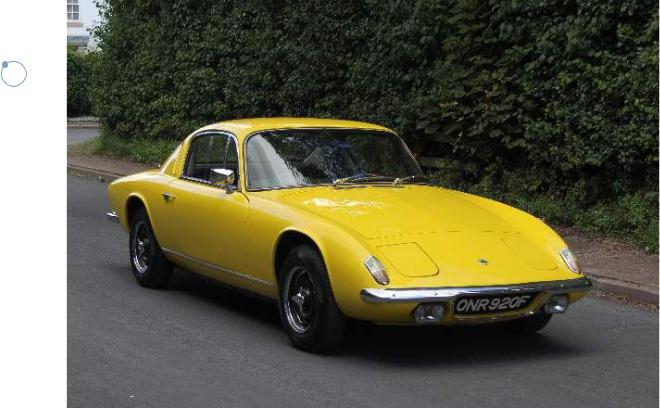
The Elan (fig. 19) changed all that. By 1962, Lotus had become the dominant force in virtually all singleseater racing categories and there was a strong demand for a road car which embodied the Lotus principles of light weight and efficient engineering. After his experience with the
136
glassfibre monocoque Elite, Chapman realised that what he didn’t need was another difficult-to-make, expensive, raw semi-racing Car.
С137 и
бАFig. 19. Lotus Elan
So the Elan was conceived toДbe a true sports car but one with practicality and ease-of-construction at the top of the agenda. Another glassfibre monocoque design was ruled out, so instead Chapman used a backbone chassis. This idea was not new (it had been seen in Edwardian times) but the method of its construction was. The Elan didn’tИuse a steel tube type chassis but a folded pressed-steel sheet forming a single girder. The lightness and rigidity of this set-up so impressed Chapman that he began using it on his Formula 1 cars. Soon all Fl constructors had copied him.
The backbone split at the front into a two-pronged fork embracing the engine/gearbox and leading to the front Suspension. A shorter fork at the rear carried a cross-member on which were mounted the rear Chapman struts. The suspension was by front wishbones, coil spring/dampers and an anti-roll bar, using proprietary parts where possible. The rear was independent by struts and coil-sprung wishbones. Disc brakes were fitted all round.
As for the body, this was a glassfibre open structure which contributed little to the rigidity of the chassis. It was a one-piece shell which bolted
137

to the chassis and featured pop-up headlamps, which were a great novelty at the time. Overall dimensions were very compact and the first Flans were strict two-seaters. They were all initially open-topped, although an optional hard top was offered from May 1963.
The Elan was launched at the 1962 London Motor-Show at £ 1,499
Сcomplete, although most buyers elected to save purchase tax and build
138
their own car from a complete kit, priced at £ 1,095. Thus it was not a cheap car but it was certainly one of the most desirable sports cars of any description in 1962.
иLotus launched the Elan with a 1498cc twin-cam engine based on the Ford Cortina block. When the international racing class was raised to 1600cc, Lotus expanded the engine to 1558cc, recalling ail the 22 Elans already built with the smaller engine. In this definitive form, the engine developed 105бАbhp, enough for 115 rriph and 0-60 mph in 8.7 seconds.
However, it was in roadholding and handling that the Elan excelled. It became a benchmark against which all others were judged and even today it has enough ability to raise the eyebrows of hardened road-testers.
There were many early problems, like flaking paint, poorly fitting trim and criticisms of the rubber doughnuts on the drive-shafts, which were quickly replaced with superior Rotofiex joints. Engine noise at high speed was also a concern, which was remedied in 1965 with the option of a higher final drive ratio.
In late 1964, Lotus introducedДa Series 2 version incorporating larger brake callipers, a better interior arid optional centre-lock wheels. The Series 3 of the following year had an extended boot lid, higher final drive and could be ordered as a fixed-head coupe as well as a drophead.
The 1966 SE (Special Equipment) became the best Elan to date, boasting a 115 bhp engine, close-ratio gearboxИand servo-assisted brakes. The final Series 4 version (1968) had flared wheel arches, rocker switches and was available, from 1971, in ultimate Sprint guise, with a Tony Ruddmodified ‘big valve’ twin-cam engine developing 126 bhp. The Sprint needed a strengthened differential and drive-shafts to cope with its performance (124mph and 0-60 mph in 6.7 sees), and was easily recognised by its two-tone paint scheme. The two-seater Elan lasted until 1973.
Inevitably the Elan made it on to the track. Lotus built special racing versions with lightweight bodies arid modified suspension to improve roadholding, which were called 26R. The drivers included Jackie Stewart, Stirling Moss, Mike Spence and John Miles, the latter achieving such great success he was given a place in Lotus' Grand Prix team.
138

There is a second chapter in the Elan story. Chapman launched another road-going Elan in the form of the ‘Plus 2’, or family man's Lotus. This was first introduced in 1967. The primary reason for the existence of the Elan +2 was to provide an extra pair of seats for children up to teenage years. In concept and layout it remained very much an Elan but it was larg-
Сer in every way.
139
The backbone chassis idea was kept but it was bigger. To compensate for the increased bulk, holes were drilled in the steel to reduce weight.
The bodywork was still glassfibre but it was substantially enlarged, gaining a foot in length and 7in. in width. It was substantially redesigned, featuring a new sloping nose, much larger boot and fastback roof (all +2s were fixed-head coupes). The interior was also improved, having a more com-
prehensiveиdash.
Mechanically,бАthe story remained much the same, although the +2 became the first Lotus to gain a standard brake servo. The same 118 bhp 1558cc twin-cam engine was used. Although the weight penalty over the standard Elan was considerable (46.8 cwt/850 kg to 14 cwt/710 kg), performance did not suffer too badly, probably because of superior aerodynamics: A +2 could reach 121 mph and 0-60 mph in 8.2 sees.
In 1968, the family Elan was uprated to +2S specification, gaining better trim and more equipment, such as fog lamps. It became the first Lotus that could not be bought in kit form, only being sold fully-built.
Elan +2S/130s are easily spottedДby their self-coloured silver roofs. The final metamorphosis came in late 1972, when a five-speed gearbox was offered as an option. By 1974, changing type approvalИregulations made it uneconomic to continue producing the Elan. In any case, by then Lotus had its brand new 2.0-litre Elite in a bid to move upmarket. The 90s Elan was a different animal and never quite rekindled the spirit of the original.
To return the Elan +2 to two-seater performance levels, Chapman introduced the +2S/130 in 1971, which had the 126 bhp big valve engine of
the Elan Sprint.
Текст 12 VOLKSWAGEN GOLF GTI
In the early 1970s Volkswagen was becoming drastically out-of-step with the rest of the car world. While virtually every other manufacturer had abandoned rear-engined cars as second-best from the point of view of both dynamics and packaging, Volkswagen soldiered on with a range based entirely on the pre-war Beetle.
139
However, Ws new partner Audi was already ahead of the game with its range of smart-looking, well-built, front-wheel-drive saloons. Volkswagen took a leaf out of Audi's book and embarked on a spectacular, revolutionary rebirth, in the space of two years, from 1973 to 1975, it launched no less than four all-new front-wheel-drive cars: the Passat,
СScirocco, Polo and Golf. Each one of them set new standards in their mar-
140
ket sectors.
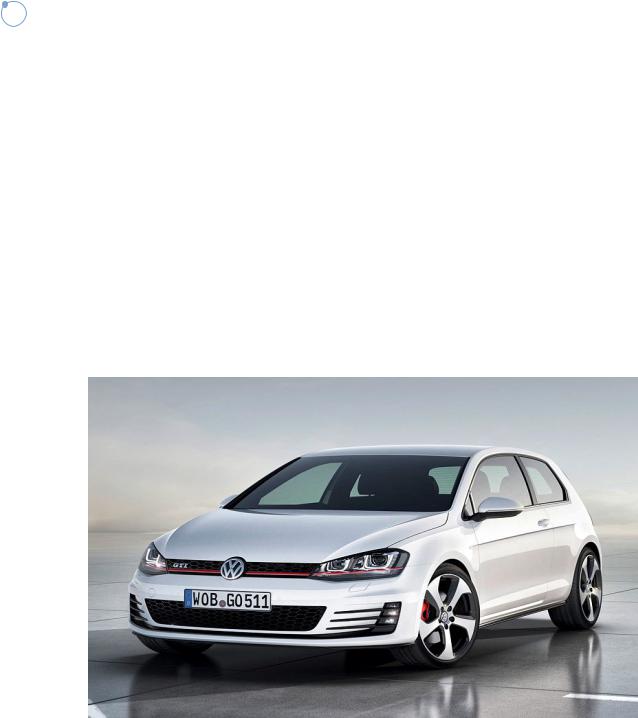
The most successful of the quartet was unquestionably the 1974 Golf. The name, incidentally, does hot derive from the game of 18 holes butиGolfstrom, the German word for the ‘Gulf Stream’. In America, where the new car (fig. 20) would also be manufactured, it was known as the Rabbit.
The Golf’s styling was the brilliantly simple work of Giugiaro’s newlyindependentбАteam, Ital De-Sign. The packaging was exactly right, the hatchback tail made it extremely practical and the build quality endeared it to a generation of owners who had known only rust and breakdowns.
Some of the engineers at Volkswagen were convinced that the car Volkswagen had conceived as a bread-and-butter shopping trolley for the masses could handle much more power. Like the Mini 15 years before it, the balance of the front-wheel-drive Golf was so good that there certainly was plenty of potential to handle it.
Д И
Fig. 20. Volkswagen Golf GTI
140