Материал: 2358

a brawny character, an extremely beautiful shape and evokes its period with faultless charm.
BMW is seriously rumoured to be reviving the Healey retaining its classic and traditional lines.
С
146
Текст 14 JAGUAR MARK II
When a luxury car-maker like Jaguar decides to expand its market in-
to the cheaper compact saloon car category, other manufacturers should quake in their boots. Britain's established marques certainly felt the impact when a new 2.4-litre Jaguar was launched in 1956. The car simply was a huge leap forward from the expected standards of the day.
и saloon manufacturer,бАbeing very successful with the Mk VII, which re-
In the 1950s, Jaguar had already become Britain’s leading high-class
mains a very underrated car even today. What it created with the new, smaller 2.4-litre saloon was not only its first-ever chassis-less monocoque design, but an attractively modern-looking compact luxury car with searingly good performance and roadholding. That reputation was enhanced by the arrival of a faster 3.4-litre version in 1957.
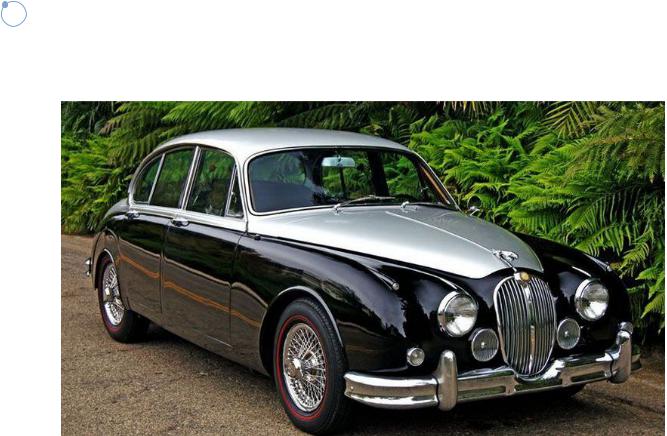
These 2.4 and 3.4-litre saloons became known retrospectively as the Mark I up till 1959, and after that, the Mark II (Fig. 22). The evolution be-
tween the two stages was subtle in most respects but in terms of the overall effect, the Mark II was a far more cohesive whole. Collectors and enthusiasts have recognised this fact and the Mark II has become the seminal classic Jaguar saloon.
drivers. Perhaps it is the old-worldДcharm of its traditional leather-and- walnut interior, leaping cat mascot and oval chrome grille. Whatever, the Mark II's appeal is enduring.
Perhaps it is the elegance of its styling. Perhaps it is the thoroughbred
responsiveness which made it such a favourite of contemporary racing И
Compared with the old Mark I, the Mark II looked much more balanced and delicate, having a larger glass area, slimmed-down pillars, more
chrome and a wider rear track. The latter point meant that the full rear spats of the Mark I were replaced with cut-away ones. The interior was also superior, having exceedingly comfortable leather seats, masses of walnut veneer and a sporting feel to the dashboard layout.
146

The big news was the availability of three configurations of the sixcylinder XK engine: the 2.4 and 3.4-litre units which had already been used in the Mark I, and the spectacular 220 bhp 3.8-litre engine from the Mk IX.
The top-of-the-range 3.8 became legendary for its performance; it
Сcould reach 125 mph and do the 0-60 mph sprint in 8.5 seconds. That is the
147
sort of performance which would not disgrace a sporting saloon car even today. In its day, it was easily the fastest production saloon car in the world.
Racing drivers certainly recognised its worth. Jaguar’s works drivers MikeиHawthorn and Duncan Hamilton were two of the more celebrated owners of 3.8-litre Mark Us. Another profession that appreciated the pace and space of the Mark II was the British police force, making it a frequently seen pursuit and motorway patrol car.
ExportбАmarkets were naturally targeted, the most important being America, where journalists had voted the Mark II ‘Car of the Year’. The Mark II was given a spectacular showing at the I960 New York Show, with an example having all of its exterior metalwork gold-plated, and a model on hand dressed in a gold-thread dress stitched with over 1,000 diamonds!
The Mark II remained largely unchanged throughout its production life (1959-67) but there were a number of interesting derivatives. The first was the Daimler 2.5-litre V8 which was given birth because Jaguar had acquired the Daimler company in I960 and inherited the fabulous Edward Turner-
hull and interior largely unchanged,Дbut added a longer tail and slightly revised front end. This was in turn developed into another pair of identical twins, the Jaguar 420 and Daimler Sovereign, which had sharper front-end styling and 4.2-litre engines.
designed Daimler V8 engine. It was a natural fitment for the Mark II body shell and found favour with buyers less interested in sporting edge and more in luxury, refinement and pulling power. Ironically, it was actually a much better performer and handler than Jaguar’s smaller-engined Mark Us.
Another derivative was the Jaguar S-Type, which used the Mark II's И
The Mark II officially died as a model in 1967, the last ones having
cheaper ‘ambla’ instead of leather interior trim, in line with a general costcutting policy at Jaguar in the late 1960s. However, there was a pair of final run-out versions of the Mark II which were called the 240 and 340. They were made between 1967 and 1969. These were considerably less lavish models with slimmer bumpers and plastic interior trim. Officially there was no 380 version, either, although a handful was built to special order.
147
In the 1980s, the classic car market began to acknowledge the Mark II as a quality car with enthusiast value. Prices rose to extraordinary heights - beyond £ 30,000 in some cases – and, unlike many other classic cars, did not fall back dramatically in value after the price bubble burst in 1990. However, all Mark Us are not equally valued. The 3.8-litre version
Сwith a manual overdrive gearbox is unquestionably the best and conse-
148
quently the most sought-after. The rather asthmatic 2.4-litre Mark II and down-market 240/340 models are at the opposite extreme, with automatic transmission also frowned on, since most potential Mark II owners - now, asиin the 1960s – have a sporting inclination and love the overdrive option.
бА Fig. 22. JaguarДMark II
Likewise, the Daimler V8-powered versionsИare generally viewed with far less enthusiasm because they are not pure Jaguars and were conceived more for comfort than rewarding sports driving. As a result, Daimlers can make the best buys because they cost so much less.
A veritable industry has sprung up to support these cars and there are even businesses doing very well updating original examples to more modern specifications, for what seem enormous sums of money. More recently still, firms have set up offering Mark Us on contract hire as an alternative to buying a brand new car. The attractions of running a classic as an everyday car have seldom been as powerful as they are with a Jaguar Mark II. It’s all part of a mystique which will undoubtedly see the Mark II remain one of the great classic cars for as long as there are enthusiasts around to drive them.
148

Текст 15 MGB
What other car can claim to have introduced so many people to sports car motoring than the MGB (fig. 23)? Countless thousands of enthusiasts across the generations have enjoyed the pleasures of MG motoring,
Сnot only in Britain but in Europe – and especially in the United States.
149
The MGB is without doubt the most famous in a long line of sports cars made by MG. It was the most durable, lasting some 18 years in pro-
duction, and the most popular, with not far short of half a million cars built. The MGB did more to establish the British sports car as an institution than any other car before or since. In its heyday, it was one of the best sports cars around but, alas, in later life it became a jaded shadow of its
formerиself.
MG beganбАin 1922 as a contraction of Morris Garages, reflecting its origins as part of the Morris group. After the war, MGs were highly successful among traditionally minded sporting drivers and became wellknown in America (especially the TC, TD and ТЕ).
The MGB grew out of MG’s celebrated MGA, the most successful sports car made up to that time, with 100,000 units sold. By the early 1960s, the MGA was looking decidedly old-fashioned. The new MGB would offer the same combination of speed, handling and good value, but would have modern styling and far more creature comforts.
tory by retaining the MGA’s well-provenДsystem of independent front suspension by coil springs and wishbones, with a live rear axle and semielliptical leaf springs.
An early decision was made to adopt unitary construction, as opposed to the separate chassis of the MGA. At that time, the idea was quite novel for sports cars. MG's Chief Engineer, Sydney Enever, began work on
‘Project EX205’ in 1959. All-independent suspension would perhaps have
been the best system for the new car but Enever fell back on familiar terri- И
The evergreen B-series engine (used in the MGA since 1955) was bored out for the MGB to 1798cc. The net effect of the expansion was a healthy
in crease in power of some 8 bhp to 94 bhp. Although this was less than the double overhead-cam engine used by the fastest MGAs, it was felt that the B-series represented a safer and more reliable choice than the troublesome twin-cam.
The MGB was launched in October 1962 at the London Motor Show and the response from press and public alike was extremely favourable. Here was a car which looked modern and felt modern but was built on sol-
149

id MG virtues. As Autocar said: “It is a forward step, in that the car is faster, and yet more docile and comfortable”.
For its day, the MGB was a strong performer. The top speed was around 105 mph and 0-60 mph was accomplished in 11.4 seconds. The B- series engine's best feature was it wide-based torque band although it was
Сnever a particularly free-revving unit.
150
Out on the open road, the MG enthusiast felt at home; here was a car with solid roadholding and entertaining handling on the limit. The ride had
improved by leaps and bounds over the rather harsh MGA. Indeed, there was some criticism from the press that MGB suffered from too much body roll and that the suspension was too soft for a sports car.
и winding windows,бАa modern dash and a leak-free hood. Options like the
Compared to the model it replaced, the MGB was a paragon of comfort – it was easier to get into, had wider and more accommodating seats,
hard top and Laycock overdrive made it even easier to live with. It cost just L950 and quickly became a sales success in Britain and the United States.
The MGB was immediately launched in a competition career. Its first outing, at the 1963 Sebring 12-Hour Race, did not go well, with both cars suffering main bearing damage. At the 1963 Le Mans, Paddy Hopkirk and Alan Hutcheson drove an MGB home to win 12th place overall, scoring a class victory at the same time. At the same event one year later, the partnership of Hopkirk and Hedges finished 19th overall. In the 19965 Le Mans, the MGB scored its best placing -11th overall and second in class.
Back with the road car programme, the closed coupe version (the MGB GT) arrived in 1965. It was an attractive car, styled with help from Pininfarina, and its elegant fastback incorporated an opening hatch. The
extra bodywork carried a small weight penalty, but this was offset by the |
|
|
И |
GT's shape which was more aerodynamic, allowing a slightly higher top |
|
speed of 106 mph. |
Д |
The GT was described by MG as a “poor man’s Aston Martin”. It certainly looked the parti and it was much more practical than the roadster. There was a modest rear seat which could fit two small children, although luggage space was still limited. The GT immediately accounted for one third of all MGB sales.
The Mark II MGB arrived in 1967, with an all-synchromesh gearbox or the first chance to opt for automatic transmission. No external changes were made until 1969, when a matt black grille replaced chrome and the traditional wire wheels were replaced by Rostyle steel wheels.
150