Материал: 2358

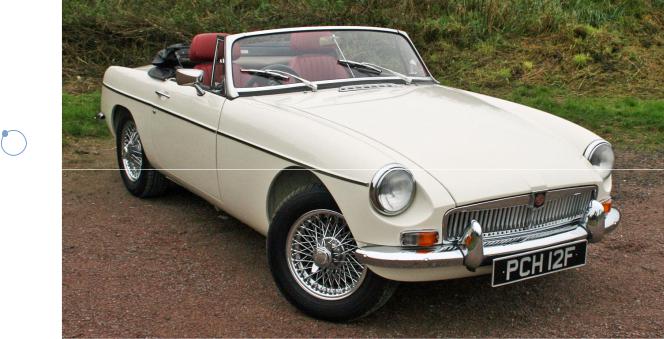
There were also two attempts to fit larger engines into the MGB shell. The first was the MGC of 1967-69, an ill-fated attempt to pack the MGB with more punch. Into the engine bay went a 145 bhp Austin 3.0-litre straight-six engine. Despite its extra performance, the engine's extra weight made it unhappy in handling terms and under 10,000 were made in total.
СThe MGB certainly could handle more power, as was proven in 1973
151
when a 137 bhp Rover 3.5-litre V8 was shoehorned into the engine bay to create the MGB GT V8. The top speed rose to 125 mph and 0-60 mph
came up in 8.6 seconds. Moreover, the alloy engine did not weigh much more than the B-series unit. The suspension did not need to be altered and handling remained as good as ever.
и Corporation.бАSlowly but surely, the MG name was strangled.
By the end of the 1960s, MG was part of an unwieldy industrial conglomeration of competing marques known as the British Leyland Motor
The most unfortunate changes were needed to bring the ‘В’ in line with American safety and emissions laws. In 1975, all MGBs suffered the ghastly fate of having black polyurethane bumpers fitted and their ride height was raised by 11/2 in (to meet US headlamp height regulations). The body weight went up and the power output went down. This was controversial, to say the least, because performance and handling obviously suffered badly as a result.
The MGB limped on until 1980, with the final run, a batch of Lim-
affordable sports car motoring. Д
ited Edition roadsters and GTs, emerging in 1981.
Today, the MGB undoubtedly has the strongest following of any classic car. More MGBs are on the road than almost any other sports car and there are dozens of owners’ clubs world-wide catering for tens of thou-
sands of owners, who have remained loyal to the original embodiment of И
A whole industry has grown up to restore and service existing cars and supply spares. Well known В specialist, Heritage, even began making replica bodyshells in the 1980s. This formed the basis of MG's revived and much modified В of 1992, called the RV8.
151
С152
ибАFig. 23. MGB
Текст 16 MINI
It is ironic that, after nearly 40 years in production, the Mini has become the very thing it originally bucked against: a motoring institution. The difference is, the Mini is a much-loved and much-respected institution. It was a pioneer in the art of transverseД-mounted engines and front-wheel drive. It was a marvel of packaging and a testament to the conquest of technical barriers. It was, quite simply, a revolution when it was launched in 1959. Five million Minis later, it remains in production, satisfying a loyal following of owners for whom its size, cost and above all character remain compelling even today. Over the years itИhas become a cult object across the world, from Carnaby Street in the 1960s to Tokyo in the 1990s.
Perhaps the most remarkable thing about the Mini is that it was the brainchild of one man: Alec Issigonis. The Mini was probably the last mass-produced car designed by one man alone; as such, it is unlike any other car seen since.
The birth of the Mini took place against the backdrop of the 1956 Suez oil crisis. For all anyone knew, there might be an indefinite shortage of oil. British drivers were rationed to ten gallons of petrol a month. The popularity of bubble cars mushroomed.
The British Motor Corporation's chairman, Leonard Lord, realised there was a potentially huge market for a cheap small car which combined economy with large-car characteristics. To whom could he entrust the task
152

of developing such a car? There was one obvious but brave choice: Alec Issigonis.
Born in Smyrna in 1906, Issigonis had come to Britain to study at the age of 15. When he had finished his education at Battersea Technical College, he worked for Humber. Then he joined Britain’s leading manufactur-
Сer, Morris, in 1936. This was where he met Leonard Lord, on a team de-
153
signing suspensions. After the war, he conceived the Morris Minor.
Then Leonard Lord asked Issigonis to begin development on a new
small car project in 1957, which assumed the title ADOIS. Assembling a small team around him, Issigonis created the Mini.
и this mechanicalбАlayout could save all the space needed for the propshaft
The essential factor for the new small car was that it should carry four adults in comfort, plus their luggage. Issigonis became obsessed with the need to save space. He was fervently in favour of front-wheel drive;
and final drive by incorporating it at the front. From the start, he knew this was going to be right for the Mini.
As for the engine, on grounds of cost, the obvious choice was the A- series unit, as found in the Austin A35 and Morris Minor. The trouble was, this power train measured 38in from stem to stern and this, in Issigonis’s view, would eat up too much space.
Then Issigonis had a leap of the imagination. What if the gearbox could be placed under the crankshaft, instead of behind? The engine and
formance and smoothness which theДnew car would require. So the decision was taken to expand the A-series engine to 948cc. On tests, the engine gave the little car too much performance – it was tested to beyond 90 mph with only 37 bhp on tap. So the engine was taken back down to 848cc and top speed fell to a less frenetic 74 mph.
gearbox would effectively become one unit and could be mounted sideways, driving each front wheel. The lubrication problem could be overcome by plumbing the gearbox into the engine, so it could use the same sump oil.
Issigonis felt that the A35’s 803cc engine would not provide the per- И
Issigonis was always strongly in favour of small wheels; the 14in wheels of the 1948 Morris Minor were easily the smallest of any saloon of its day. The Mini went much further: its ten-inch diameter wheels were far and away the smallest used in any car, except for some tiny microcars which used scooter wheels. The sole reason for such small wheels was a sacrifice to packaging. They freed up more interior space by reducing the intrusion of the inner wheel arches.
153

From his days with Morris, when he had got together with Alex Moulton to build a rubber-sprung Morris Minor, Issigonis had become a convert to the idea of rubber suspensions, which Moulton was still working on. The
СMini’s rubber cone system was so effective that it is still used on the car
154
|
The main disadvantage of ten-inch wheels was the harsh ride they |
|
gave over rough surfaces. Here again Issigonis was ahead of the objectors. |
||
|
The Mini was also fantastic to drive: nippy, sharp-handling and ma- |
|
noeuvrable. Formula 1 World Championship constructor John Cooper real- |
||
ised its potential and persuaded BMC to let him develop a Mini-Cooper in |
||
1961. |
И |
|
With a bigger 997cc engine,Дit developed 55 bhp and could reach |
||
|
||
nearly 90 mph – amazing performance for such a small car. |
||
|
The Cooper's legendary reputation really grew with the ’3 version of |
|
today.
All the major components – engine, gearbox, suspension, steering – were mounted on one subframe at the front, with a further subframe at the backиto carry the rear suspension. This eliminated a lot of vibration too, and would prove invaluable in the development of a wide range of Mini derivatives which could use these subframe assemblies completely unaltered.
KeepingбАcosts to an absolute minimum meant accommodating such measures as exposed seams in the bodywork to allow easy spot-welding of the main body sections, exposed door hinges simply bolted to the main hull and a lack of winding windows or elaborate door handle mechanisms.
By August 1959, the most important car in BMC’s history was ready to be launched. It arrived in two versions: the Morris Mini-Minor and Austin Seven (though the latter soon became just ‘Mini’ as the word pervaded the English language). Apart from the Ford Popular, it was the cheapest car on the market at L497. It caught on with city drivers who liked its parkability and with the fashion conscious who thought it ‘сооl’. Widespread acceptance of the revolutionary Mini followed.
1963. This had an ever larger engine (970cc, 1071cc or 1275cc), front disc brakes, wider wheels, even twin fuel tanks. In its most powerful 1275S form, it was capable of a top speed of up to 96 mph and 0-60 mph in 11.2 sees.
Coopers were all-conquering in rallying, their undoubted high point being three outright victories in the Monte Carlo Rally in 1964, 1965 and 1967. It could have been four wins in a row, but the entire Mini-Cooper
154

team was controversially disqualified on minor lighting regulation in the 1966 event.
They were pretty successful on the tracks, too. The Mini could humble the more powerful Jaguars and Ford Cortinas with its fantastic handling. The Mini Cooper S was not slow itself; on fast circuits such as the
Сfamous Belgian Spa track, Minis could top 130 mph.
155
The adaptability of the mechanical subframe package led to numerous Mini derivatives: estate, van and pick-up, utility Moke, luxury ‘booted’ Riley Elf and Wolseley Hornet. It also became a popular basis for customisation and special bodyworks.
Mini became a marque in its own right in 1969 and settled into notching up spectacular sales, reaching a height of 318,475 units in 1971.
The Mini is easily the best-selling British car of all time.
special editions with names like Open Classic, Red Hot and Piccadilly. Most exciting is the new generation Mini Cooper, launched in 1990,
и Recently,бАthe Mini received a new lease of life thanks to numerous
with its 63 bhp 1275cc engine and luxury trim. The popularity of the Mini show’s no sign of abating, though Rover has announced plans for a brand new Mini for 1999.
Sir Alec Issigonis summed up why the car has never been overtaken as the small classic:
«Small cars all look the same because they are designed by commit-
tees trying to copy the Mini».
That may sound arrogant but the Mini's brilliant and innovative formula of front-wheel drive, mechanical subframes and unique packaging
certainly was the benchmark which others still follow today.
FORD MUSTANG
Д Текст 17 И
Alongside the Chevrolet Corvette, there is perhaps no car more truly American than the Ford Mustang. In terms of sheer sales impact it is unrivalled among mass-produced cars. Mass-produced it certainly was, being the fastest-selling car in history, notching up a million sales in under two years.
The Mustang was a real trailblazer. In the US, coupes are even referred to as ‘ponycars’ in honour of the Mustang. It was the start of the craze for ‘рег-sonal coupes’, affordable sports-type cars designed to reflect the individualistic tastes of Americans.
155