Материал: 2358

As standard come such features as central locking with dead-locks (no one can open a door without a key, when the car is locked, even if a window has been smashed), and electric heating for the windscreen washers and the door mirrors.
The new Passat also promises to be economical, with all models top-
СThe VW badge in the centre admits air to the engine for combustion, whileиcooling air to the radiator is scooped up beneath the bumper. In many ways like these, the new Volkswagen Passat shows signs of careful thought in its design, and it looks set to do well, possibly even at some expense to the Audi 80, since it offers Audi merit without the restricted boot space. бА
131
ping 37 m.p.g. on the Transport Engineer formula, and the GT with
Digifant injection reaching an impressive 39.8 m.p.g. The fuel tank is a special plastic moulding, holding 15.4 gal (70 litres).
Текст 9 JAGUAR
Strictly speaking, the Jaguar marque, on its own, did not come into existence until 1945, for the original cars of 1931 were called “SS”, and a new range of car introduced in 1935 was badged as “SS-Jaguar”, but there was always strict continuity of design, and for more than 50 years the guiding genius behind the company, and its designs was Mr. (later Sir) William
ing special bodies for Austin SevensДin 1927. In 1928 the company was moved down to Foleshill, Coventry, and several other cars, from Wolseley, Standard, and Fiat, were given special coachwork before Lyons took the plunge and announced the SS1 in 1931.
Lyons.
Sir William joined forces with William Walmsley in Blackpool to build sidecars for motorcycles in 1922. The young Lyons, however, had a
real flair for styling, and one result was that the little company began build- И
Like other early SS models, the SS1 used a special chassis frame,
side – valve six-cylinder Standard engines, transmissions and suspension components, and coachwork styled personally by William Lyons himself. There were 16 h.p. and 20 h.p. models, and the cars gave remarkable value for money. In due course, the SSII, with smaller four-cylinder Standard engines and running gear, was announced.
The first major change came in 1935 when the company took a major step towards becoming a complete maker of cars. William Heynes was
131

hired to design a new chassis frame and suspensions, while Harry Weslake produced an overhead-valve conversion of the six-cylinder Standard engine. The whole was clothed in a truly elegant, four-door saloon body style, and sold at the remarkable price of f385. There was also a slightly cheaper side – valve 1.5-litre model. All were badged as SS-Jaguar.
СIn the next four years many improvements were made to the range.
132
In 1937 the company produced an overhead valve 1.5-litre engine (fourcylinder) and a larger 3.5-litre overhead – valve “six”, while at the same
time converting the saloon car’s coach-work to all-steel construction. Much more exciting, however, was the short-chassis car, with a two-seater sports body. This was the SS100, available with 2.5-litre or 3.5-litre sixcylinder engines. The prices of all SS – Jaguars were right, and the looks attractive, so it was no wonder that sales rushed up to more than 5000 cars
и a year in 1939.бА
After the war, in which the factories produced important items like aircraft wings and fuselages, the company dropped the “SS” part of its title, and became, simply, Jaguar cars. At first, only the prewar models (except for the SS100, which was never revived) were available, and there were no new models until 1948. In the meantime Jaguar, still with Heynes as its technical chief, was working on a brand-new series of twin-cam engines, one of which remained in production until the Eighties In 1948, Jaguar astonished the world by showing its new XK120 sports car which not only
It was not until 1950 that JaguarДrevealed the Mk VII saloon, for which the new chassis and engine had originally been intended, and it was these saloons, and the XK family of super – sports cars, which were the company’s mainstay until the mid-Fifties.
had the new engines (a 3.5-litre “six”, and a 2-litre “four” (which never went into production), but a new independent – suspension chassis, and startlingly attractive body lines. The same basic chassis design, but in long
– wheelbase form, was also to be found under the skin of the new Mk V
saloons and drophead coupes. |
И |
|
Jaguar’s post-war successes were even more obvious in export rather than in home-market territories, for the XK-engined cars soon built up a formidable reputation. It was not only the sheer performance of the cars, which was so remarkable, but the amazingly low prices at which the cars could be sold profitably. The company’s spectacular rise upset the balance of the specialist car market and hastened the demise of several such concerns.
132

During the Fifties Jaguar became involved in world-class sports car endurance racing, building limited numbers of C-Type, D-Type and XKSS two – seater models, and the factory team was victorious at Le Mans on no fewer than five occasions (1951-53-55-56-57).
By the end of the 1970s, Jaguar (and Daimler, for such cars were be-
Сing assembled alongside the Jaguar at the Browns Lane factory) had sur-
133
vived shock after shock. Not only had there been two oil price shocks, which tipped the balance against thirsty, large-engined cars, but the market for large cars in North America (one of Jaguar’s traditionally strong sales territories) had also dropped alarmingly.
и as one of theбАmost refined, technically advanced, and powerful engines in
By 1983, Jaguar was not only building and selling more cars in a year than for the past decade but demand in North America was at a new peak. In spite of all the predictions, the VI2 engine was still in production
the world, and the company’s morale had completely been restored. With new models and new engines known to be on the way the mid – Eighties looked like being an exciting period for Jaguar.
Текст 10 JAGUAR E-TYPE
Right from the very origins of William Lyons’ marque, Jaguar has meant two things: luxurious sporting saloon cars with ‘Grace, Space, Pace’
which would soon prove to be capableДof 150 mph, and a car which cost just over £ 2,000 new. The only other car capable of these speeds, the Ferrari 250GT, cost more than £ 6,300.
– and pace-setting high performance sports cars. Arguably the greatest
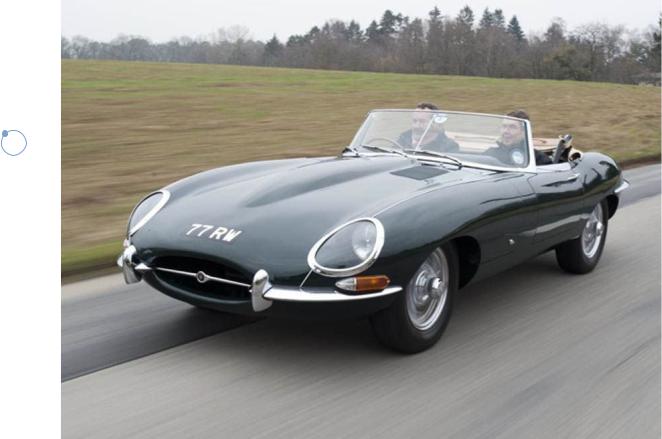
sports car of them all was the Jaguar E-Type (fig. 18).
The E-Type name still has a magical ring to it. When it was first shown to the public at the 1961 Geneva Motor Show, it was nothing short
of sensational. Here was a car, which looked absolutely stunning, a car И
Although it was a direct replacement for the ageing XK150, the E- Type’s name played on the Le Mans winning heritage of its C-Type and D-
Type racing forebears of the 1950s. In style, it certainly bore a striking resemblance to the sleek lines of the D-Type, as both cars were designed by the same man, Malcolm Sayer.
133
С |
|
134 |
|
и |
|
бА |
|
Fig. 18. Jaguar E-Type |
|
There were two models at the launch: an open-topped sports model |
|
|
Д |
and a fixed-head coupe. Both were strict two-seaters, though the coupe was |
|
more practical thanks to its sidehinged rear hatch and long load platform |
|
for luggage. |
|
Unlike the old XK series, the E-Type had no chassis: it was a com- |
|
plex unitary structure with an enormously long bonnet, which hinged for- |
|
|
И |
ward for access. Underneath that bonnet lay the latest incarnation of the fabulous six-cylinder XK engine, first seen in 1948. It had no less than 265 bhp on tap, at that time an extraordinary figure for a 3.8-litre ‘siх’. Jaguar supplied E-Types to motoring magazines for test, determined to reach the magic 150 mph – which the car did, thanks to some rather special high speed tyres. Almost all the rest of the mechanical specification was new. The four-speed gearbox was carried over but much of the rest was developed specially for the Jaguar: double-wishbone front suspension, powerassisted front disc brakes, and rear suspension mounted on a separate subframe.
134

Inside, there was less of the traditional leather-and-wood approach: for instance, owners now just got a moulded plastic dash with aluminium edgings and vinyl door trims.
The buying public went mad for the new E-Type. Demand was so high that used examples were fetching more than new ones. The mania was
Сfuelled when racing drivers such as Roy Salvador, John Coombs and Gra-
135
ham Hill took to the circuits with great success in the early days. The F- Type's best competition record had to wait until 1963, however, when a batch of Lightweight E-Types were made specifically for racing.
changesиthan the slow original.
In 1964, the E-Type was given a 4.2-litre engine and a new gearbox. The engine provided much better torque (though no extra top-end performance), and the all-synchromesh gearbox was much quicker between
Two yearsбАlater came a third E-Type body style -the 2+2. In order to fit an extra pair of children's seats in the rear, the E-Type shell had to be stretched by nine inches and the roof was raised by two inches to create extra head room. The result may not have been aesthetically pleasing but it certainly enhanced the appeal of Jaguar’s sports car range. Another option starting at this time was an automatic gearbox.
In 1968 a much revised Series 2 F-Type was hunched at Earls Court. Most of the changes were to answer new American Federal regulations about lighting and bumper height. Hence, the Series 2 had a new bonnet
had just 171 bhp. Today, purists regardДthe Series 2 as a diluted version of the original E-Type, but the period when it was sold (1968-70) represented the era of the E's greatest popularity.
incorporating uncowled headlamps, which were sited two inches higher, and there were larger, wrap-around bumpers fitted.
There were also new laws about emissions in America, so examples exported to the States began to get modified engines with restricted power
outputs. Home-market cars still had 265 bhp but emissions-restricted ones И
The final development of the E-Type came in 1971, when a brand new V12 engine became standard across the board. This fabulous and size-
able engine was the result of LЗ million of development and featured allaluminium construction, overhead cams on each bank of cylinders and no less than four Stromberg carburettors. Power was up to 272 bhp but more significantly, torque rose to an amazing 304 lb ft A 0-60 mph time of 6.4 seconds was quoted, although in outright performance it was probably no better than the very first and much lighter models.
135