Материал: 2358

AC agreed to try the idea. Amazingly, the Ace’s very simple twintube ladder chassis was retained virtually unchanged, although Girling inboard rear disc brakes and a reinforcing frame for the rear suspension were fitted.
At both ends, lower wishbones were combined with transverse leaf
Сspring upper links and telescopic dampers.
121
Production of the Cobra got underway in 1962. The chassis and lightweight (22.5kg) aluminium body were hand-built by AC in Thames Ditton. Most of the road equipment was then fitted and shipped to Californiaиfor final assembly by Shelby, using Ford engines, close ratio BorgWarner four-speed gearboxes and strengthened drive shafts.
The Cobra first appeared on the Ford stand at the 1962 New York Auto Show, where it caused a sensation, an impact which was reinforced by a numberбА
of high-profile road test reports. Sports Car Graphic described the Cobra as “one of the most impressive production sports cars we've ever driven”, adding that its acceleration was “explosive”. Their official road test recorded the astonishing times of 0-60 mph in 4.1 seconds and the standing 1/4 mile in 12.9 seconds. Those figures can put to shame most current supercars, let alone the sort of machinery which was available in 1962.
The secret of the Cobra’s performance was not a massive power output – it had a ‘mere’ 260 bhp to begin with – but its light weight. The Cobra measured only 151in (384cm)Дlong, so weight was kept down to 20201b (916kg), producing a power-to-weight ratio of 258 bhp per ton – better than the contemporary Ferrari Testa Rossa.
In America, the model was generally known as the Shelby Cobra but European markets always had cars badged as the AC Cobra, and later just AC 289 Sports. The advertising presented it as theИperfect match of British styling and craftsmanship with American power and reliability.
Right from the start, it was offered with competition options for owners who wanted to take their cars racing. Owners could buy roll hoops, racing seats, cut-down windscreen, extra vents and a whole host of engine options. Racers would soon be following in successful footsteps for the Cobra was the first British finisher in the 1963 Le Mans, scored many victories in American SCCA events and met with success in numerous European races.
On the back of its racing pedigree, the Cobra sold well, especially in America. It was actually cheaper than the old Bristol-powered Ace had been, selling for around the same price as the poorer-performing Jaguar E-
121

Type. Shelby was forced to move to bigger premises to cope with the growing demand.
In alliance with Shelby, Ford itself ironed out many of the Cobra's problems. A lot of work went into balancing the chassis. Rack-and-pinion steering replaced the archaic worm-and-roller system. Then Ford offered
СShelby their bigger 289 cu in engine.
122
This was merely a stepping-stone to the ultimate Cobra: the 427 of 1963. Conceived as a giant-killing race-winner, it was essentially a Cobra fitted with a big block 427 cu in (6997cc) V8 from the Ford Galaxie 500. The 271 bhp Cobra 289 was already a performance legend, so the impact of the 425 bhp Cobra 427 was going to be shattering. And that was in standard tune – with the right tuning gear, there was potential for that to go
up to 480 bhp and beyond. |
|
|
бА |
Two examples were completed with Paxton superchargers and |
|
claimed to deliver no less than a frightening 800 bhp. |
|
иTo cope with the extra power, the chassis was completely rede- |
|
signed. The basic ladder frame layout remained but the tubes were far |
|
thicker and the suspension towers were now tubular affairs, not fabricated |
|
sheet metal. |
|
At last, the old leaf spring suspension gave way to coil spring damp- |
|
ers and double wishbones, refined by Ford Engineering to be fully adjusta- |
|
ble. Larger brakes, beefed-up drive shafts and extra cooling completed the |
|
would have clashed with Ford’sДown СТ40. Nevertheless, a SemiCompetition (S/C) model was offered to private buyers as “the fastest production car in the world”, with a top speed of around 165 mph and a 0-60 mph time of 4.0 seconds. One 427 managed to accelerate to 100 mph and back to zero again in just 13.8 seconds.
picture.
The 427 also looked more muscular. Only the bonnet and doors stayed the same - everything else had been pumped up to accommodate
much fatter 8.15in (207mm) tyres.
The 427 did not have much of a competition life, because by 1965 it И
Safety and environmental legislation killed the Cobra in 1968. AC tried to update the concept with the Frua-bodied AC 428 but this did not last long in the fuel crisis of the 1970s.
All types of Cobra are extremely rare and sought after today, with authenticated 427s commanding prices well in excess of £ 150,000. With so few originals ever made, it is hardly surprising that a vast industry has sprung up dedicated to making AC replicas.
122

As well as literally dozens of companies producing fibreglass copies the world over, an official AC Cobra Mk IV has been manufactured from 1953 by Autok-raft, which is the only company legally entitled to use the AC name.
Carroll Shelby himself launched a controversial new Cobra in the |
|
С |
|
1990s, which he said was based on chassis left over from the 1960s. How- |
|
123 |
|
ever, none of the replicas could ever hope to match the raw magic of an |
|
original 1960s Shelby-built Cobra, one of the greatest motoring legends of |
|
all time and certainly one of the most exhilarating. |
|
|
Текст 6 |
|
ALFA SPIDER |
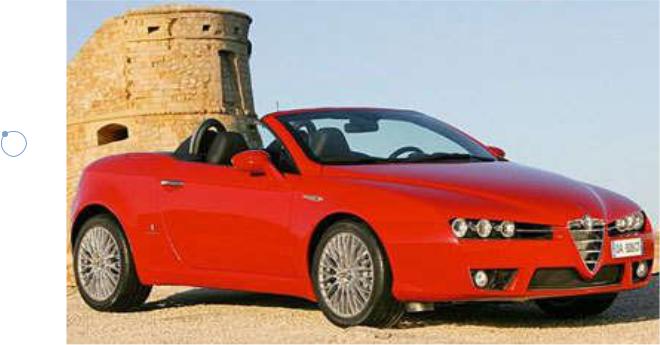
There can be no mistaking an Alfa Romeo Spider (fig. 16). The deli- |
|
бА |
|
cacyиof its lines and its unique character could not have come from any other car-maker. Nor would any other manufacturer ever consider making essentially the same sports car for no less than 27 years. Sports cars are normally a genre reserved for the cutting edge of car design.
The truth is that Alfa Romeo never really needed to replace the Spider. It was always an intensely likeable car and it gained a passionate following of devotees, especially in America. In the early 1980s, when sports cars were almost universally dropped from other car-makers’ price lists, the Alfa Romeo Spider pretty much had the ground all to itself.
The Duetto used the advancedДmechanicals from the Giulia saloon, including the 1570cc engine in its most powerfulИ(109 bhp) twin-carb state-of-tune, plus a five-speed gearbox and all-round disc brakes. It was very advanced for 1966. With its unmistakable long, flat, rounded tail, the Duetto was judged by the motoring press to be an outstanding sports car.
Few people could have realised the little Alfa sports car would become such a classic when it was launched in 1966 as the Duetto (duet), a name selected from hundreds of entries in a nation-wide competition. Alfa
Romeo even gave away a new car to the lucky winner of the contest.
In Britain at least, it was rather too expensive to make much impact, as it cost almost as much as an E-Type Jaguar.
After just one year, the engine was changed for a new 1779cc engine with 118 bhp on tap and the old Duetto name was dropped in favour of the Alfa Romeo 1750 Spider Veloce. In 1968, a short-lived 1300 Spider Junior was also launched, although that model is little-known outside Italy.
123
С124
Visually, the biggest change to the Spider came in 1970 when the car's delicately rounded rump was replaced with a harder and arguably prettier ‘Kamm’ style cut-off tail. A year later the engine was increased in capacity once more, to 1962cc, and output leapt up to a punchy 132 bhp. The early 1970s was undoubtedly the Spider's heyday: it was quicker, pret-
tier and purer than at any other time in its life.
и бАFig. 16. Alfa Spider
drive if wished, but it was alwaysДa marginal product. Then US law decreed that rubber impact bumpers and catalysts had to be fitted. Soon after, in 1952, the Spider’s glorious twin-carb engine was stultified by fuel injection, blunting its power down to a pale 115 bhp.
Then it all fell apart. In Britain, it was decided that converting Spi-
ders to right-hand drive was uneconomic and official imports ceased in 1977. If purchasers were keen enough, they could still buy a Spider
through specialists Bell & Colvill, who would even convert it to right-hand И
In this fashion, the Spider lasted right up until 1990, when Alfa Romeo boldly decided to give the Spider one last lease of life with a major restyle by Pininfarina. The central bodywork remained the same except for some plastic sill covers, but the front and rear ends were heavily revamped. Most significant were the wrap-around body-coloured plastic bumpers front and rear, and the re-shaped boot and rear wings. The engine was modernised with electronic fuel injection, variable valve-timing and a catalytic converter. Inside, the interior was considerably reworked. With this
124

last breath of fresh air, the Spider lasted for two years; Alfa Romeo did not pull the plug on its most coveted model until 1993.
It’s amazing that the Spider proved so long-lived. Pininfarina’s styling was controversial even when the car was new and, by 1970 the influential American magazine, Road & Track, was already describing both the
Сshape and the ergonomics as “outdated”. It always had a bucketful of the
125
usual Alfa quirks, such as the gear lever which sprouted from the dashboard and worked in a near-vertical plane.
Yet the Spider’s appeal was remarkably durable. Spurred on by one of the most celebrated film appearances ever for a car, when Dustin Hoffman swept Katherine Ross off her feet in The Graduate, the American market became the Spider’s mainstay during the bleak 1970s. Around 90 per cent of all Alfa Spiders were sold in the US during this time. From
и 1955, the baseбАmodel Spider was even called the Graduate in America.
Typically Italian in style and in its uncompromising engineering approach, perhaps the Spider’s best point was its silky sweet four-cylinder
twin-cam engines. Like all sports cars, the Spider was a victim of advancing legislation, developing performance-blunting fuel injection and catalysts in response to American demands. It never lost its essential charm though. Indeed, in engineering terms it always remained firmly rooted in the 1960s.
Despite its admirable handling, refinement and ride being overtaken
shortage of enthusiasts who appreciateДthe Spider's finer qualities. There is no shortage of people who remember The Graduate either. The Spider is simply too stylish to avoid being a fashion statement as well as a great sports car.
by other sports cars, the Spider remained convincing. Performance was lively and the sound from the exhaust was distinctively Alfa. There were wonderful design touches and the feel was of a very special car.
That means that it inevitably became a desirable classic. Despite the
oft-repeated stories of rampaging rust and delicate engines, there is no И
With the memory of its legendary Spider still fresh in the mind, Alfa
Romeo presented, in 1994, an all-new Spider. However, it shared only the name with its ancestor, as it was radically different in concept and design. Front-wheel drive is the biggest difference and the new car's modern styling sets the pace for rival sports cars. The new Spider promises a great future for Alfa Romeo’s venerable sports car tradition.
As the company’s 1980s advertising slogan boasted: “The magic lives on...”
125