Материал: 2358

Mairesse at the 1962 Nurburgring 1000km. It finished second but came off at Mulsanne at Le Mans later in the year. Ferrari scored a spectacular success at the 1962 Paris 1000km, occupying the first six places, four of which were GTOs. Many other drivers raced GTOs, including such illustrious names as Graham Hill, Innes Ireland and Roger Penske.
СNot only was the GTO a racing success, it could also be used on the
116
road. As expected, handling and raw performance were exemplary. Car enthusiasts might not, however, have expected it to be a tractable and usable machine, especially in town – but it was.
theиway ahead: its potential for ultimate handling balance tended to place it ahead of the GTO. The new car would effectively have rendered the GTO obsolete immediately, but racing officials refused to sanction it because too few had been made to satisfy homologation.
The downside (from the point of view of someone wanting to use it as a road car) was difficult braking, uncomfortable accommodation,
droughts and the sheer level of noise.
The 250GTO was the last of a long line of great front-engined racing
Ferraris. ByбА1963, the mid-engined 250LM had arrived and would show
There were also several ‘pseudo’ GTOs, such as the ‘bread vans’ built by Piero Drogo and Giotto Biz-zarrini, and Count Volpi's converted 250GT, which did battle with genuine GTOs on the track. They had little success.
Today the really fanatical FerrariДcollector simply must have a GTO in his or her garage. However, that person will certainly need to be extraordinarily rich: the going price for a 250GTO is around the L2.5 million mark. For that a car enthusiast could buy seven brand-new Ferrari F50s. In Britain, several music business personalities have bought GTOs, though the cars are very seldom seen in public because ofИtheir stratospheric value.
One side-effect of this situation has been the widespread replication of the GTO. Quite a few standard 250GT Ferraris have been butchered over the years to make replicas. Some have even been passed off as original; a process encouraged by the confusion over chassis numbers. More recently (in 1984), the GTO name was revived for another very special homologation car, the mid-engined 288GTO – but that, as they say, is another story.
116

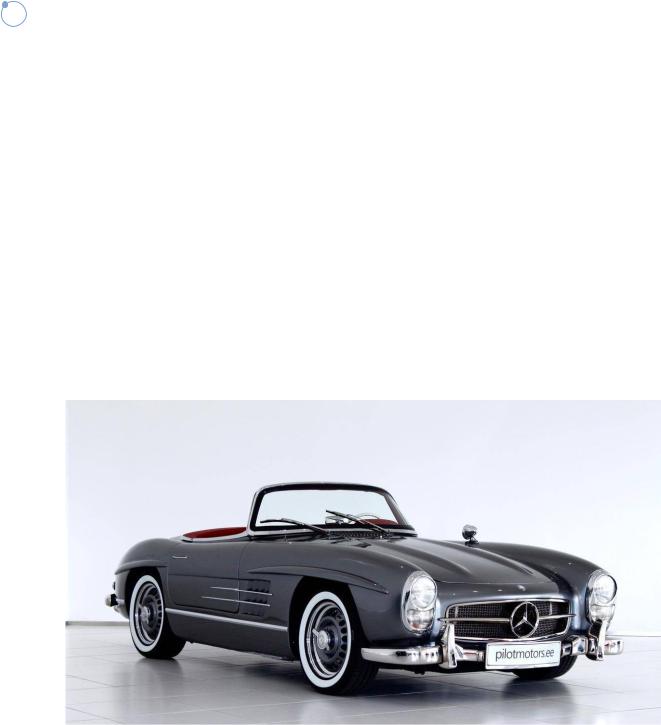
Текст 4 MERCEDES-BENZ 300SL
Since Karl Benz’s first bold experiment with internal combustion in 1885, Mercedes-Benz (fig. 14) has maintained an eminence in the motoring world. The name is synonymous with quality, power and fine sporting
Сtradition.
117
Perhaps the last great sporting era for Mercedes-Benz began with the 300SL... and the 300SL began with the gigantic Mercedes-Benz 300 sa-
loon, launched in 1951. This top-class range of cars used a six-cylinder, 3.0-litre, overhead-cam engine with an alloy head and twin carburettors, plus such advanced features as an all-synchromesh gearbox, hypoid drive (the first German car to have this) and independent rear suspension.
и sporting modelбАon. Engineer Rudolf Uhlenhaut realised that, if he used the
It was a natural choice for Mercedes-Benz engineers to base a new
basic mechanicals in a space frame chassis of the type being used by Aston Martin, Jaguar and Cisitalia, he could have a competitive racing car. And so the W194 project began.
The chassis took form of two large cross-members joined by a lattice of smaller steel tubes. To achieve the necessary stiffness, the tubes had to run beside the cockpit and it was this factor which gave rise to the gullwing doors of the 300SL. A stressed aluminium body was designed by Karl Wilfert around the space frame. It was a coupe because this body type was believed to give the best aerodynamics.
Surprisingly, the new racing coupe was given drum brakes, not discs. The 3.0-litre engine had to be inclined at 50 degrees to fit within the complex lattice of tubes, a new cylinder head was designed and dry sumping
was used. There were also three carburettors, an uprated camshaft and a |
|
|
И |
new exhaust, the net result was an output of 171 bhp which was very im- |
|
pressive for its day. |
Д |
Mercedes-Benz’s larger-than-life racing director Hans Neubauer didn't like the prototype and insisted that more power, better brakes and a five-speed gearbox should be fitted. Thus Mercedes-Benz re-entered sports car racing. With Rudi Caracciola, Karl Kling and Hermann Lang at the wheel, the team attacked the 1952 Mille Miglia. Kling came in second behind Giovanni Bracco’s Ferrari V12. However, at the next race, the Swiss Grand Prix, the 300SL scored a memorable 1-2-3 victory. This was followed by a convincing 1-2 at Le Mans.
For the 1952 Nurburgring race, Mercedes-Benz chopped the top off three 300SL coupes to create racing roadsters. Not surprisingly the all-
117

conquering Mercedes team stormed to victory with another 1-2-3 result and Lang led the trio home. The only other race run by 300SL was the gruelling Carrera Panamericana in Mexico. This yielded yet another victory for Kling and Mercedes, with Land in second place. Mercedes-Benz would not race in 1953, officially because they had learned all they needed to
Сknow.
118
After this crushingly successful competition record, the road-going version was eagerly awaited. It might never have happened had not the American Mercedes-Benz importer, Max Hoffmann, place an advance order for 1,000 cars.
и The 3.0-litreбАengine's power and torque rose significantly and it was given
Some modifications were made: the body was substantially redesigned by Paul Bracq to become more aerodynamic and steel became the main material of construction (except for a run of 29 all-aluminium cars).
Bosch fuel-injection – a pioneering step.
The suspension was modified to cure oversteer caused by the swingaxle rear, recirculating ball steering replaced the old warm-and-nut system arid proper heating was installed (though ventilation would always be a problem with the Gullwing).
The new 300SL made its debut at the 1954 New York International Motor Show. It caused a considerable stir with its amazing gullwing doors, dramatic lines and advanced specification. There was no shortage of flap-
awkward, the gullwing doors irksomeДto open, luggage space rather restricted and ventilation poor. Driving it required great skill, as it would snake as the driver floored the throttle and it still had a propensity for oversteering.
ping cheque books at the show, despite the exorbitant price being charged.
With some 215 bph on tap, and up to 240 bph with the right modifications, the new Mercedes could do an amazing 145-160 mph depending
on rear axle ratio, and reach 60 mph from rest in a little over 8 seconds.
The 300SL was by no means perfect: entry and exit was decidedly И
Although Mercedes-Benz never fielded official 300SL racers, it sup-
ported private owners. These often had great success, like Fitch and Gendebien’s class win in the Mille Maglia, Tak’s victory in the Tulip Rally and Engel’s European Touring Car Championship.
There was also a spin-off of the 300SL, the 300LR, which was conceived to compete in Grand Prix racing. Stirling Moss drove the 300LR in its debut race at the 1955 Mille Miglia, winning after a punishing ten-hour drive. At Le Mans, Levegh’s 300LR plunged into the crowd with devastat-
118
ing results, leading to the team withdrawing from the event. MercedesBenz won the 1955 World Sports Car Championship.
A Roadster version had always been planned but, when it arrived in 1957, it replaced the Coupe rather than supplementing it. The claustrophobic and impractical Gullwing was frankly unsuited to American tastes and
Сclimate and, after all, Californians did buy most of the 1,371 Coupes made.
119
The Roadster debuted at the 1957 Geneva Salon. It had a proper folding hood which disappeared into boot and the novelty of winding windows.
The gullwings were replaced by conventionally-opening doors. Suspension modifications improved handling, the headlamps were restyled and the engine now developed between 225 bph and 250 bph. A removable hard top was offered from 1958 and four-week disc brakes were standardised in 1961. By the time 300SL Roadster production ceased in 1963, Mercedes-
apparentиin the cheaper 190SL, made from 1954-63. This had only 105 bph available however, and was more of a boulevard cruiser than a true sports car.
Benz had builtбА1,858 of them. Some of the Roadster’s reflected glory was
There are few examples of a classic car, which is worth more in a closed coupe from than it is in convertible form. The Mercedes-Benz 300SL Gullwing is such a car. Its awe-inspiring presence guarantees a
premium over the more effete Roadster. The magic, which it cannot fail to weave on all who set eyes on it, continues today and examples can fetch
extraordinarily sums. |
Д |
|
|
|
И |
Fig. 14. Mercedes-Benz 300SL
119
Текст 5 AC COBRA
Cobra... The very name conjures up images of awesome performance, evocatively-shaped haunches, a blistering soundtrack and a whiteknuckle ride. It is, in short, a legend.
СHow can a car which was in production for a mere five years, and
120
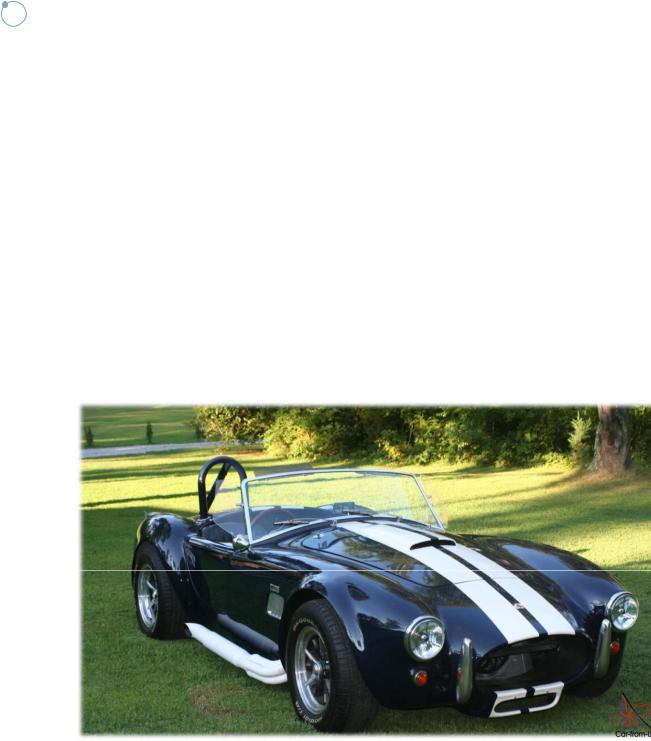
which sold only around 1,000 examples, achieve such legendary status? The story is all the more remarkable considering the Cobra (fig. 15) grew out of a not particularly exceptional sports car, made by a tiny English firm byиthe name of AC, and its combination of a frail-looking ladder chassis and a brutish V8 power plant that was hardly subtle.
One name provides the answer: that of a larger-than-life Texan racer and chicken farmer called Carroll Shelby. It was he who had the vision to mate the ACбАAce sports car with an American Ford V8 engine and it was Shelby who actually screwed the cars together in his racing workshops in Santa Fe, California.
Shelby had heard that AC’s engine supplier, Bristol, was stopping making the 2.0-litre engines used In the Ace sports car. He got in touch with AC Cars of Thames Ditton, Surrey, in 1961 with a suggestion: How about using an American-made engine in the form of a 260 cu in (4260cc) V8 unit from a Ford Fair-lane? The idea of purring an American V8 engine in a European sports car was not new but no one had dared to approach the heights to which the Cobra would ascend.Д
И
Fig. 15. AC Cobra
120