Материал: 2358
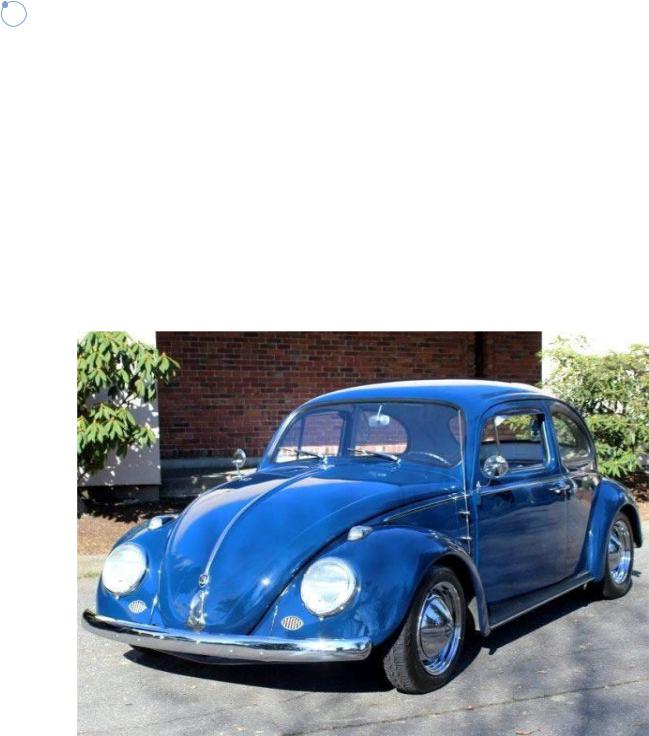
Текст 7 VOLKSWAGEN BEETLE
No other car in history has mobilised more people than the Volkswagen Beetle (fig. 17) – and yet it almost never made it into production. When the Allied Forces evaluated the prototypes at the end of World
СWar II, it was considered too crude, ugly and underdeveloped for produc-
126
tion. Sir William Rootes even said that it “does not meet the fundamental requirements of a motor car”. Necessity prevailed and the Volkswagen – or People’s Car – was given life.
и saving stampsбАscheme. Two prototypes were completed by October 1936
The Beetle’s origins can be traced back to 1934, when Ferdinand Porsche began work on Adolf Hitler's dream of a Volksauto. This was to be a four-seater, air-cooled car to cost less than DM1000 (around £50/$250). However, the car couldn't be bought for cash, only through a
and, after further development, a factory was opened in 1938 to build the ‘Kraft-durch-Freude Wagen’ – the “Strength through Joy” car. Production never really began, since the war required that the factory was turned over
to making the Kubelwagen – a military vehicle with the same mechanical basics.
Д И
Fig. 17. Volkswagen Beetle
126

After the war, Major Ivan Hirst was given the task of rebuilding the factory, which had been destroyed by Allied bombing. Among the ruins was found the remains of a KdF Wagen. The military advised that this should be produced
as a means of supplying local light transport. So a production line was set
Сup – in appalling conditions at first – and supplies flowed to all of the oc-
127
cupying forces.
It was felt that the Volkswagen, as it was now called, stood a chance
as a regular production car -it was cheap and simple, ideal for those austere post-war years. Exports to France and Russia began in 1946 and civilian orders were being fulfilled within two years. British control was handed over in 1949 and VW became a manufacturer in its own right.
severeиGerman winters. Unusually for the time, it had four-wheel independent suspension by torsion bars. The simple steel bodywork bolted on top and because of its shape, it was nicknamed the ‘Beetle’ by the Americans.
The basis of the Volkswagen was a backbone chassis/platform with a rear-mounted,бА1131cc, fiat-four engine, which was air-cooled to cope with
The early Volkswagens had split rear windows and very austere trim with no chromework. Export models were slightly more luxurious and technically more sophisticated. Early ‘split window’ Beetles are now treasured collectors’ pieces.
one hand. Hebmuller never really recoveredДfrom a serious factory tire in the year of its launch (1949). It suffered financial problems and production ground to a halt after only 696 had been built.
No Beetle is more highly prized than the convertible. Volkswagen sanctioned only two official conversions. The first was a 2+2 version, manufactured by Hebmuller. The sills, bulkhead and rear were all strength-
ened, so it felt very rigid. The original windscreen was retained, though the
side windows and engine lid were new, and the hood could be raised with И
The second convertible Beetle was a full fourseater, created by Karmann of Osnabruck, which became the definitive item. Rigidity was
addressed by adding members under the sills and around the doors, which pushed the weight up by 901b (40kg). Externally it was identical to a Beetle below the waist (except for re-positioned semaphore indicators) but there were new winding front and rear windows and an elegant fabric hood with glass rear window, which grew larger as the years passed. The hood stacked up high behind rear seats. Production of the Karmann Cabriolet ceased as late as 1980.
127

The first major change to the saloon occurred in 1953, when the rear window became oval-shaped and the engine increased in size to 1192cc, pushing power up from 25 bhp to 30 bhp. The Beetle got into its stride from now on, becoming the definitive ‘people's car’ of Germany – and the world – notching up million after million sales, pouring out of factories
Сacross the globe.
128
By the time the rear window changed again to its more familiar rectangular shape in 1957, sales in America were soaring. They were up to
64,000 that year and eventually peaked in 1970 at over 582,000 units. The Beetle'sиsuccess was partly spurred on by an inventive advertisement campaign which played on the contrast of the Beetle’s unchanging appearance versus Detroit's chaotic annual revisions. The Beetle was also widely viewed as the most reliable car around.
GraduallyбАthings became a little more sophisticated, as the engines grew in size, the gearbox gained synchromesh, automatic transmission became optional and the improved 1302 Beetle came on stream. Volkswagen, however, never lost sight of the attributes which endeared it to its owners: simplicity, value and reliability. Instead it created more up-market variants on the same basic floorpan like Karmann-Ghia’s lovely coupe, a 1500 saloon and the 411 range.
On 17 February 1972, the Beetle passed the magic milestone of 15,007,034 units produced, overtaking the record set by the Ford Model T.
That made it the most popular tar inДhistory and its total is unlikely to be exceeded by any other single model. The Toyota Corolla’s claim to have caught the Beetle is only believable if all the very different versions of the Japanese car are added together.
Even after German production ceased in January 1978, the Beetle continued to be made at factories in countriesИlike Brazil and Mexico, where Beetles are still being churned out at the rate of almost 500 a day. The current total exceeds a staggering 21 million cars.
The popularity of the Beetle has never waned. It is still viewed with tremendous affection and owners are often loyal to the point of fanaticism. This is reflected in fairly high prices for Beetles sold as classics, especially the convertibles.
The Beetle also sired a whole series of crazes. The first of these was the American fad for racing off-road. A wide variety of ‘sand rails’ were built in the late 1950s and early 1960s, and a sub-culture of performance tuning parts sprang up. This in turn led to the great dune buggy explosion, ignited when Bruce Meyers put a fibreglass body tub on a Beetle floorpan.
128

Hundreds of firms sprang up overnight to supply an insatiable desire for ‘Beach Buggy’ machines.
More recently, there has been a craze for customising. Young people attracted by the Beetle’s time-less lines often spend large sums subtly evolving their cars.
СFor instance, ‘Cal-Look’ Beetles smoothed out the lines, lowered the
129
suspension and added wild and gaudy paint schemes.
There is a strong case for naming the VW Beetle as ‘Car of the Cen-
tury’ – indeed a panel German motoring journalists has already done so. It has brought affordable and reliable motoring to countless millions, not just in its home market, but in the United States, Australia, South America, Africa and across the rest of the entire globe and it will continue do so for some time to come.
и бАТекст 8
VOLKSWAGEN PASSAT
“It’s our most important new model since the Golf II,” Michael Heelas, managing director of Audi Volkswagen in U.K. told me at the press launch of the-new Passat-in the south of France our volume car for the 90s. - “It will move Volkswagen further up-market, to area's it has not been in before.”
Previous Passats had the engine arranged longitudinally. In the new one it has been turned round positioned transversely to make better use of length, as in so many other cars these days. All engines are four-cylinder. For Britain, all are 1781 c.c. Huge boot space and ample rear-seat legroom
have resulted from reacting the long coil-sprung struts of the trailing arms |
|
rear suspension against the outer corners of the parcel shelf behind the rear |
|
|
И |
seats. For the estate car, however, this tall strut mounting requires towers |
|
that do intrude on the load-space. |
Д |
To reduce sideways deflection of the trailing arms when cornering the rubber bushes in the pivots have flared conical ends with rubber concentrated in diagonally opposed lumps to provide stiffer resistance against the sideways leverage. This careful bit of detail design is to diminish rearinduced oversteer without the expense and space occupation of a pan hard rod.
The Germans, anxious to minimise the effect of catalyser talk about it taking only about 5 per cent of the power output. The difference feels actually more like 15 per cent. The first Passat was with 2-litre 16-valve engine, and it certainly did not offer the sort of sparkling performance one
129

expects of such development The non-catalyser was with l.8-litre GL with simple Mono-Jetronic fuel injection into the inlet manifold centre and with just two valves per cylinder, yet it seemed to respond every bit as well as the more powerful model with four valves per cylinder.
Significant, too, is the fact that the British market will take the 16-
Сvalve engine in 1.8-litre form, without catalyser, and it will give the same
130
136 h.p. as the West Germans’ cleaned-exhaust 2-litre 16-valver.
As is the fashion, oil engines for the new Passat have fuel injection,
and the three different systems that are used all work well. Between the cheap system, fitted in the CL and GL, and the expensive one for the 16valve GT, there is an intermediate version of the GT with Digifant injection, giving 112 h.p.
и One might wellбАgroan, on hearing that, if one can remember cars like the
A new feature of the Passat is that the gearchange is cable-operated.
Austin Maxi, in which the cable gearchange was imprecise, stiff and trouble; but the Passat application behaves quite satisfactorily, when new, anyway. It has a light action, and an exceptionally narrow gate, with very small separation between first-second and third-fourth planes of movement.
The seats of the Passat are comfortable, with lever-operated height adjustment – although this alters the angle of the cushion – that’s why good visibility is ensured, scuttle line is fairly low and a windscreen well swept by the wipers which park at the base of the screen.
stead of water valve. Д
Instrumentation is plain, but clear and the curved nacelle in front of the driver includes three ventilation outlets, while the radio cassette unit is
mounted sensibly high up at the top of the console.
Ventilation is regulated by rotary controls. Much sales talk is spouted
by Volkswagen about its adoption of air blending temperature control in- И
The inlet for the ventilation and heating system is taken from a well at the back of the engine bay, sealed from the engine fumes when the bonnet is down, but without any visible inlet grille.
Volkswagen claims a drag factor of 0.29 for the new Passat, to which
no doubt the very neat flush glazing of the windows contributes. GT versions pet a spoiler on the boot lid.
Only two body styles are being offered, saloon and estate car: so there is no hatchback, as there was for the previous Passat. Not just the front seats, but the rear seats too adjust longitudinally and for backrest angle. Consequently, this must certainly be one of the most comfortable me- dium-range cars for rear seat passengers.
130