Материал: 2096
to more than a dozen litres. Many modern advances, including gas/electric hybrids, multi–valve engines, overhead camshafts, and four–wheel drive, were attempted, and discarded at this time.
In My Merry Oldsmobile songbook featuring an Oldsmobile Curved Dash automobile (produced 1901–1907) and period driving clothing
By 1900, it was possible to talk about a national automotive industry in many countries, including Belgium (home to Vincke, which copied Benz; СGermain, a pseudo–Panhard; and Linon and Nagant, both based on the Gobron– Brillié, Switzerland (led by Fritz Henriod, Rudolf Egg, Saurer, Johann Weber, and Lorenz Popp), Vagnfabrik AB in Sweden, Hammel (by A. F. Hammel and H. U.
Johansen at Copenhagen, in Denmark, beginning around 1886), Irgens (starting in иBergen, Norway, in 1883, but without success), Italy (where FIAT started in 1899), and as far afield as Australia (where Pioneer set up shop in 1898 (with an already archaic paraffin–fuelled centre–pivot–steered wagon). Meanwhile, the export trade had begun to be global, with Koch exporting cars and trucks from Paris to Tunisia, Egypt, Iran,бand the Dutch East Indies.
Innovation was rapid and rampant, with no clear standards for basic vehicle architectures, body styles, construction materials, or controls. Many veteran cars use a tiller, rather than a wheel for steering, for example, and most operated at a single speed. Chain drive was dominant over the modern drive shaft, and closed bodies were extremelyАrare.
On 5 November 1895, George B. Selden was granted a United States patent for a two–stroke automobile engine (U.S. Patent 549,160). This patent did more to hinder than encourage development of autos in the USA. Selden licensed his patent to most major American auto makers, collecting a fee on every car they produced. The Studebaker brothers, having Дbecome the world's leading manufacturers of horse–drawn vehicles, made a transition to electric automobiles in 1902, and gasoline engines in 1904, but they continued to build horse–drawn vehicles until 1919. In 1908, the first South American automobile was built in Peru, the Grieve.
Throughout the veteran car era, however, automobiles were seen as more of a novelty than a genuinely useful device. BreakdownsИwere frequent, fuel was difficult to obtain, roads suitable for travelling were scarce, and rapid innovation meant that a year–old car was nearly worthless. Major breakthroughs in proving the usefulness of the automobile came with the historic long–distance drive of Bertha Benz in 1888, when she traveled more than 80 kilometres (50 mi) from Mannheim to Pforzheim, to make people aware of the potential of the vehicles her husband, Karl Benz, manufactured, and after Horatio Nelson Jackson's successful trans–continental drive across the United States in 1903.
46
BRASS OR EDWARDIAN ERA
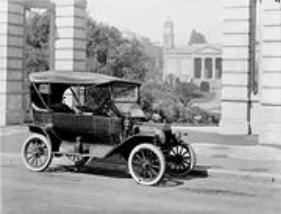
СT–model Ford car parked outside Geelong Library at its launch in Australia in 1915
и in 1914. 1905бwas a signal year the development of the automobile, marking the
Named for the widespread use of brass in the United States, the Brass, or
Edwardian era lasted from roughly 1905 through to the beginning of World War I
point when the majority of sales shifted from the hobbyist and enthusiast to the average user.
Within the 15 years that make up the Brass or Edwardian era, the various experimental designsАand alternate power systems would be marginalised. Although the modern touring car had been invented earlier, it was not until Panhard et Levassor's Système Panhard was widely licensed and adopted that recognisable and standardised automobiles were created. This system specified
front–engined, rear–wheel drive internal combustion engined cars with a sliding gear transmission. Traditional coach–styleДvehicles were rapidly abandoned, and
buckboard runabouts lost favour with the introduction of tonneaus, and other less– expensive touring bodies.
Throughout this era, development of automotive technology was rapid, due in part to a huge number (hundreds) of small manufacturers all competing to gain the world's attention. Key developments includedИelectric ignition system (by Robert Bosch, 1903), independent suspension, and four–wheel brakes (by the Arrol–Johnston Company of Scotland in 1909). Leaf springs were widely used for suspension, though many other systems were still in use, with angle steel taking over from armored wood as the frame material of choice. Transmissions and throttle controls were widely adopted, allowing a variety of cruising speeds, though vehicles generally still had discrete speed settings, rather than the infinitely variable system familiar in cars of later eras.
Between 1907 and 1912 in the United States, the high–wheel motor buggy (resembling the horse buggy of before 1900) was in its heyday, with over seventy– five makers including Holsman (Chicago), IHC (Chicago), and Sears (which sold via catalog); the high–wheeler would be killed by the Model T.
Some examples of cars of the period included the following:
47
1908–1927 Ford Model T — the most widely produced and available car of the era. It used a planetary transmission, and had a pedal–based control system.
1910 Mercer Raceabout — regarded as one of the first sports cars, the Raceabout expressed the exuberance of the driving public, as did the similarly–conceived American Underslung and Hispano–Suiza Alphonso.
1910–1920 Bugatti Type 13 — a notable racing and touring model with advanced engineering and design. Similar models were the Types 15, 17, 22, and 23.
С |
VINTAGE ERA |
|
|
и |
|
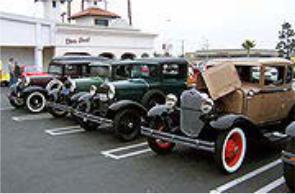
1926 Austin 7 Box saloon, Lineup of Ford Model |
|
Theбvintage era lasted from the end of World War I (1919), through the Wall Street Crash at the end of 1929. During this period, the front–engined car came to dominate, with closed bodies and standardised controls becoming the norm. In
1919, 90% of cars sold were open; by 1929, 90% were closed. Development of the internal combustion engine continued at a rapid pace, with multi–valve and
1922–1939 Austin 7 — the Austin Seven was one of the most widely copied
overhead camshaft engines produced at the high end, and V8, V12, and even V16 |
|
А |
|
engines conceived for the ultra–rich. |
|
Exemplary vintage vehicles: |
Д |
|
|
vehicles ever, serving as a template for cars around the world, from BMW to |
|
Nissan. |
И |
|
|
1924–1929 Bugatti Type 35 — the Type 35 was one of the most successful racing cars of all time, with over 1,000 victories in five years.
1922–1931 Lancia Lambda — very advanced car for the time, first car to feature a load–bearing monocoque–type body and independent suspension in front. 1925–1928 Hanomag 2 / 10 PS — early example of envelope styling, without separate fenders (wings) and running boards.
1927–1931 Ford Model A — after keeping the brass era Model T in production for too long, Ford broke from the past by restarting its model series with the 1927 Model A. More than 4 million were produced, making it the best–selling model of the era.
1930 Cadillac V–16 — developed at the height of the vintage era, the V16– powered Cadillac would join Bugatti's Royale as the most legendary ultra–luxury cars of the era.
48
СThe pre–war part of the classic era began with the Great Depression in 1930, and ended with the recovery after World War II, commonly placed at 1948. It was иin this period that integrated fenders and fully–closed bodies began to dominate sales, with the new saloon/sedan body style even incorporating a trunk or boot at the rear for storage. The old open–top runabouts, phaetons and touring cars were phased out by the end of the classic era as wings, running boards, and headlights were gradually integrated with the body of the car.
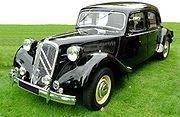
Citroën Traction Avant
by André бCitroën with the launch of the Traction Avant in 1934, though it had appeared several years earlier in road cars made by Alvis and Cord, and in racing cars by Miller (and may have appeared as early as 1897). After 1930, the number of auto manufacturers declined sharply as the industry consolidated and matured.
By the 1930s, most of the mechanical technology used in today's automobiles had been invented, although some things were later « re–invented», and credited to someone else. For example, front–wheel drive was re–introduced
Exemplary pre–war automobiles:
1932–1939 Alvis Speed 20 and Speed 25 — the first cars with all–synchromesh
gearbox. |
А |
|
|
1932–1948 Ford V–8 — introduction of the powerful Flathead V8 in mainstream |
|
vehicles, setting new performance and efficiency standards. |
|
1934–1940 Bugatti Type 57 — a singular high–tech, refined automobile for the |
|
wealthy. |
Д |
|
И |
1934–1956 Citroën Traction Avant — the first mass–produced front–wheel drive car, built with monocoque techniques.
1936–1955 MG T series — sports cars with youth appeal at an affordable price. 1938–2003 Volkswagen Beetle — a design for efficiency and low price, which progressed over 60 years with minimal basic change.
1936–1939 Rolls–Royce Phantom III — V12 engined pinnacle of pre–war engineering, with technological advances not seen in most other manufacturers until the 1960s. Superior performance and quality.
49
POST–WAR ERA
СAutomobile design finally emerged from the shadow of World War II in 1949, the year that in the United States saw the introduction of high–compression иV8 engines and modern bodies from General Motors' Oldsmobile and Cadillac brands. The unibody/strut–suspended 1951 Ford Consul joined the 1948 Morris Minor and 1949 Rover P4 in waking up the automobile market in the United Kingdom. In Italy, Enzo Ferrari was beginning his 250 series, just as Lancia
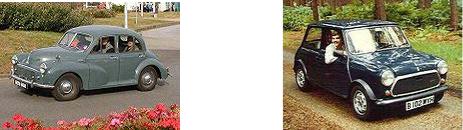
1953 Morris Minor Series II
car class putбJapan on wheels for the first time. The legendary Volkswagen Beetle survived Hitler's GermanyАto shake up the small–car market in the Americas. Ultra luxury, exemplified in America by the Cadillac Eldorado Brougham, reappeared
introduced the revolutionary V6–powered Aurelia.
Throughout the 1950s, engine power and vehicle speeds rose, designs
became more integrated and artful, and cars spread across the world. Alec
Issigonis' Mini and Fiat's 500 diminutive cars swept Europe, while the similar kei
after a long absence, and grand tourers (GT), like the Ferrari Americas, swept across Europe.
Japan appeared as a serious car–producing nation. General Motors, Chrysler, and
The market changed somewhat in the 1960s, as Detroit began to worry about foreign competition, the EuropeanДmakers adopted ever–higher technology, and
Ford tried radical small cars, like the GM A–bodies, but had little success. Captive
imports and badge engineering swept through the US and UK as conglomerates
like the British Motor Corporation consolidated the market. BMC's revolutionary space–saving Mini, which first appeared in 1959,Иcaptured large sales world–wide.
Minis were marketed under the Austin and Morris names, until Mini became a marque in its own right in 1969. The trend for corporate consolidation reached Italy as niche makers like Maserati, Ferrari, and Lancia were acquired by larger companies. By the end of the decade, the number of automobile marques had been greatly reduced.
In America, performance became a prime focus of marketing, exemplified by pony cars and muscle cars. In 1964 the Ford popular Mustang appeared. In 1967, Chevrolet released the Camaro to compete with the Mustang. But everything changed in the 1970s as the 1973 oil crisis, automobile emissions control rules, Japanese and European imports, and stagnant innovation wreaked havoc on the American industry. Throughout the decade, small imported cars outsold large American ones. Small performance cars from BMW, Toyota, and Nissan took the place of big-engined cars from America and Italy.
50