Материал: 2096
Based on the analysis, authors will be ready to offer a solution (or solutions) to the business problem they have been studying. There needs to exist a relationship between the business problem, analysis and subsequent outcomes that arises from the evidence. This chain of reasoning will support the development of appropriate business strategies which involves the matching of the strength of the business with available opportunities. To do this effectively, the entrepreneur needs to collect, analyze and understand information about business environment.
СFrom this information and often through the fuzzy process of rationalizing the Business concept (or business problem) against the market research findings, business strategies are born. This process is enhanced if the entrepreneur (author) already has a clear understanding of the mission, goals and objectives of the start– up business. The development of the business strategies must be based on commercial fact rather than entrepreneurial fiction.
Questions: |
|
|
|
1. |
б |
||
What is the aim of business research and analysis? |
|||
2. |
Why should we understand the target market? |
||
и3. What are the sources of a critique of information that will support |
|||
|
communication concerning the viability of the proposed business? |
||
4. |
What kind of relation exists between the research and subsequent |
||
|
outcome? |
А |
|
|
|
|
|
5. |
What do we need to do to achieve the best solutions (results) from the |
||
|
report (research)? |
|
|
|
|
Section B. Car classification |
|
Reading |
|
Д |
|
|
|
||
1. |
What do you know about early automobiles? |
||
2. |
What is the target market of historical classification of the cars? |
||
3. |
What is the target audience of the report devoted to it? |
||
4. |
What kind of solutions can be done from this type of information? |
||
5. |
Where can it be used? |
И |
|
|
|||
6. |
Read the text and advise your own historical classification. |
||
STEAM AUTOMOBILES
Ferdinand Verbiest, a member of a Jesuit mission in China, built the first steam–powered vehicle around 1672, designed as a toy for the Chinese Emperor, it being of small scale and unable to carry a driver or passenger but, quite possibly, the first working steam–powered vehicle ('auto–mobile').
Steam–powered self–propelled vehicles are thought to have been devised in the late 18th century. Nicolas–Joseph Cugnot demonstrated his fardier à vapeur, an experimental steam–driven artillery tractor, in 1770 and 1771. Cugnot's design proved to be impractical and his invention was not developed in his native France, the centre of innovation passing to Great Britain. By 1784, William Murdoch had built a working model of a steam carriage in Redruth, and in 1801 Richard
41
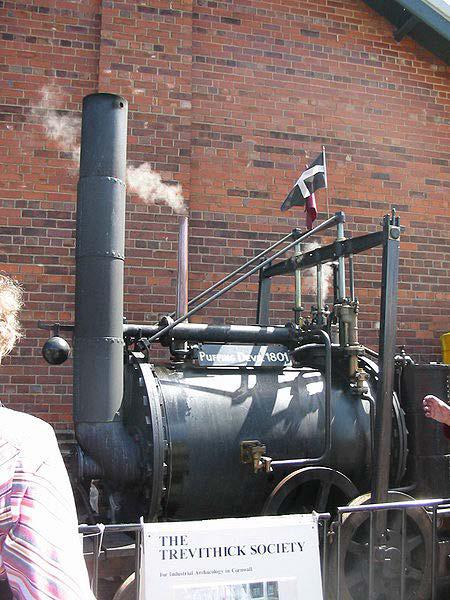
Trevithick was running a full–sized vehicle on the road in Camborne. Such vehicles were in vogue for a time, and over the next decades such innovations as hand brakes, multi–speed transmissions, and better steering developed.
Си б А Д A replica of Richard Trevithick's 1801 road locomotiveИ'Puffing Devil'
Some were commercially successful in providing mass transit, until a backlash against these large speedy vehicles resulted in passing a law, the Locomotive Act, in 1865 requiring self–propelled vehicles on public roads in the United Kingdom be preceded by a man on foot waving a red flag and blowing a horn. This effectively killed road auto development in the UK for most of the rest of the 19th century, as inventors and engineers shifted their efforts to improvements in railway locomotives. The law was not repealed until 1896, although the need for the red flag was removed in 1878.
In Russia in the 1780s, Ivan Kulibin started working on a human–pedalled carriage with a steam engine. He finished working on it in 1791. Some of its features included a flywheel, brake, gearbox, and bearing, which are also the
42
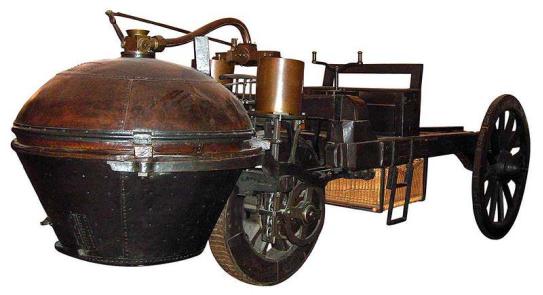
СиCugnot's steam wagon, the second (1771) version
features ofбa modern automobile. His design had three roadwheels. Unfortunately, as with many of his inventions, the government failed to see the potential market and it was not developed further.
The first automobile patent in the United States was granted to Oliver Evans in 1789. In 1805, EvansАdemonstrated his first successful self–propelled vehicle, which not only was the first automobile in the USA, but was also the first amphibious vehicle, as his steam–powered vehicle was able to travel on roadwheels on land, and via a paddle wheel in the water.
Among other efforts, in 1815, a professor at Prague Polytechnic, Josef Bozek, built an oil–fired steam carДand Walter Hancock, builder and operator of London steam buses, in 1838 built a four–seat steam.
ELECTRIC AUTOMOBILES
In 1838, Scotsman Robert Davidson built an electric locomotive that attained a speed of 4 miles per hour (6 km/h). In England, a patent was granted in 1840 for the use of rail tracks as conductorsИof electric current, and similar American patents were issued to Lilley and Colten in 1847. Between 1832 and 1839 (the exact year is uncertain), Robert Anderson of Scotland invented the first crude electric carriage, powered by non–rechargeable primary cells.
Early attempts at making and using internal combustion engines were hampered by the lack of suitable fuels, particularly liquids, and the earliest engines used gas mixtures. Early experimenters using gasses included, in 1806, Swiss engineer François Isaac de Rivaz who built an internal combustion engine powered by a hydrogen and oxygen mixture, and in 1826, Englishman Samuel Brown who
43
Си
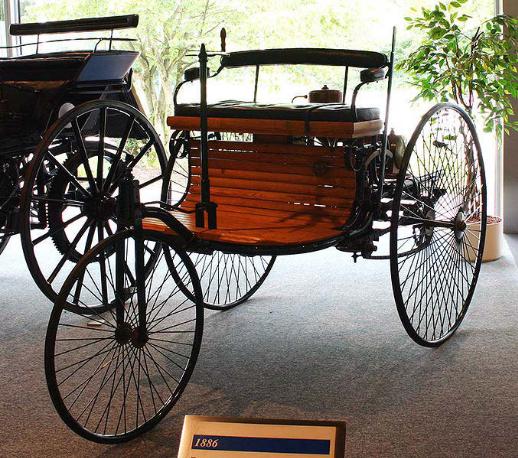
б1885–builtАBenz Patent Motorwagen, the first car
to go into production with an internal combustion engine
tested his hydrogen–fuelled internal combustion engine by using it to propel a vehicle up Shooter's Hill in southДeast London. Belgian–born Etienne Lenoir's Hippomobile with a hydrogen gas–fuelled one–cylinder internal combustion engine made a test drive from Paris to Joinville–le–Pont in 1860, covering some nine kilometres in about three hours. A later version was propelled by coal gas. A Delamare–Deboutteville vehicle was patented and trialled in 1884.
About 1870, in Vienna, Austria (then Иthe Austro–Hungarian Empire), inventor Siegfried Marcus put a liquid–fueled internal combustion engine on a simple handcart which made him the first man to propel a vehicle by means of gasoline. Today, this car is known as « the first Marcus car». In 1883, Marcus secured a German patent for a low–voltage ignition system of the magneto type; this was his only automotive patent. This design was used for all further engines, and the four–seat « second Marcus car» of 1888/89. This ignition, in conjunction with the « rotating–brush carburetor», made the second car's design very innovative.
It is generally acknowledged that the first really practical automobiles with petrol/gasoline–powered internal combustion engines were completed almost simultaneously by several German inventors working independently: Karl Benz built his first automobile in 1885 in Mannheim. Benz was granted a patent for his automobile on 29 January 1886, and began the first production of automobiles in 1888, after Bertha Benz, his wife, had proved with the first long–distance trip in
44
August 1888 – from Mannheim to Pforzheim and back – that the horseless coach was absolutely suitable for daily use. Since 2008 a Bertha Benz Memorial Route commemorates this event.
Soon after, Gottlieb Daimler and Wilhelm Maybach in Stuttgart in 1889 designed a vehicle from scratch to be an automobile, rather than a horse–drawn carriage fitted with an engine. They also are usually credited as inventors of the first motorcycle in 1886, but Italy's Enrico Bernardi, of the University of Padua, in
С1882, patented a 0.024 horsepower (17.9 W) 122 cubic centimetres (7.4 cu in) one–cylinder petrol motor, fitting it into his son's tricycle, making it at least a candidate for the first automobile and first motorcycle, Bernardi enlarged the tricycle in 1892 to carry two adults.
иOne of the first four–wheeled petrol–driven automobiles in Britain was built in Birmingham in 1895 by Frederick William Lanchester, who also patented the disc brake and the first electric starter, was installed on an Arnold, in a copy of the Benz Velo, built between 1895 and 1898.
In allбthe turmoil, many early pioneers are nearly forgotten. In 1891, John William Lambert built a three–wheeler in Ohio City, Ohio, which was destroyed in a fire the same year, while Henry Nadig constructed a four–wheeler in Allentown, Pennsylvania. It is likely they were not the only ones.
АVETERAN ERA
The first production of automobiles was by Karl Benz in 1888 in Germany and, under licence from Benz, in France by Emile Roger. There were numerous others, including tricycle builders Rudolf Egg, Edward Butler, and Léon Bollée. Bollée, using a 650 cubic centimetres (40 cu in) engine of his own design, enabled his driver, Jamin, to average 45 kilometresДper hour (28.0 mph) in the 1897 Paris– Tourville rally. By 1900, mass production of automobiles had begun in France and the United States. The first company formed exclusively to build automobiles was Panhard et Levassor in France, which also introduced the first four–cylinder engine. Formed in 1889, Panhard was quickly followed by Peugeot two years later. By the start of the 20th century, the automobile industryИwas beginning to take off in western Europe, especially in France where, in 1903, 30,204 cars were produced, representing 48.8% of world automobile production that year.
In the United States, brothers Charles and Frank Duryea founded the Duryea Motor Wagon Company in 1893, becoming the first American automobile manufacturing company. However, it was Ransom E. Olds, and his Olds Motor Vehicle Company (later known as Oldsmobile) who would dominate this era of automobile production. Its large scale production line was running in 1902. Within a year, Cadillac (formed from the Henry Ford Company), Winton, and Ford were producing cars in the thousands.
Within a few years, a dizzying assortment of technologies were being produced by hundreds of producers all over the western world. Steam, electricity and petrol/gasoline–powered automobiles competed for decades, with petrol/gasoline internal combustion engines achieving dominance in the 1910s. Dual– and even quad–engine cars were designed, and engine displacement ranged
45