Материал: 2096
МАN IN МОТION
In his efforts to move by means of other than his own feet, man has sat on the backs of mules, camels, horses and elephants, and has been pulled by them in wagons, carriages and sleds. He has used boats on water, skis on snow, skates on ice, and bicycles on land. Of all the devices which man has invented to carry him from here to there, swiftly and effortlessly, none has had quite as such impact on
Сиcentury.
his life as the automobile.
The influence of the automobile on our life has been so complete that few of us can remember what it was like to be – without one. Yet it was not so long ago that men first devised the means of mechanical self–propulsion which made the modern car possible. They had tried for hundreds of years to replace manpower with a mechanical device. None was found remarkable until late in the nineteenth
One of the earliest self–propelled cars was built by a clock–maker in Nuremberg, Germany, in 1649. It was operated on the same principle as a wind–up toy. Like a toy, it had to be rewound every few minutes. About fifty years after that, an Englishman named Thomas Sаvery developed a steam pump which raised water from coal mines. This was improved by another Englishman, Thomas Newcomen. In 1765, James Watt of Scotland, using Newcomen's engine as a model made a steam engine so efficient that he is generally considered to be its
generated бpower. Watt was opposed to using steam power to run a road vehicle but these and other men with vision saw the possibility of steam, power propelling
inventor. Although these early steam engines operated from a fixed position, they
vehicles on land and water. In Europe and the United States, men began to experiment with steam. The search for an automobile although it would be years
before it carried that name – was on. |
|
||
|
|
А |
|
7. Give a summary of this text. |
|
||
8. Retell the story according to the plan given below (use the verbs in |
|||
|
brackets): |
|
|
1. |
The earliest means of communication (to use). |
||
2. |
The first self–propelled cars (to build). |
|
|
3. |
|
Д |
|
The principle of their operation (to device). |
|
||
4. |
A steam–pump (to invent). |
|
|
5. |
A steam–engine (to consider). |
|
|
6. |
The search for an automobile (to experiment). |
||
Discussing |
|
И |
|
1.Look through the text.
2.Compare it with the previous two («History of the car» and «Man in motion»).
3.Find common and distinguishing features in its
1)titles;
2)themes;
3)ideas;
4)structures (composition).
6
4.What text have you found more
1)informative;
2)illustrative;
3)emotional;
4)complete;
5)creative.
5.What should be done to improve each of these texts?
СибАДИTHE AUTHOR OF THE CAR
The automobile as we know it was not invented in a single day by a single inventor. The history of the automobile reflects an evolution that took place worldwide. It is estimated that over 100,000 patents created the modern automobile. However, we can point to the many firsts that occurred along the way. Starting with the first theoretical plans for a motor vehicle that had been drawn up by both Leonardo da Vinci and Isaac Newton.
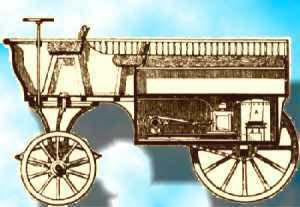
In 1769, the very first self–propelled road vehicle was a military tractor invented by French engineer and mechanic, Nicolas Joseph Cugnot (1725 – 1804). Cugnot used a steam engine to power his vehicle, built under his instructions at the Paris Arsenal by mechanic Brezin. It was used by the French Army to haul artillery at a whopping speed of 2 1/2 mph on only three wheels. The vehicle had to stop every ten to fifteen minutes to build up steam power. The steam engine and boiler were separate from the rest of the vehicle and placed in the front (see engraving above). The following year (1770), Cugnot built a steam–powered tricycle that carried four passengers.
In 1771, Cugnot drove one of his road vehicles into a stone wall, making Cugnot the first person to get into a motor vehicle accident. This was the beginning of bad luck for the inventor. After one of Cugnot's patrons died and the other was exiled, the money for Cugnot's road vehicle experiments ended.
Steam engines powered cars by burning fuel that heated water in a boiler, creating steam that expanded and pushed pistons that turned the crankshaft, which then turned the wheels. During the early history of self–propelled vehicles – both road and railroad vehicles were being developed with steam engines. (Cugnot also designed two steam locomotives with engines that never worked well.) Steam engines added so much weight to a vehicle that they proved a poor design for road
7
vehicles; however, steam engines were very successfully used in locomotives. Historians, who accept that early steam–powered road vehicles were automobiles, feel that Nicolas Cugnot was the inventor of the first automobile.
After Cugnot Several Other Inventors Designed Steam–Powered Road Vehicles. Cugnot's vehicle was improved by Frenchman, Onesiphore Pecqueur, who also invented the first differential gear. In 1789, the first U.S. patent for a steam–powered land vehicle was granted to Oliver Evans. In 1801, Richard
Trevithick built a road carriage powered by steam – the first in Great Britain. СибАДИIn Britain, from 1820 to 1840, steam–powered stagecoaches were in regular
service. These were later banned from public roads and Britain's railroad system developed as a result. Steam–driven road tractors (built by Charles Deitz) pulled passenger carriages around Paris and Bordeaux up to 1850. In the United States, numerous steam coaches were built from 1860 to 1880. Inventors included: Harrison Dyer, Joseph Dixon, Rufus Porter, and William T. James. Amedee Bollee Sr. built advanced steam cars from 1873 to 1883. The « La Mancelle» built in 1878, had a front–mounted engine, shaft drive to the differential, chain drive to the rear wheels, steering wheel on a vertical shaft and driver's seat behind the engine. The boiler was carried behind the passenger compartment. In 1871, Dr. J. W. Carhart, professor of physics at Wisconsin State University, and the J. I. Case Company built a working steam car that won a 200–mile race.
Steam engines were not the only engines used in early automobiles. Vehicles with electrical engines were also invented. Between 1832 and 1839 (the exact year is uncertain), Robert Anderson of Scotland invented the first electric carriage. Electric cars used rechargeable batteries that powered a small electric motor. The vehicles were heavy, slow, expensive, and needed to stop for recharging frequently. Both steam and electric road vehicles were abandoned in favor of gas– powered vehicles. Electricity found greater success in tramways and streetcars, where a constant supply of electricity was possible.
Learn more about the history of electrical vehicles from 1890 to the present. However, around 1900, electric land vehicles in America outsold all other types of cars. Then in the several years following 1900, sales of electric vehicles took a nosedive as a new type of vehicle came to dominate the consumer market. The very first self–powered road vehicles were powered by steam engines and by that definition Nicolas Joseph Cugnot of France built the first automobile in 1769 – recognized by the British Royal Automobile Club and the Automobile Club de France as being the first. So why do so many history books say that the automobile
was invented by either Gottlieb Daimler or Karl Benz? It is because both Daimler and Benz invented highly successful and practical gasoline–powered vehicles that ushered in the age of modern automobiles. Daimler and Benz invented cars that looked and worked like the cars we use today. However, it is unfair to say that either man invented « the» automobile.
8
Language practice
1. Examine the phrases and try to translate it.
A)Put down.
B)Put (stick) one's nose in.
C)Put on the Ritz/dog.
D)Put some distance between someone and someone / something.
E)Put someone away.
СибАДИ |
|
2. Match these phrases with the definitions given below: |
|
1) |
interfere in someone's business; |
2) |
put in prison; |
3) |
criticize someone; |
4) |
make everything special for someone else; |
5) |
move far away from. |
3. Fill in the gaps in the sentences.
Jack … him ... and he hasn't been the same since. Jason was … ... for life in prison.
I wish he wouldn't … his … in where it's not wanted. They really … on … ... for us last weekend.
He … some ... between himself and his ex–wife. Mary is ...her ... in their affairs.
Let's … some ... between us and the school.
4. Match the words in two columns
approach |
a car (step on the brakes) |
be alert |
an accident |
look |
while driving |
avoid |
lanes, tires |
change |
a road |
brake |
into mirror |
damage |
into something |
cross |
something |
crash |
a road |
Writing
1. Using phrases and word structures from section «Language practice » describe a situation which could happen with the driver
a)two hundred years ago;
b)one hundred years ago;
c)three weeks ago.
2.Write down your own variant of the report connected with the history of automobile invention.
9
Unit 2
Section A. Determining the scope of the report and Considering the target audience
Theory
A frequent mistake of many business reports is that the author makes the scope (purpose) of a report too general or vague. As most business reports are required to support specific organizational objectives, strategies and decision making it is critical that a chain of continuity in argument and evidence can be demonstrated between the purpose of the report, the research, and ultimately the solutions, findings or recommendations. The stronger this continuity the greater the weight the report will have in supporting the decision making process. When you chose a focus for your report, one of the first steps is to narrow the scope to a report length.
СибАДИ• knowledge of the report’s topic;
The scope of the report is defined by determining the factors that will be studied.
Always consider the business reports alignment with the intended audience. Business reports usually have a number of different audience groups to reach so a report will often have a hierarchical structure to support different levels of detail. Many people may be involved in a decision making process and they will have different levels of information requirements to support their decision making process. In designing the report format and style the following target audience
characteristics should be considered:
• their need for the report;
• educational level (ability to understand);
• position in organization;
• responsibility to make decisions based on the report;
• personal demographics (age, biases, alliances, attitudes).
To avoid making false assumptions about the target audience the author should compile a list of all the intended readers and develop a profile of them.
Audiences are basically of three kinds:
• primary audience – people who have to make decisions on the basis of the business report;
• secondary audience – people who are effected by the actions the Primary Audience would take in response to the position of the business report;
• immediate audience – people responsible for examining the business report, weighting its viability and distributing the report to a broader audience.
In determining if a number of versions of reports are required with varying levels of evidence, the author should consider the following audience decision making needs:
•How much background (supporting factual data, analytical findings, solutions and recommendations) will the audience need?
•Do they need to define any terms being used within the report (if so
ensure they are included in Explanation Terms or Glossary)?
10