Материал: 2096
•What language level (technical complexity) will be most appropriate for the target audience?
•What will the target audiences expect from the business report?
•Does the reader prefer everything given in detail or merely a brief presentation that touches upon the highlights?
Questions:
1.What is the most frequent mistake in business report?
2.What should business report support?
3.What strategy should we avoid making business report?
4.What is the first step after determining the focus of the business report?
5.How is the scope of the report defined?
6.What should be considered in designing of the report format and style?
7.What types of audience do you know? What is the difference between them?
Section B. Famous Inventors
Reading
1.Read the text and define:
a)the theme of the report;
b)the idea of the report (the aim);
c)the scope of the report;
d)primary, secondary and immediate audience;
e)style of the report.
2.Give another variants of the aim of the report with the theme «Leonardo da Vinci».
3.Choose one and describe the scope of your report according to your aim.
4.Write down a plan of your report.СибАДИ
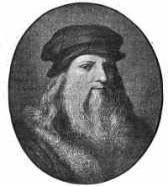 LEONARDO DA VINCI
Leonardo da Vinci was a Renaissance man. He painted, sculpted, dissected bodies, designed buildings...he pursued knowledge and self–enlightenment in a multitude of ways. This short biography provides a brief overview of his life and main contributions. Leonardo da Vinci was born April 15, 1452 in Anchiano, near Vinci, Italy, and died May 2, 1519 in Cloux, France. His father, Ser Piero, was a respected Florentine businessman. His mother, Caterina,was a peasant women. Ser
11
Piero's parents did not consider Caterina a worthy catch, so Ser Piero and Caterina remained unmarried. Caterina later married someone of her own station.
The kindly Ser Piero treated Leonardo as a legitimate son. But, although Ser Pieroprovided Leonardo with an excellent education, Leonardo did not reveal outstanding abilities as a child.
At the age of fifteen, Leonardo da Vinci was apprenticed to the artist Andrea del Verrocchio in Florence. Leonardo worked there for fourteen years. Many pen Сand pencil works remain from this period, including technical sketches of pumps, weapons, and other mechanical objects. Leonardo started to get good commissions, including the Adoration of the Magi for the monastery of San Donato a Scopeto.
But this, and other commissions, were left unfinished when he moved to Milan. иAt the age of thirty, Leonardo da Vinci moved to Milan to work for Duke Ludovico. He spent seventeen years there, until Ludovico fell from power in 1499. Leonardo acted as a technical advisor to Ludovico in fields as diverse as architecture, weaponry, hydraulics and engineering. But Leonardo's goals at this time tendedбto be grandiose and boundless, and much work remained unfinished.
Fortunately for us, Leonardo managed to complete The Last Supper for the monastery of Santa Maria delle Grazie, and the The Virgin of the Rocks for the Milanese Confraternity of the Immaculate Conception. But the twelve years Leonardo devoted to creating a monumental bronze statue of a horse were less successful. He createdАthe clay model for the horse, but just before the bronze was to be poured it was diverted to making war cannons. Then Ludovico fell, and the clay model was destroyed in the ensuing war. With the French marching into Milan, Leonardo celebrated the new century by returning home. In January 1500 he left Milan, spent a few months in Mantua and Venice, and then returned to the scene of his apprentice years, Florence.Д
In Florence, Leonardo da Vinci concentrated on mathematical studies before, after two years, taking a ten month break to work for Cesare Borgia. There he invented new cartographic techniques while mapping Borgia’s territories. He also met Nicholas Machiavelli, no doubt picking up some good tips for dealing with high officials! И
During this second period in Florence, Leonardo worked on many grand projects. These included plans for a canal to the sea, and a monumental mural in the central square. But the canal remained only a plan, and the mural was never completed. He did, however, complete the Mona Lisa during this time.
Also during this second period in Florence, Leonardo da Vinci became especially interested in science, his main impetus being simply to see what was there. His genius enabled him to look deeply into nature–– his artistic vision became a superb tool for detailed scientific investigation.
Art and science combined in his investigations of the human form, which (like everything else he did) was pursued to its limits. He performed dissections in the hospital of Santa Maria Nuova, and provided a comprehensive account of the structure and function of the human body. Leonardo studied various other natural phenomena, from the flight of birds to the movements of currents, and created vast collections of data pertaining to them.
12
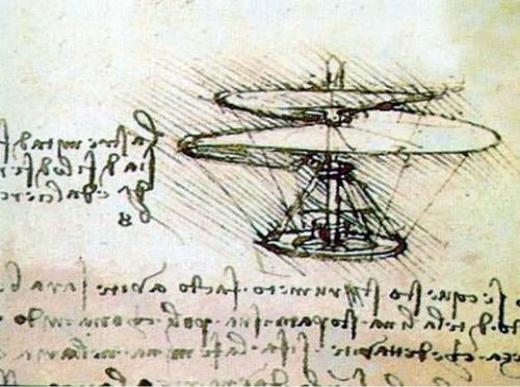
СибАДИDesign for a flying machine
King Louis XII of France greatly admired Leonardo da Vinci. After requests from Charles d'Amboise, the French governor in Milan, Leonardo returned to Milan in 1508. Leonardo's advice was sought mainly on architectural matters, but his own interests centered on science. His experiments in anatomy proceeded quickly with the collaboration of Marcantonio della Torre, an anatomist from Pavia. Leonardo also continued with botanical, mathematical, optical, mechanical, and geological studies. Leonardo became convinced that basic mechanical forces produced all organic and inorganic forms, and that they operated in accordance with orderly, harmonious laws. So Leonardo was one of the first to outline a fully scientific vision of nature and the physical universe.
In 1513 the French were forced to leave Milan, and Leonardo da Vinci moved to Rome. He hoped to find employment through his patron Giuliano de Medici, brother of the pope. Giuliano gave Leonardo rooms in his residence, the Belvedere in the Vatican, and a considerable monthly wage. But the competition was fierce. Donato Bramante was building St. Peter's; Rome was full of young talent. Leonardo could get no commissions and stuck to mathematical studies, experiments, and investigating Rome’s monuments. Feeling underemployed, in 1516, Leonardo accepted the invitation of King Francis I to serve in France and left Italy forever.
The last three years of Leonardo’s life were spent in Cloux (now Clos– Lucé), near the king's summer palace at Amboise on the Loire. Leonardo spent most of his time working on scientific manuscripts and studying anatomy. In a final work, Visions of the End of the World, or Deluge, he depicts the primal forces that rule nature with a growing pessimism. Leonardo died at Cloux and was buried in the church of Saint–Florentin
13
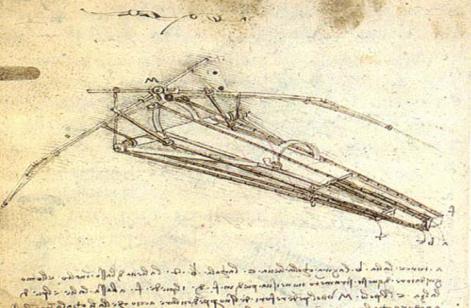
Leonardo da Vinci had an unlimited desire for knowledge, and visual perception was the main tool he used in pursuit of that knowledge. Leonardo believed that only the faculty of sight allowed you to take in experience immediately, correctly, and with certainty.
|
Seeing was paramount for Leonardo, which is why he excelled in the visual |
arts. But his penetrating vision was used to further many other branches of |
|
knowledge, including anatomy and engineering. He had over 100 drawings that |
|
illustrated his theories on flight. The ornithopter flying machine was never actually |
|
СибАДИ |
|
created. It was a design that Leonardo DaVinci made to illustrate how man could |
|
fly. Some experts feel that the modern day helicopter was inspired by DaVinci's |
|
concept. |
|
|
Design for a flying machine drawn by Leonardo Da Vinci in 1488 |
5. |
Find in the text: |
|
a) supporting factual data; |
|
b) analytical findings; |
|
c) solutions (or conclusion); |
|
d) recommendations or predictions. |
6. |
Find the terms which are in need to be explained. Explain it. |
7. |
Changing the aim should we change the style of the report? |
8. |
Changing the audience should we change the style of the report? |
9. |
Does your aim need to change the style? What about audience? |
14
С |
|
|
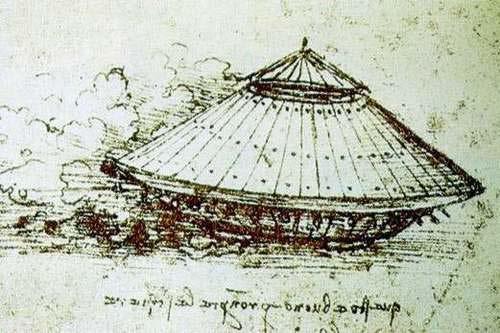
Armoured Car drawn by Leonardo Da Vinci in 1488 |
и |
|
10. |
What kind of visual illustration does your report need? |
11. |
What kind of presentation do you prefer? |
12.What kind of presentation does your report need? |
|
13. Type of presentation. What does it depend on? |
|
|
б |
|
А |
Speaking
1. Look through the text. Compare it with the report devoted to Leonardo
Da Vinci. Find common and distinguishing features in its |
|||
a) |
Titles; |
Д |
|
|
|
||
b) |
themes; |
|
|
c) |
ideas; |
|
И |
d) |
structures (composition); |
||
e) |
the scope of the report; |
||
f) |
primary, secondary and immediate audience; |
||
g) |
style of the report. |
|
|
2. What text have you found more |
|
||
a) |
informative; |
|
|
b) |
illustrative; |
|
|
c) |
emotional; |
|
|
d) |
complete; |
|
|
e) |
creative and why? Prove your answer. |
||
15