Материал: 2096
Writing
1. Look through the classification given below.
2. Chose one point. Prepare a report devoted to it in accordance with the following plan:
a) Definition.
b) History of origin.
c) |
History of the term. |
С |
|
d) Technical Characteristics. |
|
e) |
Appearance. |
f) |
Sphere of use. |
g) Advantages and disadvantages of it. |
|
и |
|
h) Cost. |
|
i) |
Comfort. |
j) |
Examples. |
k) |
Illustrations. |
l) |
References. |
3. Tryбto use all phrases and word structures from section «Language practice» in your report.
CAR CLASSIFICATION
Car classificationАis subjective since many vehicles fall into multiple categories or do not fit well into any. Not all car types are common in all countries and names for the same vehicle can differ by region. Furthermore, some descriptions may be interpreted differently in different places. Broadly speaking, there are a set of classifications which are widely understood in North America, and another set which are somewhatДunderstood in English–speaking contexts in Europe. Some terms borrowed from non–English languages may have different meanings when used in their native language.
Microcar
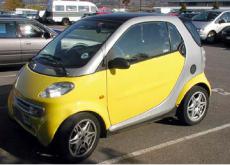
Straddling the boundary between car and motorbike, these vehicles have engines under 1.0 litre, typically seat only twoИpassengers, and are sometimes unorthodox in construction. Some microcars are three–wheelers, while the majority have four wheels. Microcars were popular in post–war Europe, where their appearance led them to be called « Bubble cars». A descendant of the microcar is the modern Smart Fortwo. Bubble car is a subjective term used for some small, economical automobiles, usually produced in the 1950s and 1960s.
Smart ForTwo
56
The Messerschmitt KR175 and KR200, and the FMR Tg500, had aircraft– style bubble canopies, giving rise to the term bubble car to refer to all these post– war microcars. Isettas and others also had a bubble–like appearance.
Bubble cars became popular in Europe at that time as a demand for cheap personal motorised transport emerged and fuel prices were high due in part to the 1956 Suez Crisis. Most of them were three–wheelers, which in many places qualified them for inexpensive taxes and licensing as motorcycles.
СMost bubble cars were manufactered in Germany, including by the former
German military aircraft manufacturers, Messerschmitt and Heinkel. Automobile and motorcycle manufacturer BMW manufactured the Italian Iso Rivolta Isetta under licence, using an engine from one of their own motorcycles. France also
иdesign in order to take advantage of the three–wheel vehicle laws in the United Kingdom. There were also indigenous British three wheeled microcars, including the larger Regal and Robin from the Reliant Motor Company in Staffordshire and the smaller P50 and Trident from the Peel Engineering Company on the Isle of Man. А
produced large numbers of similar tiny vehicles called voiturettes, but unlike the German makes, these were rarely sold abroad.
The United Kingdom had licence–built right–hand drive versions of the Heinkel Kabine and the Isetta. The British version of the Isetta was built with only
one rear wheelбinstead of the narrow–tracked pair of wheels in the normal Isetta
Bubble cars were superseded by a new wave of 'proper small cars' like the 1959 Austin Mini, which gave far more functionality for their owners for only slightly higher costs. However, the Reliant Robin remained in production until 1997, and production was briefly restarted under licence for a few months in 2002.
ДCity car
A city car is a small automobile intended for use in urban areas. Unlike microcars, a city car's greater speed, capacity and (in perception at least) occupant protection are safer in mixed traffic environments and weather conditions. While city cars can reach highway speeds, that is not their intended use. In Japan, city cars are called kei cars. Kei cars have to meet strictИsize and engine requirements: engines have a maximum displacement of 660 cm³ and the car's length must be under 3400 mm. A city car (or urban car) is a small, moderately powered automobile intended for use in urban areas.
It is comparable in size and features to a neighborhood electric vehicle («NEV»), has four seats, and is typically 3.4–3.6 metres (11–12 ft.) long. These cars have been sold in Europe since the 1960s, and now are an official car classification. They are also known as A–Segment cars. Most mainstream manufacturers have one or even two city cars in their lineup. The city car's convenient speed and occupant protection allow relatively safe operation in mixed traffic environments and in all weather conditions.
One of the earliest city cars was the American–made Crosley, a four passenger vehicle from the late 1940s. While many cars of the 1950s are small enough to be considered city cars today, these cars have been replaced by larger cars with each passing generation. Exceptions are the smaller Fiats, especially the
57
1957 Fiat 500 and Fiat 126. They were in the region of 3.0 metres (9.8 ft) in length, but had seating for four people, putting them outside the microcar category.
The Fiat/SEAT Panda, launched in 1980, was 3.40 m (134 in) long but was clearly aimed at the city car category, and did not grow significantly larger during its development. The replacement for the 126, the Fiat Cinquecento was presented in 1991 as a true city car. At only 3,200 mm (126.0 in) long, it had room for four and entry–level prices.
СThe boom. In the late 1980s superminis had grown so much that many buyers wanted even smaller four–seat cars. Renault followed Fiat in 1993 with the Renault Twingo, which featured a MPV–like design and interior room, despite its size and height 3,430 mm (135.0 in) long and 1,420 mm (55.9 in) tall. Combined
иtheir city car entries, both for the Asian and European markets. The Hyundai Atos, launched in 1997, was 3,500 mm (137.8 in) long and 1,600 mm (63.0 in) high, which was much taller than any European models (usually under 1,450 mm (57.1 in)) and provided considerable interior space. Its boxy shape provoked mixed reactions. А
with an original exterior and interior design, it quickly became a best–seller. In 1996 the Ford Ka was presented with its radical New Edge design. Its egg–shaped body did not leave much room in the rear seats, but many customers did not need them and preferred the Ka over more conservative designs.
In theбmid–1990s, South Korean brands Daewoo and Hyundai introduced
The Daewoo Matiz followed in 1998 with a Giorgetto Giugiaro design and a moderate height (1,500 mm (59.1 in)), which proved more eye–catching. Hyundai tried to react to this with the rounder Atos Prime but without much success.
These Korean city cars were much cheaper than most of the European models, especially the Opel Agila (2000)Дand Volkswagen Lupo (1999), yet were still reliable. However, sales were dominated by the Renault Twingo and Ford Ka.
Supermini crossovers
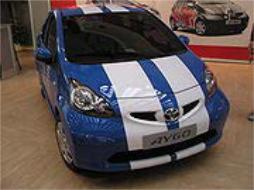 И A current model Toyota Aygo city car
While small family cars and superminis grew considerably from the 1990s to the 2000s, the same happened with city cars. After some new superminis grew to be over 3900 mm long (like the Ford Fiesta, the SEAT Ibiza and the Volkswagen Polo), some automakers developed city car models more than 3650 mm long.
The first of these models was the Nissan Micra (2002), which is 3720 mm long and smaller than many superminis of the late 1990s. Other cars are the
58
Citroën C2, Suzuki Swift, Smart Forfour, Toyota Yaris and Peugeot 1007 (the last one which can also be labelled as a mini MPV).
These vehicles are hard to classify, since their size does not fit the «city car» or «supermini» categories. A possibility is to compare the price and interior room with superminis: the Yaris is definitely a supermini, whereas the Tata Indica is closer to a city car. In addition, in the last few years some « true» city cars were released: the Fiat Panda (2003), the Kia Picanto (2004), the Citroën C1/Peugeot
С107/Toyota Aygo (2005), Renault Twingo (2006), Fiat Nuova 500 (2006), the Ford Ka (2006) and Hyundai i10 (2007).
иKei car
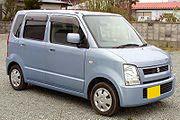
Kei car, K–бcar, or keijidōsha (« light automobile») is a Japanese category of small automobiles, including passenger cars, vans, and pickup trucks. They are designed to exploit local tax and insurance relaxations, and in more rural areas are exempted from the requirement to certify that adequate parking is available for the vehicle. These standards originated in the times following the end of the Second World War, when most Japanese could not afford a full–sized car yet had enough to buy a motorcycle. To promote the growth of the car industry, as well as to offer an alternative delivery method to small business and shop owners, kei car standards
were created. |
Д |
The cars feature yellow licence plates, earning them the name «yellow–plate |
|
cars» (black numbersАon yellow background for private use and yellow numbers on |
|
black background for commercial use) in English and Spanish–speaking circles. Because regulations only restrict physical size, engine displacement and
power, manufacturers have introduced many advanced technologies to the class. As a result, kei cars are often available with forcedИinduction engines, automatic and CVT transmissions, front–, rear– and four–wheel drive, hybrid drivetrains, air conditioning, GPS and many other features.
Daihatsu, Honda, Mitsubishi, Smart, Subaru, and Suzuki all manufacture kei cars. Nissan sells Mitsubishi and Suzuki models while Mazda sells Suzuki models under licence.
Hatchback
Hatchback is a term designating an automobile design, containing a passenger cabin with an integrated cargo space, accessed from behind the vehicle by a single, top–hinged tailgate or large flip–up window. The vehicle commonly has two rows of seats, with the rear seat able to fold down to increase cargo space. Hatchback vehicles are functionally similar to station wagons (which are intended to carry large volumes), but distinguished by a (much) smaller load area. The typical hatchback roof rakes down steeply behind the C–Pillar, resulting in very little car length behind the rear wheels and thus no room for a side window over
59
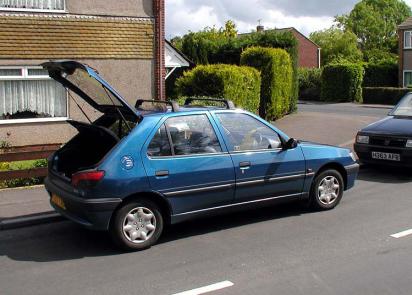
the load area. A good example of the difference can be seen in the 1999–2007 Ford Focus, which offers both a wagon (Focus ZTW/ZXW) and hatchback (Focus ZX3 and ZX5) models. The 2002–2007 Mazda 6 also came in five–door hatchback and wagon configurations.
Alternatively, cars with a longer rear end need a much more slanted rear window which is known as a liftback, in comparison to traditional hatchbacks where the tailgate is more vertical/upright. Liftbacks are sedan–size cars with a
Сfastback profile and a hatchback–type tailgate. However, the term « liftback» did not gain such mainstream acceptance as « hatchback» or « sedan», for instance being almost never used in the United Kingdom where liftback cars are particularly popular. There, 5–door liftbacks are in general called hatchbacks, though 3–door liftbacks are often referred to as coupés by certain automakers, such as the Mercedes–Benz CLC–Class.
Typically, most compact cars offer a hatchback configuration, while midsize and larger cars have a wagon style. There are some exceptions, with compact wagons such as the BMW 3–Series (E36), Ford Focus ZTW, Toyota Corolla
Fielder, and Mercedes–Benz C–Class Estate. These four lineups have or had |
|
иhatchback configurations as well, such as the 3–Series hatchback, Focus ZT3 and |
|
ZT5, Corolla Matrix (or simply Matrix), and CLC–Class (formerly the C–Class |
|
Sportcoupe). |
|
б |
|
|
А |
|
Д |
|
Peugeot 306 hatchback, with the hatch lifted |
|
И |
The tailgate is also referred to as the hatch. Hatchbacks are often described as three–door (two entry doors and the hatch) or five–door (four entry doors and the hatch) cars. In Europe, city cars, superminis, and small family cars are usually hatchbacks. Small cars often incorporate a hatch tailgate to make the best use of available space. Especially in smaller models, hatchbacks are often truncated, with the tailgate nearly vertical, to reduce the car's footprint. This is an important consideration in countries where small streets and traffic congestion are big factors (see for instance the Japanese Kei cars).
60