Материал: 2096
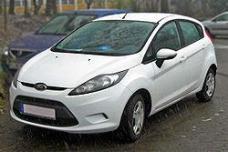
ZT5, Corolla Matrix (or simply Matrix), and CLC–Class (formerly the C–Class Sportcoupe).
A supermini
A supermini is a British car classification term that describes automobiles larger than a city car but smaller than a small family car. This car class is also known as the B–segment across Europe, and as Subcompact in North America.
In 2008, the best selling cars in Belgium, the Czech Republic, France, |
|
С |
|
Hungary, Italy, the Netherlands, Poland, Portugal, Slovakia and Slovenia were all |
|
superminis. |
|
и |
|
б |
|
|
A supermini |
Overall in 2008, of the fifteen best–selling types of car in Europe, seven |
|
were superminis. |
|
А |
|
The term «supermini» appeared around 1985. The influential Consumers' Association first used the term in its annual Car Buying Guide in October of that year. Because the term was a new one, it gave an explanation at the start of a section entitled Small Hatchbacks. It said small hatchbacks were known popularly as superminis and while similar to the Mini they were more spacious inside and more versatile. This definition madeДclear that a «supermini» was something larger than a Mini yet smaller than a typical car of the time. In its 1985 report, it included such cars as the Austin Metro, Volkswagen Polo and Ford Fiesta. Smaller or more basic cars were grouped under a Bargain Basement heading and included the Mini, Citroën 2CV, Fiat 126 and Renault 4.
The 1986 Car Buying Guide, published in June of that year, was more confident of the term and this time headed theИsection Small hatchbacks or 'superminis'. The Mini and 2CV were still relegated to the cheaper category of Bargain Basement. By the time of the 1989 Car Buying Guide, there was no longer any need to explain what supermini meant and the title appeared without comment. In its introduction, the Guide said superminis were available as three–door and five–door hatchbacks, and sometimes as saloons with a boot. The Mini and Renault 4 were still grouped separately, this year under the heading Cheapies.
By 1990 the demand for the cheapest cars, a number of them from low–cost economies in eastern Europe, was fading. For the first time the two or three remaining examples in the new car market, including the original Mini, were grouped under the heading superminis along with the couple of dozen true superminis that now dominated the cheaper end of the market. However, in its separate guide to car reliability in June 1990, the magazine grouped the smallest cars under the heading « Minis and Superminis», indicating that the smallest cars
66
were still perceived as being distinct from the larger and better equipped « Superminis». These smaller cars are now called city cars.
A compact car
A compact car (North America), or small family car (Europe), is a classification of cars which are larger than a supermini but smaller than or equal to a mid–size car. The term often leads into confusion, however, since international compact cars are somewhat larger than their North American equivalents, mostly
Сbecause no supermini/subcompact size is manufactured by American, Mexican and Canadian car makers up to date.
Current compact car size, for US and international models respectively, is approximately 4,100 mm (161 in) and 4,450 mm (175 in) long for hatchbacks, or
и to 4,700 mmб(185 in) in international–based models.
4,400 mm (173 in) and 4,600 mm (181 in) long for cabriolets, sedans or station wagons. Multi–purpose vehicles and sport utility vehicles based on small family cars (often called compact MPVs and compact SUVs) have similar sizes, ranging from 4,200 mm (165 in) to 4,500 mm (177 in) in US and from 4,400 mm (173 in)
Common engines are 1.5 to 2.4–litre straight–4s, either petrol or Diesel, with a range between 100 bhp (75 kW) and 170 bhp (127 kW). Some models also have economical 1.3 or 1.4–litre units. High–performance versions, called hot hatches or
sport compact sedans, may have turbocharged 2.0 or 2.5–litre engines, or even V6 3.2–litre units, ranging maximum outputs from 170 bhp (127 kW) to 300 bhp (224 kW). Small European family cars include the Ford Focus, Opel Astra, Peugeot 307, Renault Mégane,Fiat Bravo (2007) and Volkswagen Golf. Japanese branded examples include Honda Civic, Mazda 3, Subaru Impreza, and Toyota Corolla.
The Chevrolet Cobalt and Dodge Caliber are an example of a compact made in the |
||
United States. |
Д |
|
АFull-size car |
||
|
||
|
И |
|
|
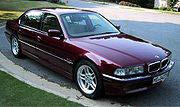
1998 BMW 750iL |
|
A full-size car is a marketing term used in North America for an automobile larger than a mid-size car. In the United States, the EPA uses «large car» to denote full-size cars.
Full-size cars are usually denoted for their length, nearing 5,000 mm (197 in) in basic sedans, with luxury models often tending to reach 5,250 mm (207 in). Previously, a wheelbase greater than 110 inches (2.79 metres) was the criterion. The term first appeared in the early 1960s to define what also became known as « standard» size cars from the new compact and intermediate models then being introduced. Full-size is also defined in space measurement as greater than 120 ft³ (3,300 L) of interior volume.
67
A «large family car», the equivalent of a full-size car class in Australian terms, often denoted by width. Therefore, the Ford Falcon, Toyota Aurion and Holden Commodore are considered large cars in the Australian and New Zealand markets. These cars are sometimes referred to as «family cars» in Australia, and are typically 4.8 meters (about 15 ft, 9 in) or more in length.
In Europe, the terms «executive car» and « luxury car» may refer to cars of this size (which are mostly luxury cars), such as the Audi A8, BMW 7–Series,
Сиreferred to as Entry–level luxury car.
Mercedes–Benz S–Class, Volkswagen Phaeton, and Jaguar XJ.
Compact executive car
Compact executive car is a mainly British car classification term applied to premium cars smaller than executive cars. In American English, they are usually
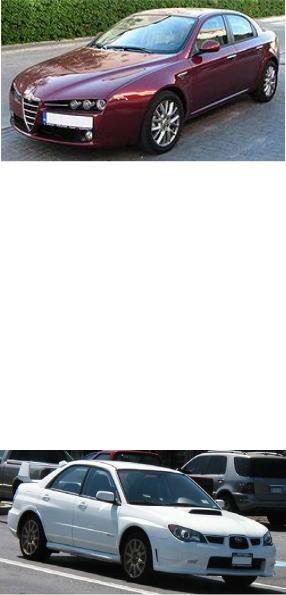
б TheАAlfa Romeo 159 is a compact executive car
Dimensionally, these vehicles are often shorter than large family cars, and the rear leg room and boot/trunk size is smaller to accommodate larger engines. While they offer the buyer less equipment, inner room or engine for the money, the material and building quality is higher and the nameplate itself is part of the value proposition. Compact executive cars are usually available in saloon, estate, coupé and cabriolet body styles.
This market segment is fairly new, pioneered by the BMW 3 Series, which found consumer demand for a small but upscale saloon in the late 1970s, as well as
Volvo. The luxury car nameplate Mercedes–Benz then branched down to create |
|
|
И |
the 1982 competitor Mercedes–Benz 190. The class then grew with the arrivals of |
|
the Rover 600 and Audi A4. |
Д |
Sport compact
2006 US–spec Subaru Impreza WRX STI
A sport compact is a high–performance version of a compact car or a subcompact car. They are typically are front engined, front–wheel drive coupés, sedans, or hatchbacks driven by a straight–4 gasoline engine. Typical sport compacts include such examples as Mitsubishi Lancer Evolution, Mitsubishi
68
Eclipse, Honda Civic Si, Ford Contour SVT, the Focus SVT, the Opel Astra GTC, the Renault Clio V6/Sport, the Mazdaspeed3, the Nissan Sentra SE–R Spec V, the Honda Prelude, the Toyota Celica and Scion tC TRD, and the Dodge SRT–4.
The design philosophy of a sport compact sharply contrasts with those of 'true' sports cars. Sports cars are designed with a performance–oriented philosophy, often compromising cargo space, seating, gas mileage, (daily) drivability, and reliability. A sport compact is usually designed with a practical design philosophy
Сand profit in mind. This philosophy has led to several compromises when it comes to performance, such as front wheel drive, conservative engine design, and platform sharing. Electronic control units are also programmed for optimal gas mileage.
иPerformance–oriented sport compacts focus on improving handling and increasing engine efficiency, rather than increasing engine size or conversion to rear–wheel drive. For example, the Celica GT–S and Civic Si are both sport compacts that produce 100 hp./ L of displacement, and have handling superior to their stockбtrims and other cars in its price range.
The exact definition of a sport compact remains a subject of debate. Some believe that any 4–cylinder compact car falls into this category, clearly placing cars such as the Nissan 240SX or Acura Integra in the sport compact category. However, the Lotus Esprit was offered with a 4–cylinder engine that produced greater than 100 horsepowerА(75 kW) per litre engine displacement –– a feat achieved only by exotic sports cars at the time. Today, its performance is largely eclipsed by high performance versions of compact cars such as the Subaru Impreza WRX STi, Volkswagen R32 or the Mitsubishi Lancer Evolution. As in most automotive bull, the category «sports compact» is not precise.
Nevertheless, the designationДof the « sport compact» is generally reserved for the higher–performance versions of common, lower–performance compact and economy vehicles. A car that is specifically designed to be a performance automobile (a sports car such as grand tourer or an exotic sport car) may also be compact in size, but is clearly delineated from an ordinary compact by manufacturer's performance intent. Thus, a «sportsИcar» is a car specifically intended to provide elevated vehicle performance. The «sports compact», on the other hand, is a compact car that has been improved (by owner or manufacturer) to provide an elevated degree of vehicle performance over the base version of the car.
Note that the debate is often confused by arguments of power, since engine power is a clear indication of straight–line acceleration performance. However, categorization by number of engine cylinders, the addition of forced induction, or even an arbitrary horsepower reference does not provide clearer categorization. This is due to the rapidly advancing performance capability of new sport compact cars as compared to yesterday's sports cars. Cars such as the Toyota Supra, Acura NSX, Lotus Elise, and the Nissan Skyline clearly fall into a different market segment than even the highest performance production versions of the Honda Civic and specifically prepared post–production–tuned automobiles.
69
Despite this, Sport Compact Car Magazine often contains articles on the Toyota Supra, Nissan 350Z, Honda S2000, Lotus Elise, Mitsubishi Lancer Evolution, in addition to other sport compacts.
It has become fairly popular to modify or customize a sport compact, commonly referred to as tuning. This has given rise to the term «tuner» for the owners of modified sport compacts (and other vehicle classes), and by extension, their automobiles. As with trucks and other vehicle categories, there is a large
Сmarket for performance–enhancing equipment designed to fit small cars. Unfortunately, tuning» is a term that is also symbolized by cosmetic and non– performance related vehicle modifications. It is the subject of some controversy whether to recognize a compact «tuner» car that has been modified to offer lesser иvehicle performance than a « sport compact».
Restoration of a Japanese import to its JDM specifications (or J–Spec) has become a fairly popular modification for many tuners in North America. It is quite common for Japanese automakers to produce or export less powerful versions of their modelsбto the North American market. The common exception to this is the 1993–1998 Toyota Supra which received a more powerful engine for US export due to the «Gentleman's Agreement» in Japan. Such modifications usually involve swapping engines and transmissions. Popular examples include the conversion of parts from a JDM Silvia onto a USDM Nissan 240SX, or replacing JDM Honda parts and equipment (suchАas from a Civic Type–R) onto a United States Domestic Market USDM Honda Civic. Most Hondas are particularly good examples of this because of the cost saving «parts bin» designing used at Honda. To save production costs many high–end production equipment use the same or similar mounting locations as a cheaper or lower–performance alternative. These modifications can also be cosmetic,Дsuch as the replacement of the front fascia or rear spoiler with its JDM counterpart.
Small cars with high power ratings can be formidable racing vehicles. The Sports Car Club of America SCCA has long hosted races for compact cars. More recently, sport compacts have become so popular that the Australian National Drag Racing Association (ANDRA) (www.andra.com.au)Иnow have special classes for sport compact racing, and the National Hot Rod Association (NHRA) has made sport compact cars eligible to compete in the Lucas Oil Sportsman Series, and Sport Compact «Pro RWD» type cars are used in the NHRA Pro Stock category as the Chevrolet Cobalt is used as the manufacturer's car in the class.
ANDRA has no less than 7 dedicated classes catering for the popularity of Sport Compact Drag Racing: 1 – Pro Rear Wheel Drive 2 – Sport Modified 3 – OZ Modified 4 – Front Runner 5 – All Motor 6 – Sport Rear Wheel Drive 7 – Sport Front Wheel Drive. All these classes are officially sanctioned by ANDRA and are recognised through a series of successful events and National Records. Some highly modified sport compact dragsters can accelerate from 0–60 mph in less than four seconds.
Sport compacts are fairly popular for autocross competitions. The Acura Integra, Toyota Celica, and MINI Cooper are some of the more successful sport compacts within their classes. It is also worth noting that sport compact cars have
70