Материал: 2096

been the backbone of the latest motorsport discipline to emerge – drifting – since its beginnings.
The former NASCAR Goody's DASH Series found new life in 2005 when acquisitioned by International Sport Compact Auto Racing Series (ISCARS) DASH Touring, which tours primarily on asphalt ovals throughout the southeast. In 2008 the series accepted the sanction of American Speed Association (ASA).
Grand tourer
СиA classic Gran Turismo, the 1962 Ferrari 250 GTO
A grandбtourer (Italian: gran turismo) (GT) is a high–performance luxury automobile designed for long–distance driving. The most common format is a two–door coupé with either a two–seat or a 2+2 arrangement.
The term derives from the Italian phrase gran turismo, homage to the tradition of the grand tour, used to represent automobiles regarded as grand tourers abilities to make long–distance, high–speed journeys in both comfort and style. The English translation is grand touring; the French is grand tourisme.
more space for the cabinАthan mid–mounted engine layouts. Softer suspensions, greater storage, and more luxurious appointments add to their driving appeal. Some
Grand tourers differ from standard two–seat sports cars in typically being
larger, heavier, and emphasizing comfort over straight–out performance.
Historically, true GTs have been front–engined with rear–wheel drive, which leave
very high–performance grand tourers, such as the Aston Martin DB9, Ferrari 599 GTB Fiorano, Jaguar XK8, BMW 8–Series, and the Mercedes–Benz SLR
McLaren make various compromises in the opposite direction while rivalling
sports cars in speed, acceleration, and cornering ability, earning them the special |
|
designation Grand Tourers. |
Д |
History of the term supercarИ
The term «Supercar» was first noted by Car & Track in 1917 to describe an Alfa Romeo Monza. An advertisement for the Ensign Six, a 6.7 L (~409 cu in) high–performance car similar to the Bentley Speed Six, appeared in The Times for 11 November 1920 with the phrase « If you are interested in a supercar, you cannot afford to ignore the claims of the Ensign 6». The Oxford English Dictionary also cites the use of the word in an advertisement for an unnamed car in The Motor dated 3 November 1920, «The Supreme development of the British super–car» and defines the phrase as suggesting 'a car superior to all others'. The phrase Supercar did not become popular until much later and is often said to have has its revival originated with British motor journalist L. J. K. Setright writing about the Lamborghini Miura in CAR Magazine in the mid–1960s. The magazine claims to have «coined the phrase» although it was also used in May 1965 by the American
71
Magazine Car Life, in a test of the Pontiac GTO. By the 1970s and 1980s the phrase was in regular use, if not precisely defined. During the late 20th century, the term Supercar was used to describe «a very expensive, fast or powerful car with a centrally located engine» and stated in more general terms: « it must be very fast, with sporting handling to match», «it should be sleek and eye–catching» and its price should be «one in a rarefied atmosphere of its own».
С |
Muscle car |
|
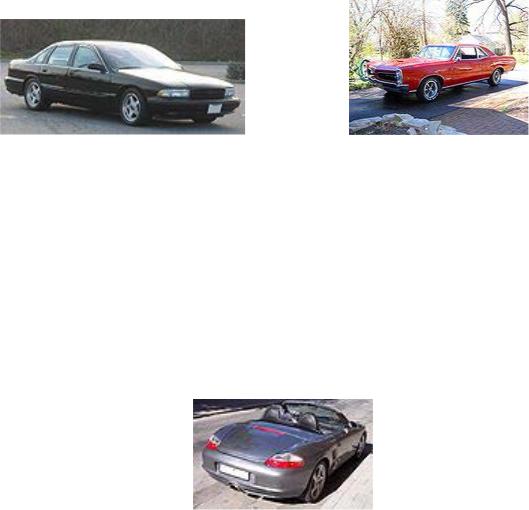
This 1966 Pontiac GTO is |
||
1994–1996 Chevrolet Impala SS |
||
|
an example of classic muscle |
иautomobiles. At its most widely accepted the term refers to American 2–door rear wheel drive mid–size cars of the late 1960s and early 1970s equipped with large,
expensive б2+2 GTs intended for high–speed touring and road racing. Building on the American phenomenon and developing simultaneously in their own markets,
Muscle car is a term used to refer to a variety of high performance
powerful V8s and sold at an affordable price for street use and drag racing,
formally and informally. As such, they are distinct from two–seat sports cars and
muscle cars also emerged in their own fashions in Australia, South Africa, the UK and elsewhere.
А ConvertibleД
A convertible is a type of automobile in which the roof can retract and fold away, converting it from an enclosed to an open–air vehicle. Many different automobile body styles are manufactured and marketed in convertible form.
A convertible type of automobileИ
Roof designs vary widely, but a few characteristics are common to all convertibles. Roofs are affixed to the body of the vehicle and are usually not detachable. Instead the roof is hinged and folds away, either into a recess behind the rear seats or into the boot or trunk of the vehicle. The roof may operate either manually or automatically via hydraulic or electrical actuators, and the roof itself may be constructed of soft or rigid material. Soft–tops are made of vinyl, canvas or other textile material, while hard–tops are made of steel, aluminum, plastic or other rigid materials.
72
Contemporary convertibles are known and marketed under several different terms due to the convergence of body styles over the years. A soft–top convertible may also be referred to as a cabriolet or cabrio, although two–seater soft tops often retain the name roadster, referring to their body style. Hard–tops are marketed under the terms coupé cabriolet, coupé convertible or simply retractable hardtop, while two–seaters more commonly use coupé roadster/roadster coupé.
С |
Four–wheel drive (Off–road vehicles) |
Off–road vehicles, or «off–roaders» are sometimes referred to as «four |
|
wheel drives», «four by fours», or 4x4s — this sometimes happens colloquially in |
|
cases where certain models or even an entire range does. |
|
Four–wheel drive, 4WD, 4x4 («four by four»), or AWD («all wheel drive») |
|
и |
|
is a four–wheeled vehicle with a drivetrain that allows all four wheels to receive torque from the engine simultaneously. While many people associate the term with off–road vehicles, powering all four wheels provides better control in normal road cars on many surfaces, and is an important part of rally racing.
б |
|
А |
|
Д |
|
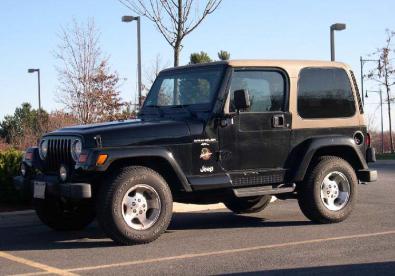
Sport utility vehicle. The Jeep Wrangler is a 4WD vehicle with a transfer |
|
case to select low range or high range 4WD. |
И |
In abbreviations such as 4x4, the first figure is normally taken as the total number of wheels and the second is normally taken as the number of powered wheels (the numbers are actually axle–ends to allow for more than one wheel on each end of an axle). 4x2 means a four–wheel vehicle in which engine power is transmitted to only two axle–ends: the front two in front–wheel drive or the rear two in rear–wheel drive.
There is often confusion as to the difference between 4x4s and sport utility vehicles. This leads to criticisms of 4x4 vehicles in the media that should actually be directed at sport utility vehicles (see criticism of sport utility vehicles).
73
СA crossover uses a car's monocoque/unibody platform construction while forgoing the body on frame construction in use on most SUVs. The crossover combines, in highly variable degrees, the design features such as tall interior packaging, high H–point seating, high ground–clearance, or all–wheel–drive
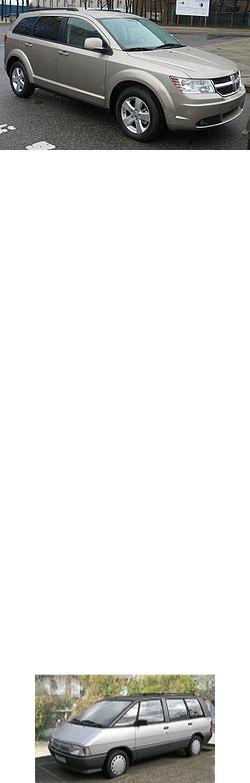
2009 Dodge Journey, CUV
Crossover is a marketing term for a vehicle that derives from a car platform
while borrowing features from a Sport Utility Vehicle (SUV).
иeconomy. Crossovers typically are designed for only light off–road capability, if any at all.
capability of the SUV—with design features from an automobile such as
article indicatedбthat «many consumers can't tell the difference between an SUV and a crossover». A January, 2008 Wall Street Journal article called the CUVs, « wagons that look like sport utility vehicles but ride like cars». To avoid referring to their vehicles as station wagons, some nameplates will instead call them crossovers.
independent rear suspension, car–like handling, interior roominess and fuel
The term crossover began as a marketing term, and a 2008 CNN Money
While the segmentАhas notable historical antecedents, it had come into strong visibility in the US by 2006,Дwhen crossover sales «made up more than 50% of the overall SUV market». Sales in the crossover market segment increased in 2007 by 16%. Notably in the US, the crossover segment is one of the few segments of the light truck market where import brands lead domestic brands, and the segment has strong appeal to aging baby boomers.
Minivan И
A minivan, multi–purpose vehicle (abbreviated MPV), people–carrier, people–mover or multi–utility vehicle (shortened MUV) is a type of automobile similar in shape to a van that is designed for personal use. Minivans are taller than a sedan, hatchback or a station wagon, and are designed for maximum interior room.
74
The term «minivan» was coined in North America, deriving from the fact that these vehicles were considerably smaller and more streamlined than traditional North American passenger vans, such as the Ford E–Series.
Other terms are used in other English–speaking countries. In Europe and India, «multi–purpose vehicle» (MPV) describes the general vehicle type without reference to its size. These are described with a word before the acronym: a «mini MPV» is derived from a supermini, a « compact MPV» is based on a small family car and a « large MPV» has about the same size as a large family car. In Asia, «multi–utility vehicle» (MUV) has more or less the same meaning as MPV. « People–carrier» and «people mover» describe both large MPVs and minibuses, but
not smaller models. |
|
|
С |
Van, camper, RV, minibus etc. |
|
|
||
и |
||
|
|
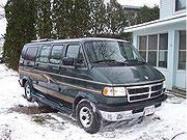
American conversion van |
|
In some countries, the term «van» can refer to a small panel van based on a |
|
passenger car design (often the estate model / station wagon); it also refers to light |
||
|
б |
|
trucks, which themselves are sometimes based on SUVs or MPVs. (But note that |
||
those retaining seats and windows, while being larger and more utilitarian than |
||
MPVs, may be called «minibuses».) The term is also used in the term « camper |
||
van» (or just «camper») — equivalent to a North American recreational vehicle |
||
(RV). |
|
А |
|
In the United States, the term «van» refers to vehicles that, like European |
|
minibuses, are even larger than largeДMPVs and are rarely seen being driven for domestic purposes — except for « conversion vans». These possess extremely large interior space and are often more intendedИfor hauling cargo than people. Most vans use body–on–frame construction and are thus suitable for extensive modification and coachwork, known as conversion. Conversion vans are often quite luxurious, boasting comfortable seats, soft rides, built–in support for electronics such as television sets, and other amenities. The more elaborate conversion vans straddle the line between cars and recreational vehicles.
75