Материал: m013800e

3.3 Controller
SYSTEM DATA:
|
750-812 |
750-815 |
750-814 |
|
750-816 |
|
|
|
|
|
|
Max. number of nodes |
99 with repeater |
1 |
|
||
Max. number of I/O points |
about 6,000 (depends on master) |
256 |
|||
Transmission medium |
|
Shielded Cu cable 2 (4) x 0.25 mm² |
|
||
Max. length of bus line |
1,200 m (depends on baud rate/on the |
about 5 m |
|||
Baud rate |
150-19,200 bauds |
1.2-115.2 kbauds |
150-19,200 bauds |
|
1.2-115.2 kbauds |
Type of transmission |
RS 485 |
RS 232 |
|||
IEC 1131-3 programming |
|
WAGO-I/O-PRO |
IL, LL, FDB, ST, FC |
|
|
Table 3.3: System data, controller |
|
|
|
|
|
TECHNICAL DATA:
|
|
750-812, 750-814, 750-815, 750-816 |
|
|
|
|
Max. number of I/O modules |
64 |
|
Digital points per node |
256 (inputs and outputs) |
|
Analogue points per node |
128 (inputs and outputs) |
|
Configuration possibility |
With function modules and switches |
|
Program memory |
32 kbytes |
|
Data memory |
32 kbytes |
|
Residual memory |
8 kbytes (retain) |
|
I/O fieldbus area |
256 words in input area and 256 words in output area |
|
I/O modules area |
256 words for inputs and 256 words for outputs |
|
Cycle time |
< 3 ms for 1,000 statements / 256 I/O |
|
Bus coupler connection |
1 x D-Sub 9 |
|
Voltage supply |
24 V DC (-15%/+20%) |
|
Internal current consumption |
350 mA |
|
Current supply |
85 mA typ. |
|
|
580 mA max. |
|
Power jumper contacts |
Blade / spring contact, |
|
|
slide contacts, self-cleaning |
|
Voltage power jumper contacts |
24 V DC |
|
Current power jumper contacts |
10 A DC |
|
Max. current supply at intern. |
1.65 A |
|
Data contacts |
Slide contacts, 2.5ÿ hart gold-plated |
|
|
self-cleaning |
|
Housing material |
Polycarbonate, polyamide 6.6 |
|
Marking |
Standard marker cards WAGO BR247/278 |
|
|
Marking cards 8 x 47 mm |
|
Wire connection |
CAGE CLAMP, 0.08 mm² - 2.5 mm² |
|
Resistance to shocks/vibrations |
IEC 68-2-6 / IEC 68-2-27 |
|
Fitting position |
any |
|
System of protection |
IP 20 |
|
Insulation |
500 V system/supply |
|
Operating temperature |
0 °C ... +55 °C |
|
Dimensions in mm |
51 x 65* x 100 (*from upper edge of DIN 35 rail) |
|
Table 3.4: Technical data, controller |
|
MODBUS / Technical data |
21 |
|
15.12.99

|
|
|
|
|
|
|
|
|
|
|
|
|
|
|
|
|
|
|
|
|
|
|
|
22 |
MODBUS / Technische Daten |
||
15.12.99
4 MODBUS
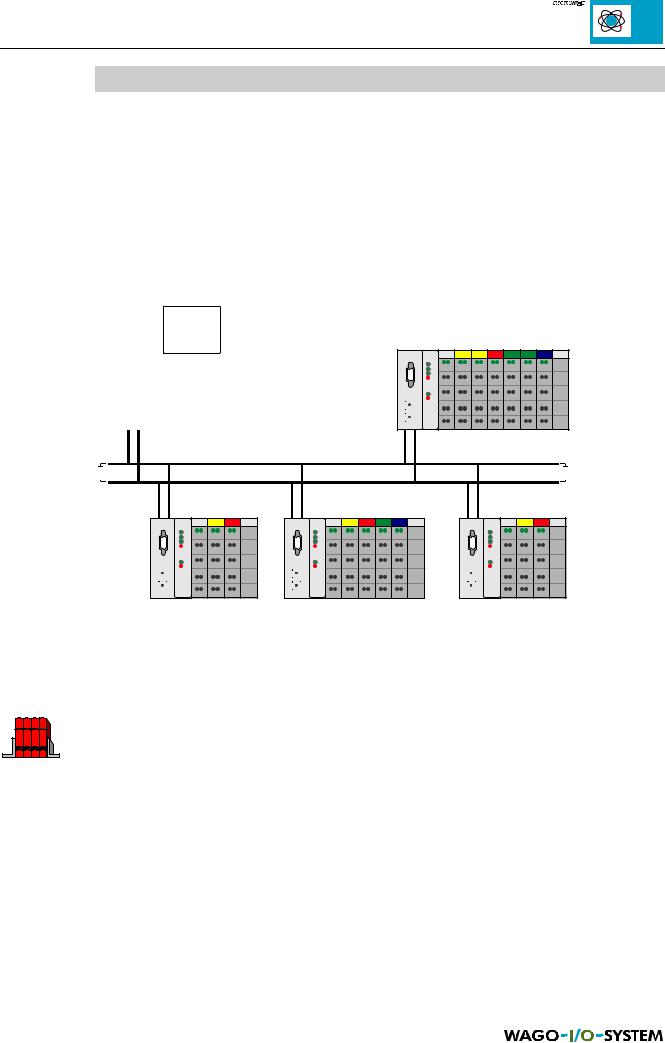
MODBUS is a master/slave system. The master is a superimposed control unit, e.g. a PC or a PLC device. The MODBUS coupler/controller of the WAGO-I/O-SYSTEMS are slave devices.
Bus conflicts do not occur because only one node is sending. The master makes a query for communication. This query can be sent to a specific node or to all nodes as a broadcast message. The nodes receive the query and return a response to the master, depending on the kind of query.
Fig. 4.1: Example of a MODBUS topology
This bus topology is only valid for the variants with the RS 485 interface. With RS 232 it is only possible to have a peer-to-peer connection.
You will find further information on MODBUS in:
Online information on MODBUS: http://www.modicon.com/techpubs/toc7.html
MODBUS tools for PC: |
http://www.win-tech.com |
MODBUS / Description MODBUS |
23 |
15.12.99

|
|
|
|
|
|
|
|
|
|
|
|
|
|
|
|
|
|
|
|
|
|
|
|
24 |
MODBUS / Description MODBUS |
||
15.12.99
5 Configuration
5.1 Coupler
750-312,
750-314,
750-315,
750-316
5.1.1 Settings
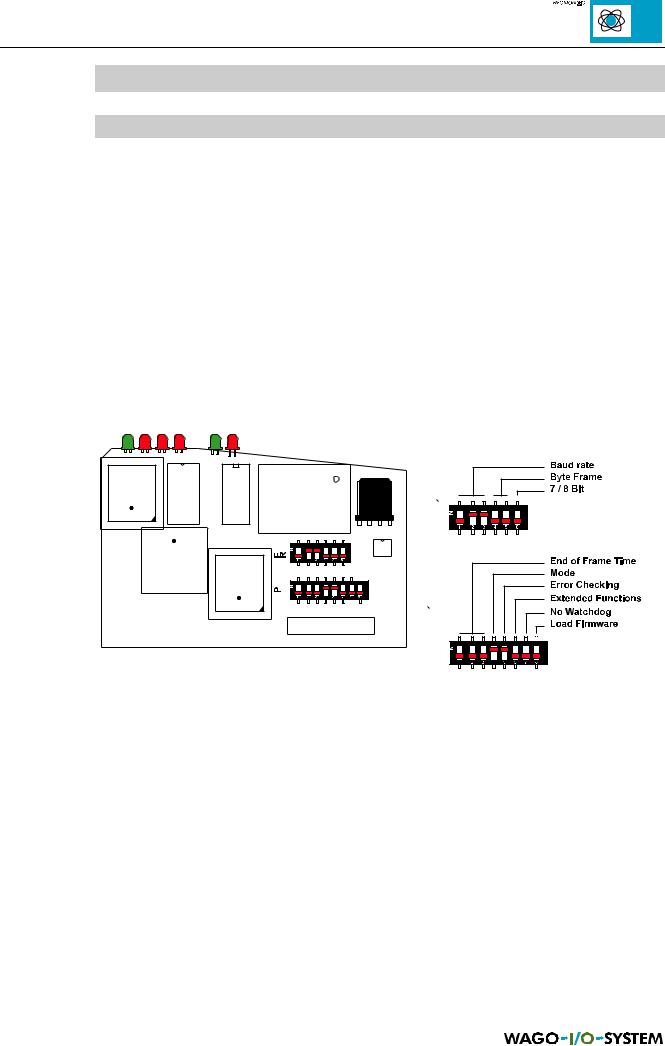
The factory set coupler configuration can be changed using the DIP switches FR and P. The setting is made prior to start-up. Changes to switch settings during running operation does not affect the configuration. This is only read in when switching on the coupler power supply.
The ‘MODBUS coupler/controller’ chapter describes how to remove the enclosure from the coupler to permit settings to be made.
Fig. 5.1: DIP switch arrangement on CPU printed circuit board, coupler
The following is a description of the coupler settings. Here the term ‘Frame’ is frequently used. A ‘Frame’ is a data transmission block.
MODBUS / Configuration |
25 |
15.12.99