Материал: m013800e

Внимание! Если размещение файла нарушает Ваши авторские права, то обязательно сообщите нам

6 Application in Explosive Environments

Classifications meeting the NEC 500

Ex-1.4 Classifications meeting the NEC 500

The following classifications according to NEC 500 (National Electric Code) are valid for North America.

Ex-1.4.1 Divisions

The "Divisions" describe the degree of probability of whatever type of dangerous situation occurring. Here the following assignments apply:

Explosion endangered areas due to combustible gases, fumes, mist and dust:

Division 1 encompasses areas in which explosive atmospheres are to be expected occasionally (> 10 h ≤ 1000 h /year) as well as continuously and long-term (> 1000 h /year).

Division 2 encompasses areas in which explosive atmospheres can be expected rarely and short-term (>0 h ≤ 10 h /year).

Ex-1.4.2 Explosion protection groups

Electrical components for explosion endangered areas are subdivided in three danger categories:

Class I (gases and fumes):

Group A (Acetylene)


Group B (Hydrogen)


Group C (Ethylene)


Group D (Methane)


Class II (dust):

Group E (Metal dust)


Group F (Coal dust)


Group G (Flour, starch and cereal dust)


Class III (fibers):

No sub-groups


WAGO-I/O-SYSTEM 750

Modular I/O-System

Application in Explosive Environments

7

Classifications meeting the NEC 500


Ex-1.4.3 Temperature classes

Electrical components for explosive areas are differentiated by temperature classes:

Temperature classes

Maximum

Ignition temperature


surface temperature

of the combustible materials

T1

450 °C

> 450 °C


T2

300 °C

> 300 °C ≤ 450 °C


T2A

280 °C

> 280 °C ≤ 300 °C


T2B

260 °C

> 260 °C ≤ 280 °C


T2C

230 °C

>230 °C ≤ 260 °C


T2D

215 °C

>215 °C ≤ 230 °C


T3

200 °C

>200 °C ≤ 215 °C


T3A

180 °C

>180 °C ≤ 200 °C


T3B

165 °C

>165 °C ≤ 180 °C


T3C

160 °C

>160 °C ≤ 165 °C


T4

135 °C

>135 °C ≤ 160 °C


T4A

120 °C

>120 °C ≤ 135 °C


T5

100 °C

>100 °C ≤ 120 °C


T6

85 °C

> 85 °C ≤ 100 °C


WAGO-I/O-SYSTEM 750

Modular I/O-System
8 Application in Explosive Environments

Identification

Ex-1.5 Identification

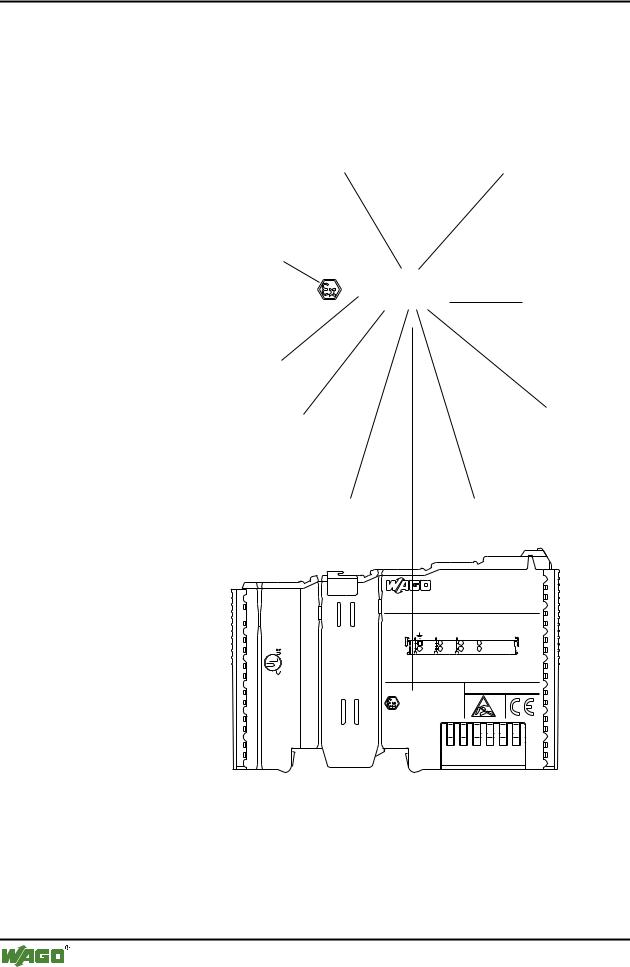
Ex-1.5.1 For Europe

According to CENELEC and IEC

Explosion protection group

Unit category

Community symbol for explosion protected electrical components

II 3 G


KEMA 01ATEX1024 X


EEx nA II T4

Temperature class

Approval body and/or number of the examination certificate

Explosion protection group

E = conforming with European standards Ex = explosion protected component

n = Type of ignition

Extended identification

ITEM-NO.:750-400

24V DC AWG 28-14 55°C max ambient

CL I DIV 2 Grp. A B C D op temp code T4A

LISTED 22ZA AND 22XM

-02----03

4246

1-

2

210


Hansastr. 27

2DI 24V DC 3.0ms


D-32423 Minden

0.08-2.5mm2

0V 24V DI1

Di2

PATENTS PENDING

II 3 G

KEMA 01ATEX1024 X EEx nA II T4

Fig. 1-1: Example for lateral labeling of bus modules


(750-400, 2 channel digital input module 24 V DC)

g01xx03e

WAGO-I/O-SYSTEM 750

Modular I/O-System
Application in Explosive Environments

9

Identification


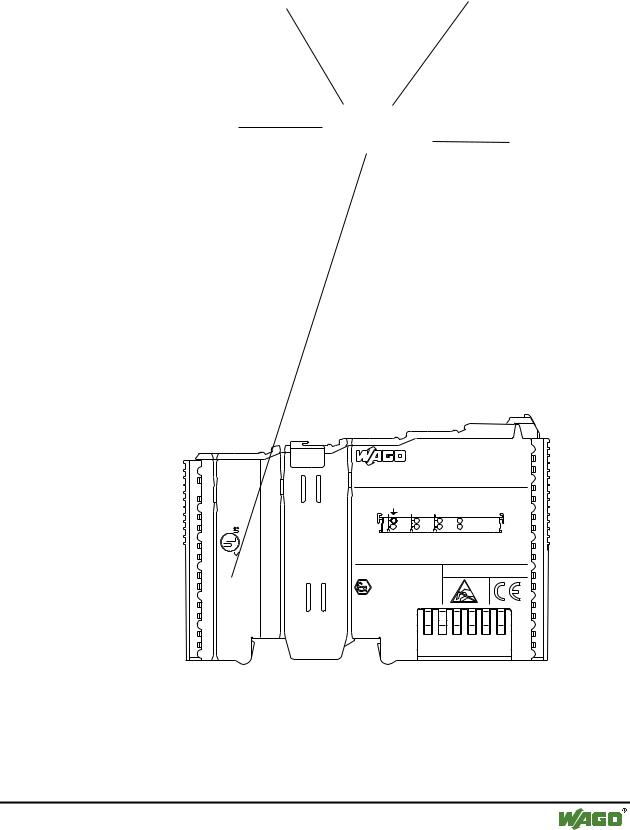
Ex-1.5.2 For America

According to NEC 500

Explosion protection group

Area of application (zone)

(condition of use category)


Explosion group

CL I DIV 2


Grp. ABCD


(gas group)


optemp code T4A

Temperature class


24V DC AWG 28-14 55°C max ambient

CL I DIV 2 Grp. A B C D op temp code T4A

LISTED 22ZA AND 22XM

-02----03

4246

0-

2

410


ITEM-NO.:750-400

Hansastr. 27

2DI 24V DC 3.0ms


D-32423 Minden

0.08-2.5mm2

0V 24V DI1

Di2

PATENTS PENDING

II 3 G

KEMA 01ATEX1024 X EEx nA II T4

Fig. 1-2: Example for lateral labeling of bus modules


(750-400, 2 channel digital input module 24 V DC)

g01xx04e

WAGO-I/O-SYSTEM 750

Modular I/O-System

10 Application in Explosive Environments

Installation regulations

Ex-1.6 Installation regulations

In the Federal Republic of Germany, various national regulations for the installation in explosive areas must be taken into consideration. The basis being the ElexV complemented by the installation regulation DIN VDE 0165/2.91. The following are excerpts from additional VDE regulations:

DIN VDE 0100

installation in power plants with rated voltages up to


1000 V


DIN VDE 0101

installation in power plants with rated voltages above


1 kV


DIN VDE 0800

installation and operation in tele-communication plants


including information processing equipment


DIN VDE 0185

lightning protection systems


The USA and Canada have their own regulations. The following are excerpts from these regulations:

NFPA 70

National Electrical Code Art. 500 Hazardous Locations


ANSI/ISA-RP

Recommended Practice

12.6-1987


C22.1

Canadian Electrical Code


WAGO-I/O-SYSTEM 750

Modular I/O-System