Материал: m013800e
5.1.2 Data exchange between MODBUS master and I/O modules
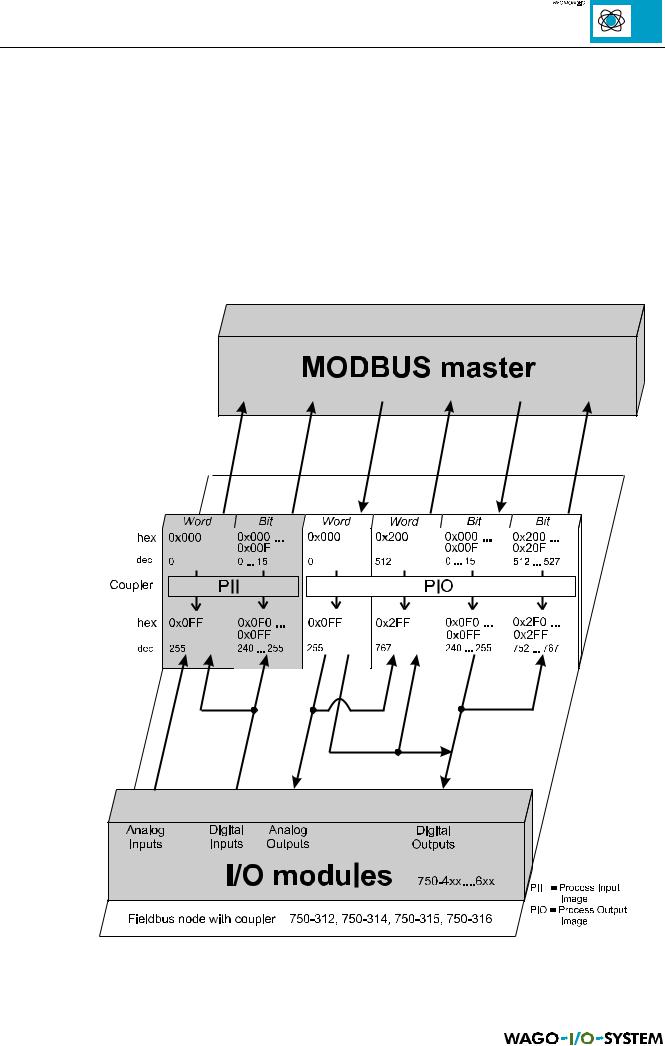
The data exchange between the MODBUS master sand coupler is made by bit or byte reading and writing.
In the coupler are 4 different types of process data:
∙Input words
∙Output words
∙Input bits
∙Output bits
The addresses of the data words in the process illustration of the inputs and outputs are shown in the next illustration:
Fig. 5.2: Data exchange between MODBUS master and I/O modules
MODBUS / Configuration |
31 |
15.12.99

Access word for word to the digital input and output modules is made in accordance with the following table:
Digital inputs/ |
8. |
7. |
6. |
5. |
|
4. |
3. |
2. |
1. |
16. |
15. |
14. |
13. |
|
12. |
11. |
10. |
9. |
outputs |
|
|
|
|
|
|
|
|
|
|
|
|
|
|
|
|
|
|
|
|
|
|
|
|
|
|
|
|
|
|
|
|
|
|
|
|
|
Process data word |
Bit |
Bit |
Bit |
Bit |
|
Bit |
Bit |
Bit |
Bit |
Bit |
Bit |
Bit |
Bit |
|
Bit |
Bit |
Bit |
Bit |
|
15 |
14 |
13 |
12 |
|
11 |
10 |
9 |
8 |
7 |
6 |
5 |
4 |
|
3 |
2 |
1 |
0 |
|
|
|
|
|
|
|
|
|
|
|
|
|
|
|
|
|
||
Byte |
|
|
|
High-Byte |
|
|
|
|
|
|
Low-Byte |
|
|
|
||||
|
|
|
|
|
D1 |
|
|
|
|
|
|
|
D0 |
|
|
|
||
Table 5.10: Allocation of digital inputs/outputs for process data word, coupler |
|
|
|
|
|
|
|
|
||||||||||
5.1.3 Addressing the I/O modules
∙The arrangement of the I/O modules in a node is optional.
∙The I/O module addressing is based on the attendant coupler.
∙Addressing is organised word for word and starts with the word address ‘0’ both for the inputs as well as the outputs.
∙The I/O module addressing corresponds to the sequence of their arrangement behind the coupler. Addressing starts with the bus coupler, which can assign one or more words per channel. This is followed by the I/O module addresses which can assign one or two bits per channel. For the number of input and output bits or bytes please refer to the corresponding I/O module data sheets.
∙Addressing of I/O modules which are assigned to one or two bits per channel is also made word for word. In other words in each case 16 inputs or outputs are allocated one word. If less channels are present the remaining bits of the word remain free or are reserved for extensions.
∙If a node is extended by additional I/O modules for which one or more words are assigned per channel, the I/O module addresses are displaced by one or two bits per channel.
Data width ÿ 1 Word / channel |
Data width = 1 Bit / channel |
Analog input modules |
Digital input modules |
Analog output modules |
Digital output modules |
Input modules for thermal elements |
Digital output modules with diagnosis (2 Bit / channel) |
Input modules for resistance sensors |
Power supply modules with fuse holder / diagnosis |
Pulse width output modules |
Solid State power relay |
Interface module |
Relay output modules |
Up/down counter |
|
I/O modules for angle and path measurement |
|
Table 5.11: I/O module data width |
|
32 |
MODBUS / Configuration |
15.12.99
5.1.4 Application examples
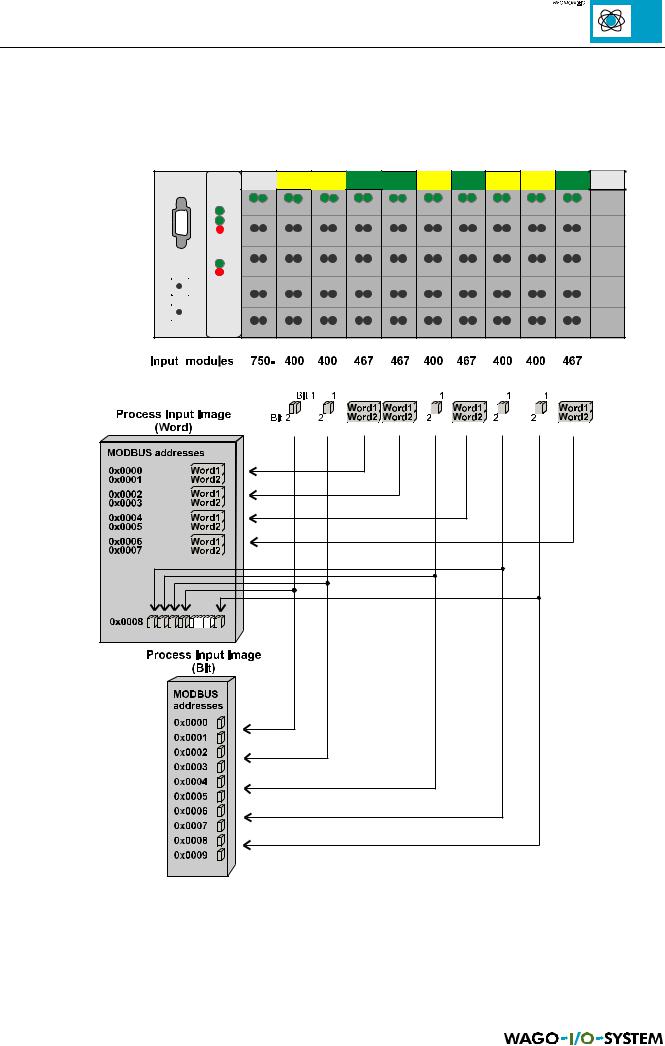
The following figure is an example for a process input image. The configuration comprises of 10 digital and 8 analog inputs. The process image thus has a data length of 8 words for the analog and 1 word for the digital inputs, i.e. 9 words.
Fig. 5.3: Example for process input image, coupler
MODBUS / Configuration |
33 |
15.12.99
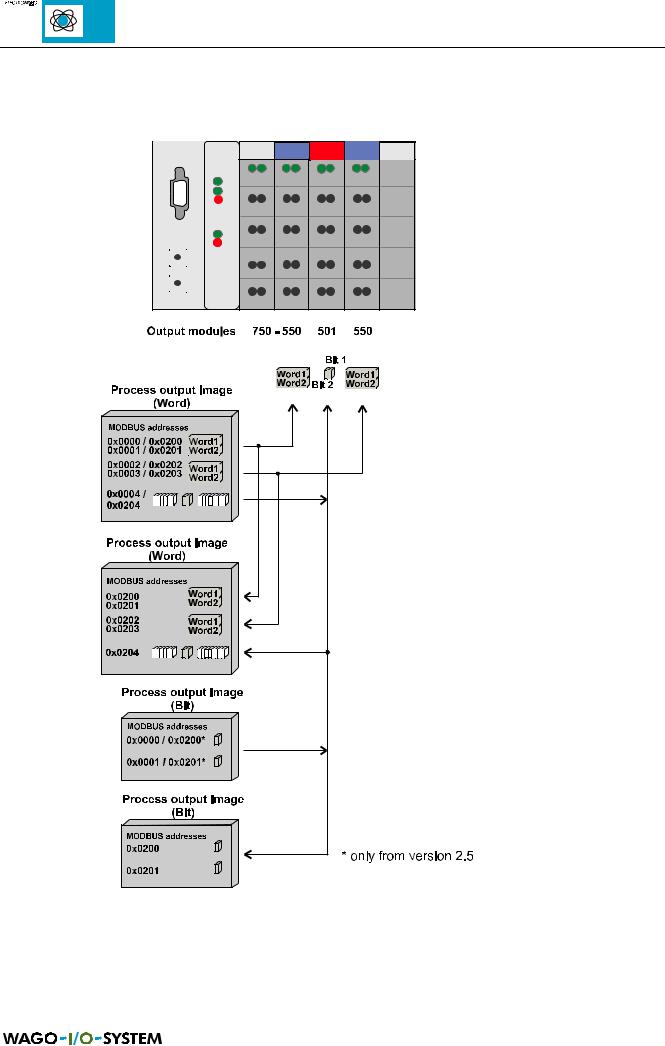
The following configuration comprises of 2 digital and 4 analog outputs. This is an example for a process output image. It comprises of 4 words for the analog and one word for the digital outputs.
Fig. 5.4: Example for process output image, coupler
34 |
MODBUS / Configuration |
15.12.99
5.2 Controller
750-812,
750-814,
750-815,
750-816
5.2.1 Settings
As opposed to the MODBUS coupler the factory configuration of the controller change is not made by DIP switch, but is changed using a PC. The communication between the controller and PC is described in the ‘Start-up and diagnosis’ chapter.
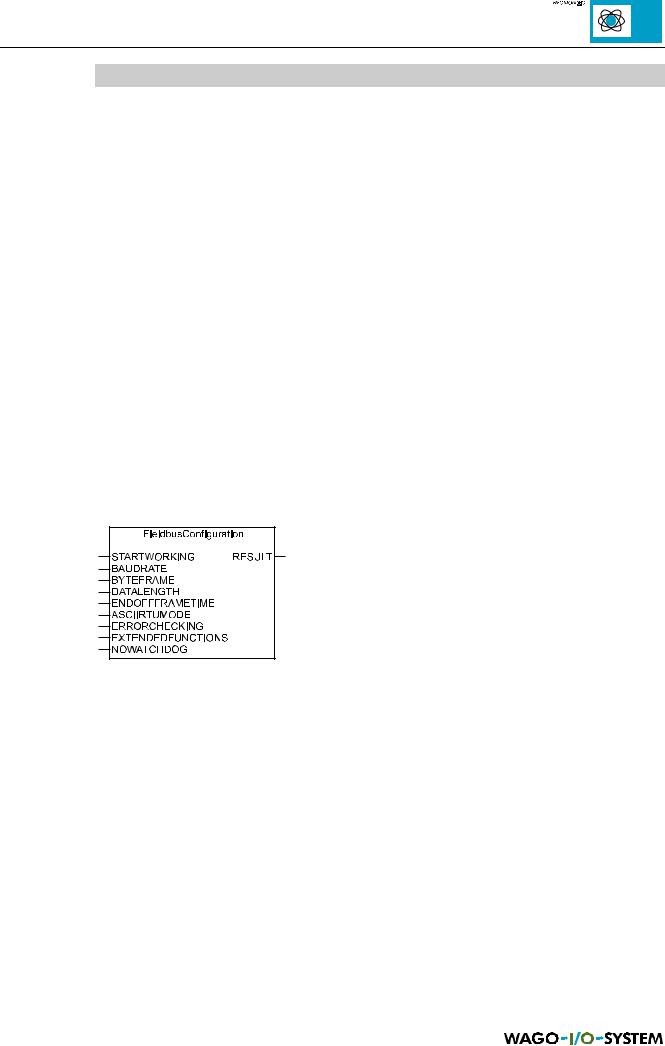
The controller is set on the software side using the ‘Fieldbus configuration’ function block of the WAGO-I/O-PRO library. If this module is taken up in the control program, the setting is made automatically even after changing the controller. The settings are taken over into the controller parameter block. If the desired values are not already set, a firmware reset is automatically made in bus operation and the controller restarts with the selected settings.
If the controller is to be set independent of a machine or plant, a program which only comprises of the configuration module can be downloaded and started from the programming system.
Fig. 5.5: Function block for controller setting
The coupler settings are described as follows. Here the term ‘Frame’ is frequently used. ‘Frame’ is a data transfer record.
MODBUS / Configuration |
35 |
15.12.99