Материал: m013500e_x06
|
|
|
|
|
The WAGO-I/O-SYSTEM 750 • 11 |
||||||
|
|
|
|
|
|
|
Technical Data |
||||
|
|
|
|
|
|
|
|
|
|
|
|
|
|
|
|
|
|
|
|
|
|
|
|
|
Safe electrical isolation |
|
|
|
|
|
|
|
|
|
|
|
Air and creepage distance |
|
acc. to IEC 60664-1 |
|
|
|
|
||||
|
|
|
|
|
|
|
|
|
|
|
|
|
Degree of protection |
|
|
|
|
|
|
|
|
|
|
|
Degree of protection |
|
IP 20 |
|
|
|
|
|
|
|
|
|
|
|
|
|
|
|
|
|
|
|
|
|
Electromagnetic compatibility* |
|
|
|
|
|
|
|
|||
|
Directive |
|
Test values |
|
|
Strength |
|
Evaluation |
|
|
|
|
|
|
|
|
|
|
class |
|
criteria |
|
|
|
Immunity to interference acc. to EN 50082-2 (96) |
|
|
|
|
||||||
|
EN 61000-4-2 |
|
4kV/8kV |
(2/4) |
|
B |
|
||||
|
|
|
|
|
|
|
|
||||
|
EN 61000-4-3 |
|
10V/m 80% AM |
(3) |
|
A |
|||||
|
|
|
|
|
|
|
|
||||
|
EN 61000-4-4 |
|
2kV |
(3/4) |
|
B |
|||||
|
|
|
|
|
|
|
|
||||
|
EN 61000-4-6 |
|
10V/m 80% AM |
(3) |
|
A |
|||||
|
|
|
|
|
|
|
|
|
|||
|
Emission of interference acc. to |
|
|
Measuring |
|
Class |
|
||||
|
EN 50081-2 (94) |
|
|
|
|
distance |
|
|
|
|
|
|
EN 55011 |
|
30 dBµV/m |
|
|
(30m) |
|
A |
|
||
|
|
|
|
|
|
|
|
|
|
|
|
|
|
|
37 dBµV/m |
|
|
|
|
|
|
|
|
|
|
|
|
|
|
|
|
|
|||
|
Emission of interference acc. to |
|
|
Measuring |
|
Class |
|
||||
|
EN 50081-1 (93) |
|
|
|
|
distance |
|
|
|
|
|
|
EN 55022 |
30 dBµV/m |
|
|
(10m) |
|
B |
|
|||
37dBµV/m * Exception: 750-630, 750-631
Range of applica- |
Required specification |
Required specification |
|
tion |
emission of interference |
immunity to interference |
|
Industrial areas |
EN 50081-2 |
: 1993 |
EN 50082-2 : 1996 |
Residential areas |
EN 50081-1 |
: 1993*) |
EN 50082-1 : 1992 |
|
|
|
|
*) The system meets the requirements on emission of interference in residential areas with the fieldbus coupler/controller for:
ETHERNET 750-342/-842
LonWorks 750-319/-819
CANopen 750-337/-837
DeviceNet 750-306/-806
MODBUS 750-312/-314/ -315/ -316 750-812/-814/ -815/ -816
With a special permit, the system can also be implemented with other fieldbus couplers/controllers in residential areas (housing, commercial and business areas, small-scale enterprises). The special permit can be obtained from an authority or inspection office. In Germany, the Federal Office for Post and Telecommunications and its branch offices issues the permit.
It is possible to use other field bus couplers / controllers under certain boundary conditions. Please contact WAGO Kontakttechnik GmbH.
WAGO-I/O-SYSTEM 750
DeviceNet
12• The WAGO-I/O-SYSTEM 750
Technical Data
Maximum power dissipation of the components
Bus modules |
0.8 W / bus terminal (total power dissipation, sys- |
|
tem/field) |
|
|
Fieldbus coupler / controller |
2.0 W / coupler / controller |
|
|
Warning
The power dissipation of all installed components must not exceed the maximal conductible power of the housing (cabinet).
When dimensioning the housing, care is to be taken that even under high external temperatures, the temperature inside the housing does not exceed the permissible ambient temperature of 55 °C.
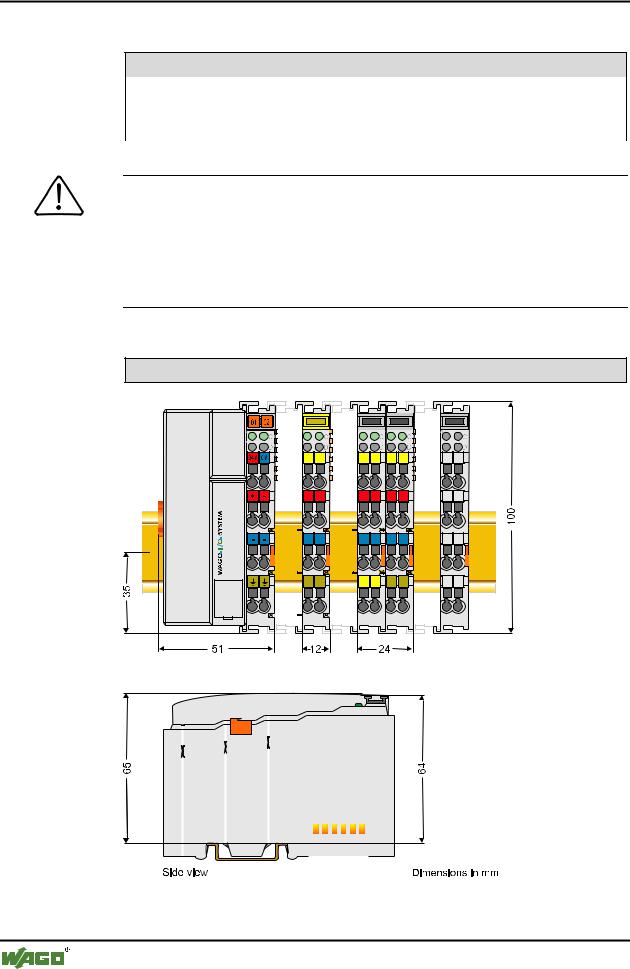
Dimensions |
|
|
|
|
|
|
|
|
|
|
|
|
|
|
|
|
|
|
|
|
|
|
|
|
|
|
|
|
|
|
Fig. 2-2: Dimensions |
g01xx05e |
|||
WAGO-I/O-SYSTEM 750
DeviceNet
The WAGO-I/O-SYSTEM 750 |
• 13 |
Manufacturing Number |
|
|
|
2.3 Manufacturing Number
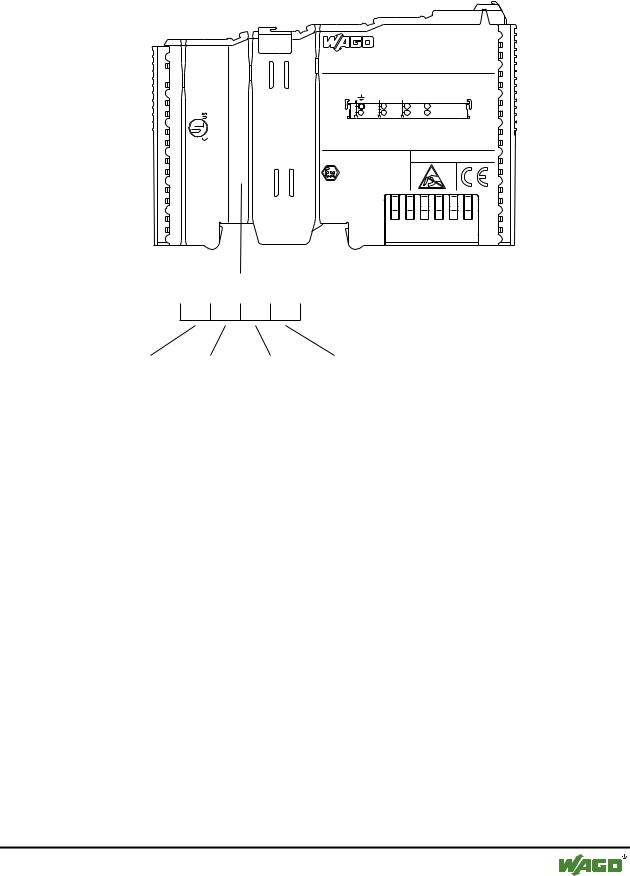
The production number is part of the lateral marking on the component.
24V DC AWG 28-14 55°C max ambient
CL I DIV 2 Grp. A B C D op temp code T4A
LISTED 22ZA AND 22XM
-02----03 |
4246 |
1- |
2 |
090 |
|
|
ITEM-NO.:750-400 |
Hansastr. 27 |
2DI 24V DC 3.0ms |
|
|
D-32423 Minden |
0.08-2.5mm2 |
0V 24V DI1
Di2
PATENTS PENDING
II 3 G
KEMA 01ATEX1024 X EEx nA II T4
Manufacturing Number |
|
|||
|
0 9 0 |
1 - - 0 |
2 |
|
Calendar |
Year |
Software |
Hardware |
|
week |
|
version |
version |
|
Fig. 2-3: |
Manufacturing Number |
g01xx09e |
||
The manufacturing number consists of the production week and year, the software version (if available), the hardware version of the component, the firmware loader (if available) and further internal information for
WAGO Kontakttechnik GmbH.
As of calendar week 43/2000, the production number is also printed on the cover of the configuration and programming interface of the fieldbus coupler or controller.
WAGO-I/O-SYSTEM 750
DeviceNet
14• The WAGO-I/O-SYSTEM 750
Storage, Consignment and Transport
2.4 Storage, Consignment and Transport
Wherever possible, the components are to be stored in their original packaging. Likewise, the original packaging provides optimal protection during transport.
When consigning or repacking the components, the contacts must not be soiled or damaged. The components must be stored and transported in appropriate containers/packaging. Thereby, the ESD information is to be regarded.
Statically shielded transport bags with metal coatings are to be used for the transport of open components for which soiling with amine, amide and silicone has been ruled out, e.g. 3M 1900E.
2.5 Mechanical Setup
2.5.1 Installation Position
Along with horizontal and vertical installation, all other installation positions are allowed.
Attention
In the case of vertical assembly, an end stop has to be mounted as an additional safeguard against slipping.
WAGO item 249-117/002-000 End stop for DIN 35 rail, 10 mm wide
2.5.2 Total Expansion
The maximum total expansion of a node is calculated as follows:
Quantity |
Width |
Components |
1 |
51 mm |
coupler / controller |
|
|
|
64 |
12 mm |
bus modules |
|
|
- inputs / outputs |
|
|
- power supply modules |
|
|
- etc. |
|
|
|
1 |
12 mm |
end stop |
sum |
831 mm |
|
Warning
The maximal total expansion of a node must not exceed 831 mm
WAGO-I/O-SYSTEM 750
DeviceNet
The WAGO-I/O-SYSTEM 750 |
• 15 |
Mechanical Setup |
|
|
|
2.5.3 Assembly onto Carrier Rail
2.5.3.1 Carrier rail properties
All system components can be snapped directly onto a carrier rail in accordance with the European standard EN 50022 (DIN 35).
Warning
WAGO supplies standardized carrier rails that are optimal for use with the I/O system. If other carrier rails are used, then a technical inspection and approval of the rail by WAGO Kontakttechnik GmbH must take place.
Carrier rails have different mechanical and electrical properties. For the optimal system setup on a carrier rail, certain marginal terms must be observed:
•The material must be non-corrosive.
•Most components have a contact to the carrier rail to ground electro-magnetic disturbances. In order to avoid corrosion, this tin-plated carrier rail contact must not form a galvanic cell with the material of the carrier rail which generates a differential voltage above 0.5 V (saline solution of 0.3% at 20°C) .
•The carrier rail must optimally support the EMC measures integrated into the system and the shielding of the bus module connections.
•A sufficiently stable carrier rail should be selected and, if necessary, several assembly points (every 20 cm) should be used in order to prevent bending and twisting (torsion).
•The geometry of the carrier rail must not be altered in order to secure the safe hold of the components. In particular, when shortening or mounting the carrier rail, it must not be crushed or bent.
•The base of the components extends into the profile of the carrier rail. For carrier rails with a height of 7.5 mm, assembly points (screws) are to be riveted under the node in the carrier rail (slotted head captive screws or blind rivets).
WAGO-I/O-SYSTEM 750
DeviceNet