Материал: m013500e_x06

6 • Important Comments
Font Conventions
1.3 Font Conventions
Italic
Italic
\
END
< >
Courier
Names of path and files are marked italic i.e.: C:\programs\WAGO-IO-CHECK
Menu items are marked as bold italic i.e.: Save
A backslash between two names marks a sequence of menu items
i.e.: File\New
Press buttons are marked as bold with small capitals i.e.: ENTER
Keys are marked bold within angle brackets i.e.: <F5>
Program code is printed with the font Courier. i.e.:
1.4 Number Notation
Number Code |
Example |
Note |
Decimal |
100 |
normal notation |
|
|
|
Hexadecimal |
0x64 |
C notation |
|
|
|
Binary |
'100' |
Within ', |
|
'0110.0100' |
Nibble separated with dots |
|
|
|
WAGO-I/O-SYSTEM 750
DeviceNet
Important Comments |
• 7 |
Safety Notes |
|
|
|
1.5 Safety Notes
Attention
Switch off the system prior to working on bus modules!
In the event of deformed contacts, the module in question is to be replaced, as its functionality can no longer be ensured on a long-term basis.
The components are not resistant against materials having seeping and insulating properties. Belonging to this group of materials is: e.g. aerosols, silicones, triglycerides (found in some hand creams).
If it cannot be ruled out that these materials appear in the component environment, then additional measures are to be taken:
-installation of the components into an appropriate housing
-handling of the components only with clean tools and materials.
Attention
Cleaning of soiled contacts may only be done with ethyl alcohol and leather cloths. Thereby, the ESD information is to be regarded.
Do not use any contact spray, as in a worst-case scenario; the functioning of the contact area can be impaired.
The WAGO-I/O-SYSTEM 750 and its components are an open system. It must only be assembled in housings, cabinets or in electrical operation rooms. Access must only be given via a key or tool to authorized qualified personnel.
The relevant valid and applicable standards and guidelines concerning the installation of switch boxes are to be observed.
ESD (Electrostatic Discharge)
The modules are equipped with electronic components that may be destroyed by electrostatic discharge. When handling the modules, ensure that the environment (persons, workplace and packing) is well grounded. Avoid touching conductive components, e.g. gold contacts.
WAGO-I/O-SYSTEM 750
DeviceNet
8 • Important Comments
Scope
1.6 Scope
Item no. |
Description |
750-306 |
fieldbus Coupler DeviceNet; 125 – 500 kBaud |
|
|
750-806 |
prog. Fieldbus Controller DeviceNet; 125 – 500 kBaud |
|
|
Attention
This document is a supplement for the DeviceNet manual.
This manual describes the modular WAGO-I/O-SYSTEM 750 with the fieldbus Coupler for DeviceNet or with the programmable fieldbus Controller for DeviceNet.
This extract does not contain:
The chapter 3 "I/O modules"
(Description of the field bus independent I/O modules).
1.7 Abbreviation
AI |
Analog Input |
AO |
Analog Output |
BC |
BusCoupler |
CAL |
CAN Application Layer |
CAN |
Controller Area Network |
DI |
Digital Input |
DIP |
Dual In-line Package |
DO |
Digital Output |
EDS |
Electronic Data Sheets |
I/O |
Input/Output |
ID |
Identifier, Identification |
Idx |
Index |
ISO/ OSI |
International Organization for Standardization / Open Systems Interconnec- |
|
tion (model) |
M |
Master |
MAC ID |
Media Access Control Identifier (nodeaddress) |
MS |
Module Status |
NMT |
Network Management |
NS |
Network Status |
PFC |
Programmable fieldbus Controller |
RO |
Read Only |
RW |
Read/Write |
WAGO-I/O-SYSTEM 750
DeviceNet
The WAGO-I/O-SYSTEM 750 |
• 9 |
System Description |
|
|
|
2 The WAGO-I/O-SYSTEM 750
2.1 System Description
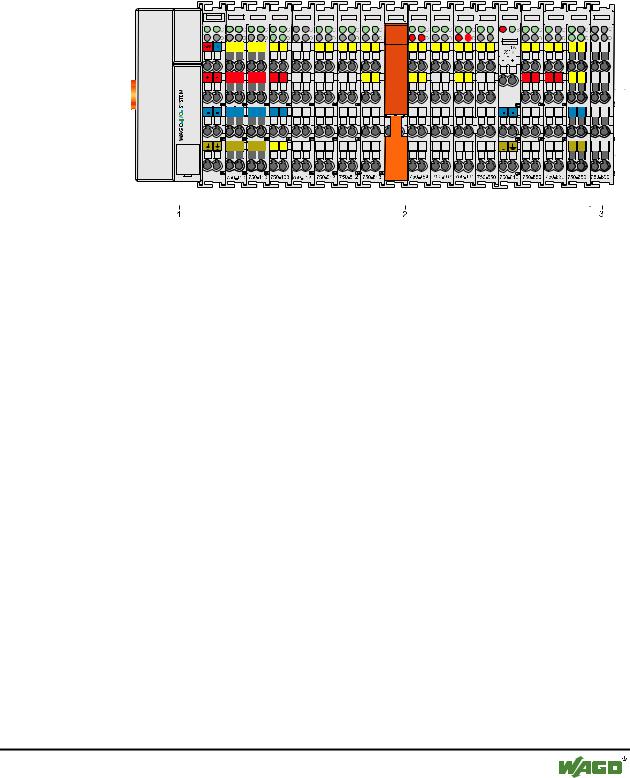
The WAGO-I/O-SYSTEM 750 is a modular, fieldbus independent I/O system. It is comprised of a fieldbus coupler/controller (1) and up to 64 connected fieldbus modules (2) for any kind of signal. Together, these make up the fieldbus node. The end module (3) completes the node.
|
|
|
|
|
|
|
|
|
|
|
|
|
|
|
|
|
|
|
|
|
|
|
|
|
|
|
|
|
|
|
|
|
|
|
|
|
|
|
|
|
|
|
|
|
|
|
|
|
|
|
|
|
|
|
|
|
|
|
|
|
|
|
|
|
|
|
|
|
|
|
|
|
|
|
|
|
|
|
|
|
|
|
|
|
|
|
|
|
|
|
|
|
|
|
|
|
|
|
|
|
|
|
|
|
|
|
|
|
|
|
|
|
|
|
|
|
|
|
|
|
|
|
|
|
|
|
|
|
|
|
|
|
|
|
|
|
|
|
|
|
|
|
|
|
|
|
|
|
|
|
|
|
|
|
|
|
|
|
|
|
|
|
|
|
|
|
|
|
|
|
|
|
|
|
|
|
|
|
|
|
|
|
|
|
|
|
|
|
|
|
|
|
|
|
|
|
|
|
|
|
|
|
|
|
|
|
|
|
|
|
|
|
|
|
|
|
|
|
|
|
|
|
|
|
|
|
|
|
|
|
|
|
|
|
|
|
|
|
|
|
|
|
|
|
|
|
|
|
|
|
|
|
|
|
|
|
|
|
|
|
|
|
|
|
|
|
|
|
|
|
|
|
|
|
|
|
|
|
|
|
|
|
|
|
|
|
|
|
|
|
|
|
|
|
|
|
|
|
|
|
|
|
|
|
|
|
|
|
|
|
|
|
|
|
|
|
|
|
|
|
|
|
|
|
|
|
|
|
|
|
|
|
|
|
|
|
|
|
|
|
|
|
|
|
|
|
|
|
|
|
|
|
|
|
|
|
|
|
|
|
|
|
|
|
|
|
|
|
|
|
|
|
|
|
|
|
|
|
|
|
|
|
|
|
|
|
|
|
|
|
|
|
|
|
|
|
|
|
|
|
|
|
|
|
|
|
|
|
|
|
|
|
|
|
|
|
|
|
|
|
|
|
|
|
|
|
|
|
|
|
|
|
|
|
|
|
|
|
|
|
|
|
|
|
|
|
|
|
|
|
|
|
|
|
|
|
|
|
|
|
|
|
|
|
|
|
|
|
|
|
|
|
|
|
|
|
|
|
|
|
|
|
|
|
|
|
|
|
|
|
|
|
|
|
|
|
|
|
|
|
|
|
|
|
|
|
|
|
|
|
|
|
|
|
|
|
|
|
|
|
|
|
|
|
|
|
|
|
|
|
|
|
|
|
|
|
|
|
|
|
|
|
|
|
|
|
|
|
|
|
|
|
|
|
|
|
|
|
|
|
|
|
|
|
|
|
|
|
|
|
|
|
|
|
|
|
|
|
|
|
|
|
|
|
|
|
|
|
|
|
|
|
|
|
|
|
|
|
|
|
|
|
|
|
|
|
|
|
|
|
|
|
|
|
|
|
|
|
|
|
|
|
|
|
|
|
|
|
|
|
|
|
|
|
|
|
|
|
|
|
|
|
|
|
|
|
|
|
|
|
|
|
|
|
|
|
|
|
|
|
|
|
|
|
|
|
|
|
|
|
|
|
|
|
|
|
|
|
|
|
|
|
|
|
|
|
|
|
|
|
|
|
|
|
|
|
|
|
|
|
|
|
|
|
|
|
|
|
|
|
|
|
|
|
|
|
|
|
|
|
|
|
|
|
|
|
|
|
|
|
|
|
|
|
|
|
|
|
|
|
|
|
|
|
|
|
|
|
|
|
|
|
|
|
|
|
|
|
|
|
|
|
|
|
|
|
|
|
|
|
|
|
|
|
|
|
|
|
|
|
|
|
|
|
|
|
|
|
|
|
|
|
|
|
|
|
|
|
|
|
|
|
|
|
|
|
|
|
|
|
|
|
|
|
|
|
|
|
|
|
|
|
|
|
|
|
|
|
|
|
|
|
|
|
|
|
|
|
|
|
|
|
|
|
|
|
|
|
|
|
|
|
|
|
|
|
|
|
|
|
|
|
|
|
|
|
|
|
|
|
|
|
|
|
|
|
|
|
|
|
|
|
|
|
|
|
|
|
|
|
|
|
|
|
|
|
|
|
|
|
|
|
|
|
|
|
|
|
|
|
|
|
|
|
|
|
|
|
|
|
|
|
|
|
|
|
|
|
|
|
|
|
|
|
|
|
|
|
|
|
|
|
|
|
|
|
|
|
|
|
|
|
|
|
|
|
|
|
|
|
|
|
|
|
|
|
|
|
|
|
|
|
|
|
|
|
|
|
|
|
|
|
|
|
|
|
|
|
|
|
|
|
|
|
|
|
|
|
|
|
|
|
|
|
|
|
|
|
|
|
|
|
|
|
|
|
|
|
|
|
|
|
|
|
|
|
|
|
|
|
|
|
|
|
|
|
|
|
|
|
|
|
|
|
|
|
|
|
|
|
|
|
|
|
|
|
|
|
|
|
|
|
|
|
|
|
|
|
|
|
|
|
|
|
|
|
|
|
|
|
|
|
|
|
|
|
|
|
|
|
|
|
|
|
|
|
|
|
|
|
|
|
|
|
|
|
|
|
|
|
|
|
|
|
|
|
|
|
|
|
|
|
|
|
|
|
|
|
|
|
|
|
|
|
|
|
|
|
|
|
|
|
|
|
|
|
|
|
|
|
|
|
|
|
|
|
|
|
|
|
|
|
|
|
|
|
|
|
|
|
|
|
|
|
|
|
|
|
|
|
|
|
|
|
|
|
|
|
|
|
|
|
|
|
|
|
|
|
|
|
|
|
|
|
|
|
|
|
|
|
|
|
|
|
|
|
|
|
|
|
|
|
|
|
|
|
|
|
|
|
|
|
|
|
|
|
|
|
|
|
|
|
|
|
|
|
|
|
|
|
|
|
|
|
|
|
|
|
|
|
|
|
|
|
|
|
|
|
|
|
|
|
|
|
|
|
|
|
|
|
|
|
|
|
|
|
|
|
|
|
|
|
|
|
|
|
|
|
|
|
|
|
|
|
|
|
|
|
|
|
|
|
|
|
|
|
|
|
|
|
|
|
|
|
|
|
|
|
|
|
|
|
|
|
|
|
|
|
|
|
|
|
|
|
|
|
|
|
|
|
|
|
|
|
|
|
|
|
|
|
|
|
|
|
|
|
|
|
|
|
|
|
|
|
|
|
|
|
|
|
|
|
|
|
|
|
|
|
|
|
|
|
|
|
|
|
|
|
|
|
|
|
|
|
|
|
|
|
|
|
|
|
|
|
|
|
|
|
|
|
|
|
|
|
|
|
|
|
|
|
|
|
|
|
|
|
|
|
|
|
|
|
|
|
|
|
|
|
|
|
|
|
|
|
|
|
|
|
|
|
|
|
|
|
|
|
|
|
|
|
|
|
|
|
|
|
|
|
|
|
|
|
|
|
|
|
|
|
|
|
|
|
|
|
|
|
|
|
|
|
|
|
|
|
|
|
|
|
|
|
|
|
|
|
|
|
|
|
|
|
|
|
|
|
|
|
|
|
|
|
|
|
|
|
|
|
|
|
|
Fig. 2-1: Fieldbus node |
|
|
|
|
|
|
|
|
|
|
|
|
|
g0xxx00x |
|||||||||||||||||||||||||||||||||||||||||||||||||||||||
Couplers / controllers for fieldbus systems such as PROFIBUS, INTERBUS, ETHERNET TCP/IP, CAN (CANopen, DeviceNet, CAL), MODBUS, LON and others are available.
The coupler / controller contains the fieldbus interface, electronics and a power supply terminal. The fieldbus interface forms the physical interface to the relevant fieldbus. The electronics process the data of the bus modules and make it available for the fieldbus communication. The 24 V system supply and the 24 V field supply are fed in via the integrated power supply terminal.
The fieldbus coupler communicates via the relevant fieldbus. The programmable fieldbus controller (PFC) enables the implementation of additional PLC functions. Programming is done with the WAGO-I/O-PRO 32 in accordance with IEC 61131-3.
Bus modules for diverse digital and analogue I/O functions as well as special functions can be connected to the coupler / controller. The communication between the coupler/controller and the bus modules is carried out via an internal bus.
The WAGO-I/O-SYSTEM 750 has a clear port level with LEDs for the status indication, insertable mini WSB markers and pullout group marker carriers. The 3-wire technology supplemented by a ground wire connection allows the direct sensor/actuator wiring.
WAGO-I/O-SYSTEM 750
DeviceNet
10 • The WAGO-I/O-SYSTEM 750
Technical Data
2.2 Technical Data
Mechanic
|
Material |
Polycarbonate, Polyamide 6.6 |
|
|
|
|
|
|
Dimensions Coupler / Controller |
51 mm x 65* mm x 100 mm |
|
|
|
|
|
|
Dimensions I/O module, single |
12 mm x 64* mm x 100 mm |
|
|
|
|
|
|
Dimensions I/O module, double |
24 mm x 64* mm x 100 mm |
|
|
|
|
|
|
Installation |
on DIN 35 with interlock |
|
|
|
|
|
|
modular by |
double featherkey-dovetail |
|
|
|
|
|
|
Mounting position |
any position |
|
|
|
|
|
|
Length of entire node |
≤ 831 mm |
|
|
|
|
|
|
Marking |
marking label type 247 and 248 |
|
|
|
paper marking label 8 x 47 mm |
|
|
|
|
|
|
Wire range |
|
|
|
Wire range |
CAGE CLAMP® Connection |
|
|
|
0,08 mm² ... 2.5 mm² |
|
|
|
AWG 28-14 |
|
|
|
8 – 9 mm Stripped length |
|
|
|
|
|
|
Contacts |
|
|
|
Power jumpers contacts |
blade/spring contact |
|
|
|
self-cleaning |
|
|
|
|
|
|
Current via power contactsmax |
10 A |
|
|
Voltage drop at Imax |
< 1 V/64 modules |
|
|
Data contacts |
slide contact, hard gold plated |
|
|
|
1,5µ, self-cleaning |
|
|
|
|
|
|
Climatic environmental conditions |
|
|
|
Operating temperature |
0 °C ... 55 °C |
|
|
|
|
|
|
Storage temperature |
-20 °C ... +85 °C |
|
|
|
|
|
|
Relative humidity |
95 % without condensation |
|
|
|
|
|
|
Resistance to harmful substances |
acc. to IEC 60068-2-42 and IEC 60068-2-43 |
|
|
|
|
|
|
Special conditions |
Ensure that additional measures for components are |
|
|
|
taken, which are used in an environment involving: |
|
|
|
– dust, caustic vapors or gasses |
|
|
|
– ionization radiation. |
|
|
|
|
|
|
Mechanical strength |
|
|
|
Vibration resistance |
acc. to IEC 60068-2-6 |
|
|
|
|
|
|
Shock resistance |
acc. to IEC 60068-2-27 |
|
|
|
|
|
|
Free fall |
acc. to IEC 60068-2-32 |
|
|
|
≤ 1m (module in original packing) |
|
|
|
|
|
|
|
* from upper edge of DIN 35 rail |
|
WAGO-I/O-SYSTEM 750
DeviceNet