Материал: Гольцева О.Ю. Международное право в официальных документах. Под ред. И.А. Горшеневой
321
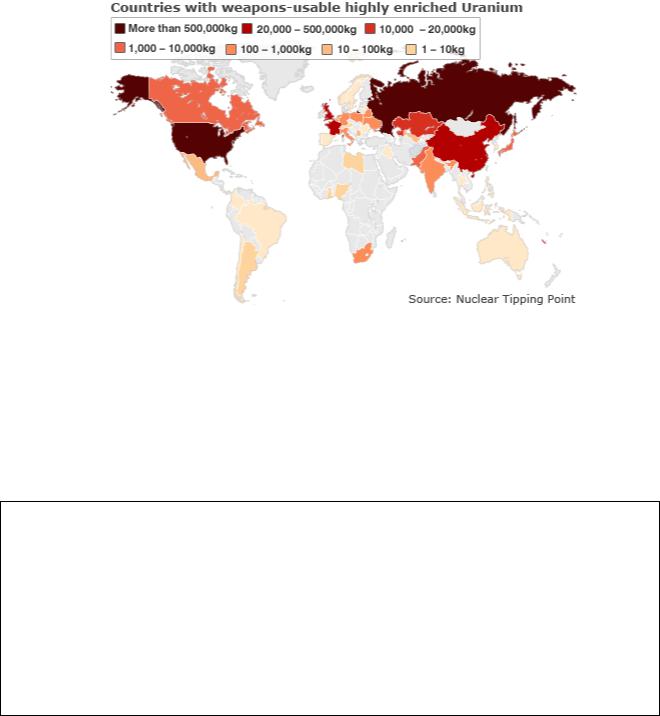
5.Study the chart below and discuss the following questions.
6.What is enriched uranium used for?
7.What countries are have enriched uranium produc-
tion?
8.Do all this countries have nuclear weapons?
9.What is the basis for the decision not to let any other countries into the “nuclear club”?
Exercise 20. Look at the first sentence of the article
(in bold) which has been turned into the headline of the article. Compare the structure of both pieces: what changes have been made?
Now read the article. What was the agenda of the summit? What issues came up?
Nuclear security summit hears of terror risk
World leaders at a summit on nuclear security in Washington have heard dire warnings of the danger of nuclear material falling into the wrong hands.
US President Barack Obama, opening the biggest international meeting hosted by the US since 1945, greeted leaders from nearly 50 countries.

322
Officials said more should be done to prevent theft or smuggling.
Meanwhile, France's leader stressed his country could not give up its own nuclear weapons.
The US welcomed a Ukrainian pledge to eliminate its stockpile of highly enriched uranium by 2012.
The two-day summit is taking place without representatives of Iran and North Korea, neither of whom were invited by the US because of the disputes over their nuclear programmes.
Israeli Prime Minister Benjamin Netanyahu dropped plans to attend the summit, reportedly because of concern that Muslim states planned to press for Israel to open its own nuclear facilities to international inspection.
'Proliferators not welcome'
The head of the International Atomic Energy Agency,
Ikia Amano, said that nuclear powers needed to do more to protect nuclear materials. "The problem is that nuclear material and radioactive material are not well protected and member states need to better protect these materials against the theft or smuggling," he told the BBC.
Exercise 21. Read the article below and translate it into Russian. Express your opinion on the information of the article.
Washington (CNN) – Ukraine announced Monday that it will get rid of all its highly enriched uranium, which can be used in nuclear weapons, within the next two years.
The announcement by Ukrainian President Viktor Yanukovich followed his meeting with President Obama before the start of a 47-nation summit on nuclear security.
In an exclusive interview with CNN on Monday, Yanukovich said that most of his nation's highly enriched uranium would be gone by the end of 2010.
"The Ukraine has quite a number of power plants and various universities and research institutes where we are

323
trying to understand to best utilize nuclear in a peaceful means," Yanukovich told CNN foreign affairs correspondent Jill Dougherty. "We are working on it. However, we are already taking the necessary step to remove highly enriched uranium from the country. By the end of this year, Ukraine is going to have the larger part of this uranium taken out of the country".
A White House statement said Obama "praised Ukraine's decision as a historic step and a reaffirmation of Ukraine's leadership in nuclear security and nonproliferation".
"Ukraine joins the United States in the international effort to convert civil nuclear research facilities to operate with low enriched uranium fuel, which is becoming the global standard in the 21st century", the statement said.
Exercise 22. Study the text of the treaty and be ready to answer the following questions.
1.What countries were the original parties to the treaty?
2.When and where was the treaty signed?
3.What is the date of its entry into force?
4.What are the depository governments?
5.What is proclaimed as a principal aim of the treaty?
Treaty Banning Nuclear Weapon Tests in the Atmosphere, in Outer Space and under Water
Signed by the Original Parties, the Union of Soviet Socialist Republics, the United Kingdom of Great Britain and Northern Ireland and the United States of America at Moscow: 5 August 1963.
Opened for signature at London (L), Moscow (M) and Washington (W): 8 August 1963.
Entered into force: 10 October 1963.
Depositary Governments: Russian Federation, United Kingdom of Great Britain and Northern Ireland and United States of America.

324
The Governments of the United States of America, the United Kingdom of Great Britain and Northern Ireland, and the Union of Soviet Socialist Republics, hereinafter referred to as the "Original Parties",
Proclaiming as their principal aim the speediest possible achievement of an agreement on general and complete disarmament under strict international control in accordance with the objectives of the United Nations which would put an end to the armaments race and eliminate the incentive to the production and testing of all kinds of weapons, including nuclear weapons,
Seeking to achieve the discontinuance of all test explosions of nuclear weapons for all time, determined to continue negotiations to this end, and desiring to put an end to the contamination of man's environment by radioactive substances,
Have agreed as follows:
Article I
1. Each of the Parties to this Treaty undertakes to prohibit, to prevent, and not to carry out any nuclear weapon test explosion, or any other nuclear explosion, at any place under its jurisdiction or control:
(a)in the atmosphere; beyond its limits, including outer space; or under water, including territorial waters or high seas; or
(b)in any other environment if such explosion causes radioactive debris to be present outside the territorial limits of the State under whose jurisdiction or control such explosion is conducted. It is understood in this connection that the provisions of this subparagraph are without prejudice to the conclusion of a Treaty resulting in the permanent banning of all nuclear test explosions, including all such explosions underground, the conclusion of which, as the Parties have stated in the Preamble to this Treaty, they seek to achieve.

325
2. Each of the Parties to this Treaty undertakes furthermore to refrain from causing, encouraging, or in any way participating in, the carrying out of any nuclear weapon test explosion, or any other nuclear explosion, anywhere which would take place in any of the environments described, or have the effect referred to, in paragraph 1 of this Article.
Article II
1.Any Party may propose amendments to this Treaty. The text of any proposed amendment shall be submitted to the Depositary Governments which shall circulate it to all Parties to this Treaty. Thereafter, if requested to do so by one-third or more of the Parties, the Depositary Governments shall convene a conference, to which they shall invite all the Parties, to consider such amendment.
2.Any amendment to this Treaty must be approved by a majority of the votes of all the Parties to this Treaty, including the votes of all of the Original Parties. The amendment shall enter into force for all Parties upon the deposit of instruments of ratification by a majority of all the Parties, including the instruments of ratification of all of the Original Parties.
Article III
1.This Treaty shall be open to all States for signature. Any State which does not sign this Treaty before its entry into force in accordance with paragraph 3 of this Article may accede to it at any time.
2.This Treaty shall be subject to ratification by signatory States. Instruments of ratification and instruments of accession shall be deposited with the Governments of the Original Parties – the United States of America, the United Kingdom of Great Britain and Northern Ireland, and the Union of Soviet Socialist Republics – which are hereby designated the Depositary Governments.