Материал: Гольцева О.Ю. Международное право в официальных документах. Под ред. И.А. Горшеневой
306
The issue, according to arms control experts, was resolved by including nonbinding language in the START treaty's preamble stating that there is a relationship between offensive and defensive weapons; however, the treaty itself deals only with limits on offensive weapons systems.
This resolution could help placate U.S. critics who want no link in the treaty between offensive and defensive weapons, arguing that it might be used to try to limit a U.S. missile-defense plan.
The new treaty would be the first pact related to arms control since the end of the Cold War, experts have said, setting the stage for further arms reductions that will tackle thorny issues such as what to do with nondeployed warheads that are kept in storage, tactical nuclear weapons and further cuts in missiles and launch vehicles.
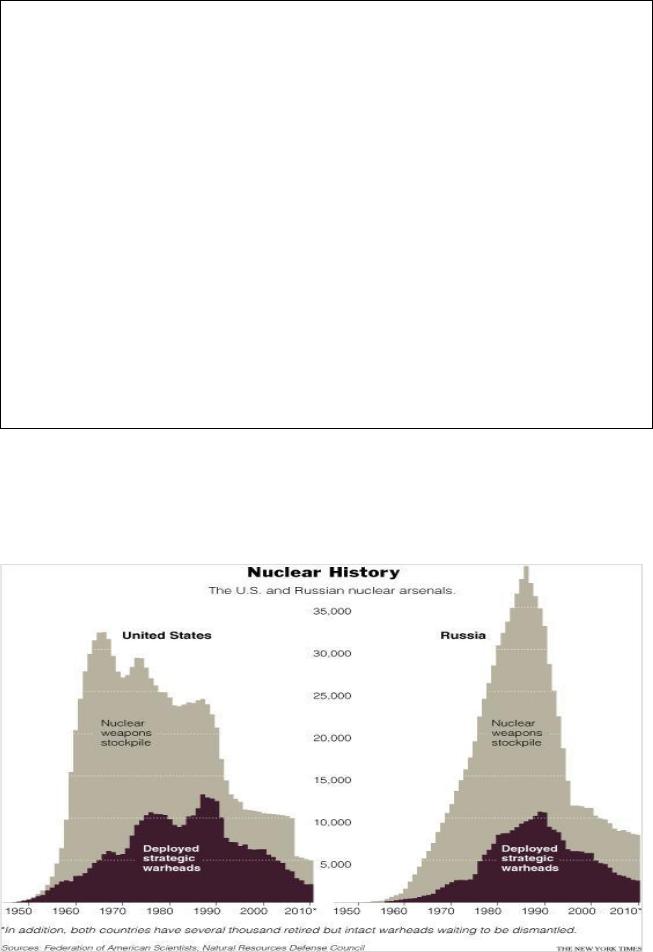
Exercise 8. Analyze the data of the chart and compare nuclear arsenals of both countries. Study the progress of the arms race. What were the basic reasons for it?

307
Exercise 9. Analyse the headline of the article below. What do you think is the article about?
US and Russian leaders hail nuclear arms treaty
US President Barack Obama and his Russian counterpart, Dmitry Medvedev, have signed a landmark nuclear arms treaty in the Czech capital, Prague.
The treaty commits the former Cold War enemies to each reduce the number of deployed strategic warheads to 1,550 – 30% lower than the previous ceiling.
Mr Obama said it was an important milestone, but "just one step on a longer journey" of nuclear disarmament.
Mr Medvedev said the deal would create safer conditions throughout the world.
If ratified by lawmakers in both countries, the treaty will replace the Strategic Arms Reduction Treaty (Start) of 1991, which has expired.
Missile defence
The US and Russian leaders signed the New Start treaty at a ceremony attended by hundreds of officials in the lavishly decorated Spanish Hall of Prague Castle, the Czech president's residence.
Under the pact, each side is allowed a maximum of 1,550 warheads, about 30 % lower than the 2002 Moscow Treaty.
It also limits the number of deployed delivery vehicles – ballistic missiles and heavy bombers – to no more than 700. However, each bomber counts as one warhead irrespective of the fact that it might carry multiple bombs or missiles.
Speaking after the signing ceremony, President Obama said the treaty demonstrated that both countries had halted the deterioration of their relations, which had prevented agreement on mutually important issues in the past.
He said the talks – beginning this summer – would cover missile defence, threat assessments, and the completion of a joint assessment of emerging ballistic missiles.
For his part, President Medvedev said the negotiating process had not been simple, but the treaty represented a "win-win situation" that would enhance strategic stability and bilateral relations.

308
But Mr Medvedev said disagreements remained between Moscow and Washington over US plans for a missile defence shield, which have been modified by Mr Obama.
It was Moscow's concerns over Washington's plans to base interceptor missiles in Poland and a radar station in the Czech Republic that helped delay the new treaty. President Obama shelved the idea in September, although new plans include ground-based interceptor missiles in Romania.
The White House has said it hopes and expects the US Senate to ratify the New Start treaty this year. Senate ratification requires 67 votes, which means it must include Republicans.
The Russian lower house of parliament must also approve the treaty, but as long as the Kremlin supports it, ratification there is expected to be a formality.
During private talks before the signing ceremony, Mr Obama and Mr Medvedev also discussed Iran's nuclear programme.
The US wants the UN Security Council to approve tougher sanctions against Tehran, over its refusal to halt uranium enrichment.
"Unfortunately Tehran is not reacting to an array of constructive compromise proposals. We cannot close our eyes to this," Mr Medvedev said afterwards.
Exercise 10. Give the Russian equivalents for the following word combinations.
counterpart, to reduce the number of deployed strategic warheads, to limit the number of deployed delivery vehicles, ballistic missiles, heavy bombers, to halt the deterioration of their relations, to prevent agreement on mutually important issues, the benefits of co-operation, to pursue discussions, a joint assessment of emerging ballistic missiles, to enhance strategic stability and bilateral relations, ground-based interceptor missiles, to approve tougher sanctions against, in compliance with their nuclear nonproliferation obligations.
309
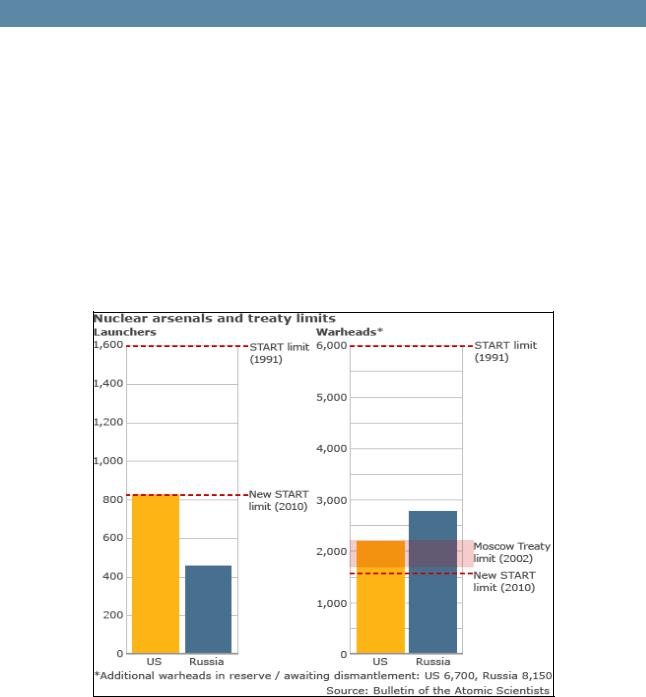
Exercise 11. Look at the data and study the chart.
Discuss the following questions in group.
1.What are the estimated figures?
2.What do you think of the efficiency and necessity of the new START?
3.Is START important for keeping the nuclear balance in the world?
4.What consequences could it have? Will it influence the situation in the world?
TREATY LIMITS
Warheads: 1,550 (74 % lower than the 1991 Start Treaty and 30 % lower than the figure of 2,200 that each side was meant to reach by 2012 under the 2002 Strategic Offensive Reductions Treaty (Sort)).
Launchers: 700 deployed intercontinental and subma- rine-launched ballistic missiles, and deployed heavy bombers equipped for nuclear armaments.
New limit on delivery systems less than half current ceiling of 1,600.
US AND RUSSIA NUCLEAR WEAPONS

310
Exercise 12. Translate the following noun phrases and make up sentences with them.
five-yearly review conference, a nuclear-weapons free world, test ban treaty, disarmament obligations, the key passage, the 2000 NPT review conference statement, longrange nuclear missile force nuclear weapons technology.
Exercise 13. Debate the following questions.
1.Is a nuclear-weapons free world possible? Why? Why
not?
2.Are not the nuclear states supposed to be disarming under the NPT?
3 What exactly does the NPT say?
4.Is the NPT legally binding?
5.What weapons have the nuclear states given up?
6.Do the nuclear-weapon states have any intention of giving up nuclear weapons?
7.Are nuclear-weapon states building new nuclear weapons and delivery systems?
8.Are double standards operating against some countries?
Exercise 14. Read the article and check whether you were right in your suggestions.
In 2010, the next five-yearly review conference of the Nuclear Non-Proliferation Treaty will be held. President Obama has spoken of his hopes for a nu- clear-weapons free world.
On 24 September 2009, the UN Security Concil, adopted a resolution (1887) calling for the creation of "conditions for a world without nuclear weapons... "
Is a nuclear-weapons free world possible?
It is possible but unlikely for the foreseeable future. Even President Obama said that he did not expect to see it in his lifetime and also said that as long as such weapons existed, the US would keep its own nuclear arsenal.