Материал: Гольцева О.Ю. Международное право в официальных документах. Под ред. И.А. Горшеневой
296
crimes and are so close to death now they surely care not about their physical future.
Let those who have committed these unspeakable acts come forward and apologize. Let those who have been in these camps find it in their hearts to forgive.
There should be no question of forgetting the holocaust but if our world is driven by nothing more than a need for retribution and the acrid bitterness of long ago events then we can never move forward. Bill Geddes, Macclesfield.
Stop hunting phantoms and stop being obsessed about a historic event that happened more than 60 years ago. Germany today is probably one of the few countries around the globe that has learned from history...
The English however are still obsessed with the Nazis more than any other country, but they actually know very little. They need to keep the phantom enemy alive to distract the world from their own bleak history. What about looking at the countless war crimes and the millions killed during British colonial rule. Not one serious effort has ever been made by England and the English to de-glorify their recent history. Wherever Britons put their feet there has been death and war: Zimbabwe, Gaza/Israel, Pakistan, Sri
Lanka, Sudan, Iraq just to name a few… Mike, London.
OVER TO YOU
1.Choose one of the opinions above and write an essay to agree or disagree with it.
2.Study the quotations below and write an essay to express your opinion about the idea presented in it.
“War is a simple continuation of politics with other means”.
“War is an act of violence intended to compel our opponent to fulfill our will”.
Carl Philipp Gottlieb von Clausewitz (1780–1831), a Prussian soldier and German military theorist
297
LESSON 15
NUCLEAR THREAT AND DISARMAMENT Stating up
Analyze the quotation. What does the author mean?
“We face the dangerous prospect of a world where the spread of nuclear knowledge to an increasing number of states risks creating 30 or 40 nuclear weapon states by the middle of this century”.
Prof. Nikolas j. Wheeler
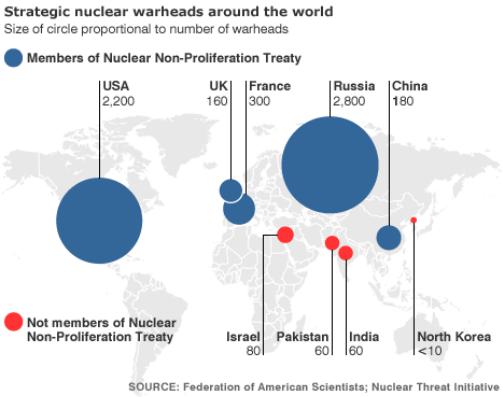
Exercise 1. Study the information about global nuclear arsenals and comment on it.
•All numbers are estimates because exact numbers are top secret.
•Strategic nuclear warheads are designed to target cities, missile locations and military headquarters as part of a strategic plan.

298
ISRAEL
Israeli authorities have never confirmed or denied the country has nuclear weapons.
NORTH KOREA
The highly secretive state claims it has nuclear weapons, but there is no information in the public domain that proves this.
IRAN
The International Atomic Energy Agency reported in 2003 there had been covert nuclear activity to make fissile material and continues to monitor Tehran's nuclear program.
SYRIA
US officials have claimed it is covertly seeking nuclear weapons.
NUCLEAR WARHEAD CUTS
United States: |
|
France |
70,000 produced since 1945 |
1,260 produced since 1964 |
|
10,000 in current |
stockpile |
350 in current stockpile |
(5,735 operational) |
|
|
Russia: |
|
China |
55,000 produced since 1949 |
600 produced since 1964 |
|
16,000 in current |
stockpile |
Approx 200 in current stock- |
(5,830 operational) |
|
pile (approx 130 deployed) |
Britain:
1,200 produced since 1953
Fewer than 200 Trident missiles remain
Source: All figs are estimates from Bulletin of Atomic Scientists (July 2006)
Exercise 2. Read the following text. Find the answers to the following questions.
1.What is the definition of nuclear proliferation?
2.Why is it considered to be an extremely important issue in the national security policies of many countries?

299
3.What is the difference between “vertical” proliferation and “horizontal” proliferation? Why does this difference exist?
4.What are the methods used by the leading countries in their combating nuclear proliferation?
Nuclear disarmament
The proliferation of nuclear weapons (nuclear proliferation), which is defined as an increasing number of nonnuclear states and, possibly in the future, non-state organizations, gaining access to nuclear weapons, is in the focus of the international security agenda. It is a top priority issue in the official national security policies of the United States, Russia and many other leading countries in the world. Efforts to check nuclear proliferation involve the intensive work of secret services, the use of force against individual states and even large-scale military operations. The efficiency of these efforts is crucial for the world’s prospects and for global security in the foreseeable future.
The buildup of nuclear armaments by the largest states, concomitant with the desire of an increasing number of non-nuclear countries to obtain them, have remained closely interconnected phenomena. This is why any nuclear arms race is often described as nuclear proliferation: there exists ‘vertical’ proliferation (a nuclear buildup by the leading nuclear states) and ‘horizontal’ proliferation (an increase in the number of countries having nuclear armaments in their armies).
Exercise 3. Explain the meaning of the following word combinations in English. Give their Russian equivalents.
nuclear proliferation, an increasing number of nonnuclear states, non-state organizations, gain access to nuclear weapons, the international security agenda, a top priority issue, the efficiency of the efforts, global security in the foreseeable future, the buildup of nuclear armaments, concomitant with, nuclear arms race.

300
Exercise 4. Read the following article. Pay attention to the connecting words in bold. Before you read, match these word combinations to their Russian translation.
a) rivalry |
1. |
в конце концов, в конечном |
||
|
счете |
|
|
|
b) major achievements |
2. |
подписавшиеся стороны |
||
c) eventually |
3. |
возобновление |
ядерных |
|
|
испытаний |
|
|
|
d) delivery vehicles |
4. |
слияние с |
международным |
|
|
терроризмом |
|
|
|
e) measures |
5.средство доставки |
|
||
f) signatories |
6. |
вывести |
|
|
g) a resumption of nu- |
7. |
испытывать |
недостаток в |
|
clear tests |
координации |
|
|
|
h) to plunge the world |
8. |
соперничество |
|
|
into |
|
|
|
|
j) merger with interna- |
9. |
меры |
|
|
tional terrorism |
|
|
|
|
k) to withdraw |
10. непоследовательный, |
|||
|
противоречивый |
|
|
|
l) inconsistent |
11. главные достижения |
|||
m) to lack coordination |
12. погрузить мир в … |
|
||
n) to stem from |
13. возникать из |
|
||
New phase in proliferation
The world is entering a fundamentally new stage in the proliferation of nuclear weapons – the most destructive and dangerous of WMD.
Following the end of the Cold War, when the two superpowers ceased to be enemies and their ideological and geopolitical rivalry gave way to broad cooperation, the campaign against proliferation enjoyed several major achievements. Those years were marked by an unprecedented growth of the
United Nations’ authority and the role of its Security Council,