Материал: Гольцева О.Ю. Международное право в официальных документах. Под ред. И.А. Горшеневой
56
in regard to / as regards / |
в области, в отношении, с |
regarding / with regard |
точки зрения, что касается |
to (for) |
|
having regard for (to) |
обращая внимание на |
with due regard to |
учитывая должным образом |
to regard as |
рассматривать как |
having respect for |
в духе уважения |
in respect of (for) / with |
по отношению, относительно |
respect to |
|
relating to, as to / as for |
касательно, что касается |
concerning / as concerns |
с связи, по поводу |
|
|
Exercise 43. Translate into Russian.
1.Nothing in the foregoing shall be construed as prejudicing the positions of the parties concerned with regard to the status and effects of such lines under their special regimes or as affecting their temporary character.
2.Any measure in this respect must be based on the recognition of the inalienable right of all states to territorial integrity or political unity of sovereign and independent States.
3.The exceptional importance of the search for solutions in regard to settlement of international disputes by peaceful means will warrant particularly close attention.
4.Every State has the duty to refrain from any forcible action which deprives peoples referred to in the elaboration of the principle of equal rights and self-determination of their right to self-determination and freedom and independence.
5.The participating States declare their resolve to pay due regard to and implement the provisions of the Final Act of the Conference.
6.Nothing in the foregoing paragraphs prejudices or derogates from the applicable provisions of the Charter, in particular those relating to the pacific settlement of international disputes.
57
Exercise 44. Translate into Russian.
The Helsinki summit had unprecedented historic mission to perform. It defined a code of conduct governing relations among states with different social systems. The summit dealt with standards and principles which were brought forth by the realities of European life and were voluntary accepted as a basis for building future relations among states. The final Helsinki Act affirms the following ten principles:
sovereign equality, respect for the rights inherent in sovereignty;
refraining from the threat or use of force against territorial integrity or political independence of any state;
inviolability of one another’s frontiers and the frontiers of all states in Europe, and refraining at present and in the future from any encroachment of these frontiers;
peaceful settlement of disputes by means of negotiation, mediation, and arbitration;
non-intervention in the internal affairs of other states;
respect for human rights and fundamental freedoms, including the freedom of thought, conscience, religion or belief;
equal rights and self-determination of peoples;
cooperation among states on equal footing, promoting mutual understanding and trust, friendly relations, international peace, security and justice;
fulfillment in good faith of obligations of states under international law.
OVER TO YOU
Study the information below and discuss the issues. Write a paragraph expressing your point of view on how well the basic principles of international law are observed nowadays.
58
The principles of International Law cover use of force, war crimes, torture and other mistreatment of prisoners, arbitrary detention, command responsibility, and adherence to international law. The following are shorthand summaries of the principles, together with the interpretations of the implicit messages intended by many – though not all – members of the Society.
Other members of the Society may read the implicit messages differently. Still others may insist, with a straight face, that these principles are no more than bland statements of law, aimed at no one in particular. Such is the diversity of views within the Society.
|
Principle |
|
|
|
Implicit message |
||||
|
|
|
|
|
|
||||
Resort |
|
to |
|
armed |
The U.S. invasion of Iraq, with- |
||||
force |
is |
governed |
by |
out United Nations Security Council |
|||||
the |
Charter |
|
of |
the |
approval and absent an imminent |
||||
United |
Nations |
and |
threat to our security, violated the |
||||||
other international law. |
UN Charter and international law. |
||||||||
|
|
|
|
|
|||||
Armed |
|
conflict |
and |
Where the “war” against terror |
|||||
occupation |
are |
gov- |
involves armed conflict or military |
||||||
erned |
by |
the |
Geneva |
occupation as in Afghanistan and |
|||||
Conventions. |
|
|
|
|
Iraq, |
Administration claims that |
|||
|
|
|
|
|
|
|
|
the Geneva Conventions do not |
|
|
|
|
|
|
|
|
|
apply are bogus. |
|
|
|
|
|
|
|||||
Torture |
and |
cruel, |
The |
U.S. violates international |
|||||
inhuman |
or |
degrading |
law by using techniques like “wa- |
||||||
treatment |
of |
prisoners |
ter boarding” (simulated drown- |
||||||
are prohibited by in- |
ing) and dogs menacing naked |
||||||||
ternational |
law, |
with- |
prisoners. |
||||||
out exception. |
|
|
|
|
|
||||
|
|
|
|
|
|
||||
Prolonged, |
|
|
secret, |
CIA |
“ghost prisons” holding |
||||
incommunicado |
deten- |
“ghost prisoners,” who are kept in |
|||||||
tion |
of |
prisoners |
is |
secret locations unknown even to |
|||||
prohibited |
by |
interna- |
the Red Cross, and with no access |
||||||
tional law. |
|
|
|
|
|
to lawyers, family or the outside |
|||
|
|
|
|
|
|
|
|
world, violate international law. |
|
|
|
|
|
|
|
|
|
|
|
|
|
|
|
|
|
|
59 |
|
|
|
|
||||
International |
|
law |
Neither the CIA nor private |
||||
standards |
for |
treat- |
contractors are exempt from rules |
||||
ment of prisoners ap- |
against torture and mistreatment. |
||||||
ply to all branches of |
Nor, for that matter, are Al Qaeda |
||||||
governments, to |
their |
and other terrorist groups who |
|||||
agents, and to com- |
kidnap and behead people in Iraq |
||||||
batants. |
|
|
|
and Afghanistan. |
|||
|
|
|
|
||||
In |
some |
circum- |
There ought to be a serious in- |
||||
stances, both |
military |
vestigation of |
whether Secretary |
||||
and civilian command- |
of Defense Donald Rumsfeld and |
||||||
ers are personally re- |
other senior officials have “com- |
||||||
sponsible |
for |
acts of |
mand |
responsibility” for torture |
|||
their subordinates. |
|
and mistreatment of prisoners at |
|||||
|
|
|
|
|
Abu |
Ghraib, |
Guantanamo, and |
|
|
|
|
|
elsewhere. |
|
|
|
|
|
|
||||
All |
states |
should |
In its zeal to safeguard Ameri- |
||||
maintain |
security |
and |
can security and liberty, the Ad- |
||||
liberty |
in |
a |
manner |
ministration tramples on funda- |
|||
consistent |
with |
their |
mental rules of international law. |
||||
international law |
obli- |
|
|
|
|||
gations. |
|
|
|
|
|
|
|
|
|
|
|
|
|
|
|
60
LESSON 4
INTERNATIONAL ORGANIZATIONS Starting up
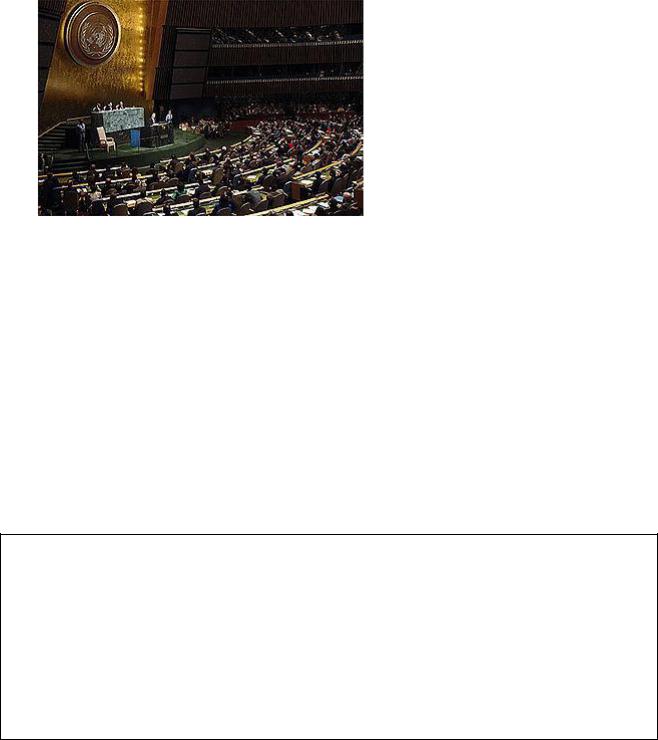
Look at the photo. What event does it show? What do you know about this organization? What does it responsible for?
Analyze this quotation. Give your reasons if you agree.
“The United Nations remains our most important global actor. These days we are continuously reminded of the enormous responsibility of the Security Council to uphold international peace and stability”.
Anna Lindh, (1957 - 2003), a Swedish Social Democratic politician, a Swedish Minister for Foreign Affairs from 1998 until her assassination in 2003.
Exercise 1. Read the following text.
The United Nations
In 1945, representatives of 50 countries met in San Francisco at the United Nations Conference on International Organization to draw up the United Nations Charter. The United Nations officially came into existence on 24 October 1945, when the Charter had been ratified by China, France, the Soviet Union, the United Kingdom, the United