Материал: 2425
border |
subtropical |
diversity |
highland |
parliamentary |
cover |
count |
territory |
vegetation |
scientific |
Europe |
various |
forests |
steppes |
iron ore |
occupy |
mountain |
chamber |
variety |
temperate |
south |
arctic |
judicial |
tundra |
decrease |
surface |
territory |
council |
supreme |
continental |
5.Use these words to complete the sentences:
1)Russia is the largest … in the world.
2)The … in Russia is very rich.
3)Russia is extremely rich in … .
4)The country impresses with its … and size.
5)The climate ranges from the Arctic north to the generally ... south.
6)The Russian Federation occupies the first place in the world for its
….
7)Most of Russia consists of vast stretches of … that are predominantly
…to the south and heavily forested to the north, with … along the northern coast.
6.Match a word on the left with a word on the right to make common expressions:
|
arable; |
|
country; |
|
energy; |
|
distances; |
|
fishing; |
|
fleet; |
|
forest; |
|
land; |
|
fresh; |
|
republic; |
|
mineral; |
|
reserves; |
|
semi-presidential; |
|
resources; |
|
transcontinental; |
|
superpower; |
|
vast; |
|
water; |
|
federal; |
|
subjects. |
7.Now use the phrases in the following sentences:
1.The Russian Federation is a ... extending over much of northern Eurasia.
2.It is a ... comprising 83 … .
3.Russia has the world's greatest reserves of mineral and …, and is considered an … .
4.Russia has the world's largest … and its lakes contain unfrozen … .
158
5.Russian … are a major contributor to the world's fish supply.
6.Russia possesses 10% of the world's … .
7.The largest and most prominent of Russia's bodies of … is Lake Baikal.
8.Read the text, translate it and check up your answers.
Pic. 35
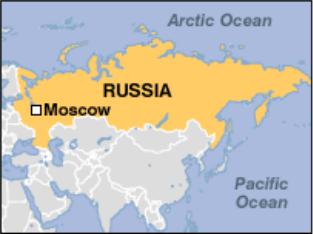
The Russian Federation is a transcontinental country extending over much of northern Eurasia. Russia shares land borders with the following countries: Norway, Finland, Estonia, Latvia, Lithuania, Poland, Belarus, Ukraine, Abkhazia, Georgia, South Ossetia, Azerbaijan, Kazakhstan, China, Mongolia and North Korea. It also borders the Arctic Ocean, the Pacific Ocean, the Caspian Sea, the Baltic Sea, and the Black Sea. Russia is close to the United States (Alaska) and Japan.
At 17,075,400 square kilometers (6,592,800 sq mi), Russia is the largest country in the world, covering more than an eighth of the Earth’s land area; with 142 million people, it is the ninth largest by population. Russia has the world's greatest reserves of mineral and energy resources, and is considered an energy superpower. It has the world's largest forest reserves and its lakes contain approximately one-quarter of the world's unfrozen fresh water.
The Russian Federation with its topography, its climates, vegetation, and soils span vast distances. From north to south the East European Plain is clad sequentially in tundra, coniferous forest (taiga), mixed and broadleaf forests, grassland (steppe), and semi-desert (fringing the Caspian Sea) as the changes in vegetation reflect the changes in climate.
159
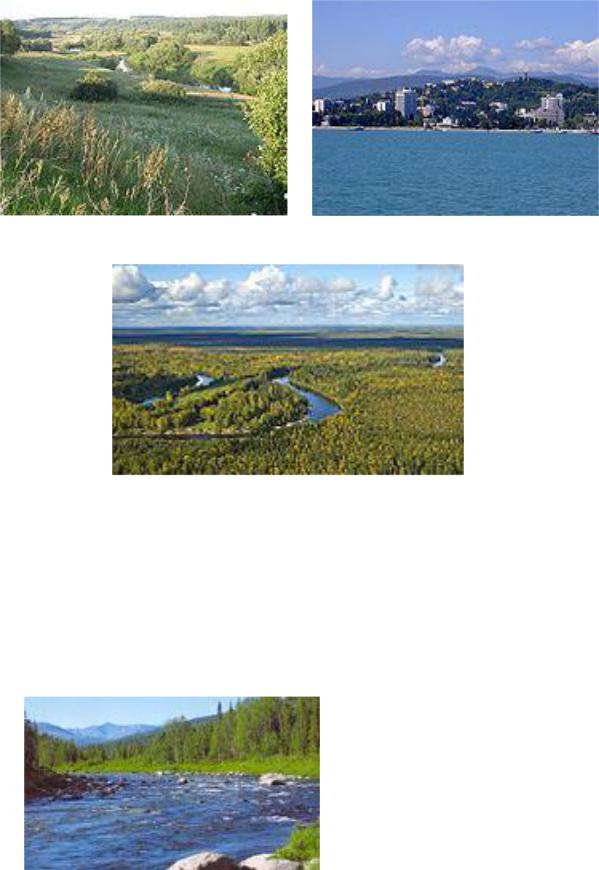
Pic. 36. Central Russian Upland, Zaraysk |
Pic. 37. Sochi, Krasnodar Krai |
Pic. 38. The plains of Western Siberia,
Vasyugan River, Tomsk Oblast
Russia has the world's largest forest reserves and is known as “the lungs of Europe”. It provides a huge amount of oxygen for not just Europe, but the world. With access to three of the world's oceans — the Atlantic, Arctic and Pacific — Russian fishing fleets are a major contributor to the world's fish supply. The Caspian is the source of what is considered the finest caviar in the world.
Pic. 39. Saranpaul, Khanty-Mansi Autonomous Okrug
160
Mountain ranges are found along the southern borders, such as the Caucasus (containing Mount Elbrus, Russia's and Europe's highest point at 5,642 m / 18,511 ft) and the Altai, and in the eastern parts, such as the Verkhoyansk Range or the volcanoes on Kamchatka. The Ural Mountains form a north-south range that divides Europe and Asia, rich in mineral resources. Russia possesses 10% of the world's arable land.
Russia has thousands of rivers and inland bodies of water, providing it with one of the world's largest surface water resources. The largest and most prominent of Russia's bodies of fresh water is Lake Baikal, the world's deepest, purest, most ancient and most capacious freshwater lake. Other major lakes include Lake Ladoga and Lake Onega, two largest lakes in Europe. Of Russia's 100,000 rivers, The Volga is the most famous—not only because it is the longest river in Europe but also because of its major role in Russian history. Europe's biggest river, the Volga, flows into the Caspian Sea. The main Siberian rivers (the Ob, the Yenisei and the Lena) flow from the south to the north. The Amur in the Far East flows into the Pacific Ocean.
On the vast territory of the country there are various types of climate. It ranges from the Arctic north to the generally temperate south. In the middle of the country the climate is temperate and continental.
9. Answer the questions:
1)Where is the Russian Federation situated?
2)What oceans is our country washed by?
3)Can you name any seas, which Russia is washed by?
4)What is the total area of the country?
5)What countries does the Russian Federation border on in the west (in the east)?
6)What can you say about the relief in Russia?
7)What mountain chains are there on the territory of our country?
8)What sea does the Europe's biggest river flow into?
9)What is the world's deepest lake famous for?
10)What types of climate are there in Russia?
11)What mineral resources is Russia rich in?
10. Tell about geographical location and mineral resources of our country using your answers.
161
11. Match a word on the left with a word on the right to make common expressions and translate them:
appoint; |
contract; |
approve; |
government; |
federal; |
referendum; |
national; |
to the position; |
social; |
treaties. |
12. Match these expressions with their definitions.
1)competition and mutual restraint among the various branches of government;
2)submission of an issue of public importance to the direct vote of the electorate;
3)an agreement, entered into by individuals, that results in the formation of the state or of organized society, the prime motive being the desire for protection, which entails the surrender of some or all personal liberties;
4)a formal agreement or contract between two or more states, such as an alliance or trade arrangement;
5)to assign officially, as for a position, responsibility.
13. Study the following words from the text: adopt – (официально) принимать (что-л.); bicameral – двухпалатный;
branch – ветвь; chamber – палата;
checks and balances – сдержки и противовесы; constitutional crisis – кризис конституционной власти; declare war – объявить войну;
deem – книжн. полагать, считать; executive power – исполнительная власть; legal document – юридический документ; legislative power – законодательная власть; overturn – опровергать;
power of the purse – право кошелька;
representative democracy – представительная демократия; supreme – верховный, высший;
wherein – книжн. где.
162