Материал: 2425

Russia has the world's largest natural gas reserves, the second largest coal reserves and the eighth largest oil reserves. It is the world's leading natural gas exporter and the second leading oil exporter. Oil, natural gas, metals, and timber account for more than 80% of Russian exports abroad. Since 2003, however, exports of natural resources started decreasing in economic importance as the internal market strengthened considerably. Despite higher energy prices, oil and gas only contribute to 5.7% of Russia's GDP and the government predicts this will drop to 3.7% by 2011. The state-run gas monopoly Gazprom is the world’s largest producer and exporter, and supplies a growing share of Europe’s needs. Russia is also considered well ahead of most other resource-rich countries in its economic development, with a long tradition of education, science, and industry. The country has more higher education graduates than any other country in Europe.
The federal budget has run surpluses since 2001 and ended 2007 with a surplus of 6% of GDP. Over the past several years, Russia has used oil revenues from its Stabilization Fund of the Russian Federation to prepay all Soviet-era sovereign debt to Paris Club creditors and the IMF. Oil export earnings have allowed Russia to increase its foreign reserves from $12 billion in 1999 to $597.3 billion on 1 August 2008, the third largest reserves in the world. The country has also been able to substantially reduce its formerly massive foreign debt.
The economic development of the country though has been uneven geographically with the Moscow region contributing a disproportionately high amount of the country's GDP. Much of Russia, especially indigenous and rural communities in Siberia, lags significantly behind. Nevertheless, the middle class has grown from just 8 million persons in 2000 to 55 million persons in 2006. Russia is home to the largest number of billionaires in the world after the United States, gaining 50 billionaires in 2007 for a total of 110.
Over the last five years, fixed capital investments have averaged real gains greater than 10% per year and personal incomes have achieved real gains more than 12% per year. During this time, poverty has declined steadily and the middle class has continued to expand. Russia has also improved its international financial position since the 1998 financial crisis. A principal factor in Russia's growth has been the combination of strong growth in productivity, real wages, and consumption. The upward trend
168

continued in the first quarter of 2008, driven largely by rising food costs. Infrastructure, ageing and inadequate after years of being neglected, is considered to be a bottleneck to economic growth. The government has said $1 trillion will be invested in infrastructure by 2020.
During Putin's eight years in office, industry grew by 75%, investments increased by 125%, and agricultural production and construction increased as well. Real incomes more than doubled and the average salary increased eightfold from $80 to $640. The volume of consumer credit between 2000–2006 increased 45 times, and during that same time period, the middle class grew from 8 million to 55 million, an increase of 7 times. The number of people living below the poverty line also decreased from 30% in 2000 to 14% in 2008.
Arms sales have increased to the point where Russia is first in the world in sale of weapons, the IT industry has recorded a record year of growth concentrating on high end niches like algorithm design and microelectronics; Russia is now the world's third biggest destination for outsourcing software behind India and China. The space launch industry is now the world's second largest behind Arian Space of Europe and nuclear power plant companies are going from strength to strength, selling plants to China and India, and recently signed a joint venture with Toshiba to develop cutting edge power plants. Russia is experiencing a regrowth of Electronics. Among Russia's biggest television sets producers is Rolsen.
The large majority of Russia's exports are made up by raw materials and fertilizers, although exports as a whole accounted for only 8.7% of the GDP in 2007, compared to 20% in 2000.
The mineral-packed Ural Mountains and the vast oil, gas, coal, and timber reserves of Siberia and the Russian Far East make Russia rich in natural resources. However, most such resources are located in remote and climatically unfavorable areas that are difficult to develop and far from Russian ports. Oil and gas exports continue to be the main source of hard currency. Russia is a leading producer and exporter of minerals, gold, and all major fuels. The Russian fishing industry is the world's fourth-largest, behind Japan, the United States, and China. Natural resources, especially energy, dominate Russian exports. Ninety percent of Russian exports to the United States are minerals or other raw materials.
169

Russia comprises roughly three-quarters of the territory of the former Soviet Union but has relatively little area suited for agriculture because of its arid climate and inconsistent rainfall. Northern areas concentrate mainly on livestock, and the southern parts and western Siberia produce grain. Restructuring of former state farms has been an extremely slow process. The new land code passed by the Duma in 2002 should speed restructuring and attract new domestic investment to Russian agriculture. Private farms and garden plots of individuals account for over one-half of all agricultural production.
22.Match the beginnings of the sentences with their endings.
1.Since the turn of the century, rising oil prices, increased foreign investment, higher domestic consumption and …
2.Growth was primarily driven by non-traded services and goods for the
...
3.Oil, natural gas, metals, and timber account for …
4.Russia has also improved its international financial position since …
5.A principal factor in Russia's growth has been the combination of …
6.Arms sales have increased to the point where …
7.However, most such resources are located in remote and climatically unfavorable areas that are …
8.The new land code passed by the Duma in 2002 should speed restructuring and …
a)more than 80% of Russian exports abroad.
b)greater political stability have bolstered economic growth in Russia.
c)strong growth in productivity, real wages, and consumption.
d)difficult to develop and far from Russian ports.
e)domestic market, as opposed to oil or mineral extraction and exports.
f)the 1998 financial crisis.
g)Russia is first in the world in sale of weapons.
h)attract new domestic investment to Russian agriculture.
23.Read the text again and draw up the plan.
24.Tell about the development of Russia’s economy using your own plan.
170

25. Make the correct word boundaries and make a text. Give the main idea of the text you have got after correction.
It is interesting to know that …
EXPECTINGTHEAREATOBECOMEMOREACCESSIBLEASCLIMA TECHANGEMELTSARCTICICEANDBELIEVINGTHEAREACONTAINSL ARGERESERVS OFUNTAPPEDOILANDNATURALGASONAUGUST22007RUSSIANEXP LORERSINSUBMERSIBLESPLANTEDTHERUSSIANFLAGONTHEARCT ICSEABEDSTAKINGACLAIMTOENERGYSOURCESRIGHTUPTOTHEN ORTHPOLEREACTIONTOTHEEVENTWASMIXEDPRESIDENVLADIMI RPUTINCONGRATULATEDTHEEXPLORERSFORTHEOUTSTANDING SCIENTIFICPROJECTWHILECANADIANOFFICIALSSTATEDTHEEXP EDITIONWASJUS APUBLI SHOW
To your opinion was it only a show?
What advantages will Russia have from this event? Give the examples.
26. Read the supplementary information about foreign relations and military of our country. Before reading the text study some new words and expressions:
albeit, союз; сокр. от "all though it be (that)"- хотя (и); assets – фонды, активы;
assume – принимать, брать на себя (ответственность); conscription term – срок воинской службы;
defense industry – оборонная промышленность; draft – призывать в армию;
embassy – посольство;
equal partners – равноправные партнеры; fleet – военно-морской флот;
foreign policy – внешняя политика; implement – приводить в исполнение; international treaty – международный договор;
joint collaboration – совместное сотрудничество; maintain relations – поддерживать отношения; procurement – приобретение;
171
production facilities – производственное оборудование; proliferation – распространение;
stockpile – запас, резерв;
volatile – неустойчивый, непостоянный, изменчивый.
Foreign relations and military
The Russian Federation has a permanent seat on the UN Security Council, membership in other international organizations, the rights and obligations under international treaties and property and debts. Russia has a multifaceted foreign policy. It maintains diplomatic relations with 178 countries and has 140 embassies. Russia's foreign policy is determined by the President and implemented by the Ministry of Foreign Affairs.
As one of five permanent members of the UN Security Council, Russia plays a major role in maintaining international peace and security, and plays a major role in resolving international conflicts by participating in the Quartet on the Middle East, the Six-party talks with North Korea, promoting the resolution of the Kosovo conflict and resolving nuclear proliferation issues. Russia is a member of the Group of Eight (G8) industrialized nations, the Council of Europe, OSCE and APEC. Russia usually takes a leading role in regional organizations such as the CIS, EurAsEC, CSTO, and the SCO. Former President Vladimir Putin had advocated a strategic partnership with close integration in various dimensions including establishment of four common spaces between Russia and the EU. Since the collapse of the Soviet Union, Russia has developed a friendlier, albeit volatile relationship with NATO. The NATORussia Council was established in 2002 to work together as equal partners to pursue opportunities for joint collaboration.
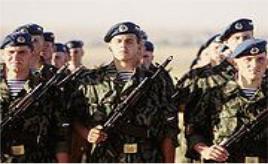
Pic. 46. Russian paratroopers at an exercise in Kazakhstan
172