Материал: 2425
14. Read the text about the government and politics in Russia and answer the questions after it:
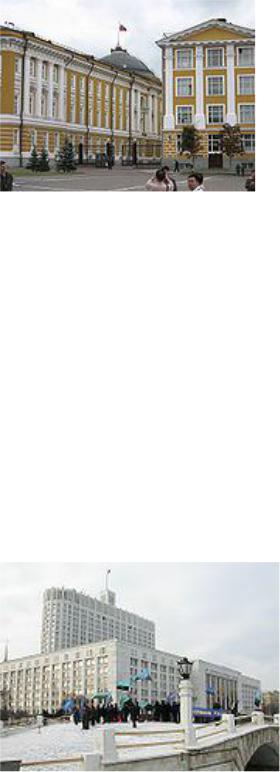
Pic. 40. Entrance to the Kremlin Senate, part of the Moscow Kremlin and
the working residence of the Russian president
According to the Constitution, which was adopted by national referendum on 12 December 1993 following the 1993 Russian constitutional crisis, Russia is a federation and formally a semi-presidential republic, wherein the President is the head of the state and the Prime Minister is the head of the government. The Russian Federation is fundamentally structured as a representative democracy. Executive power is exercised by the government. Legislative power is vested in the two chambers of the Federal Assembly. The government is regulated by a system of checks and balances defined by the Constitution of the Russian Federation, which serves as the country's supreme legal document and as a social contract for the people of the Russian Federation.
Pic. 41. The White House, the seat of the Russian Government
163
The federal government is composed of three branches:
Legislative: The bicameral Federal Assembly, made up of the State Duma and the Federation Council adopts federal law, declares war, approves treaties, has the power of the purse, and has power of impeachment, by which it can remove the President.
Executive: The president is the commander-in-chief of the military, can veto legislative bills before they become law, and appoints the Cabinet and other officers, who administer and enforce federal laws and policies.
Judiciary: The Constitutional Court, Supreme Court, Supreme Court of Arbitration and lower federal courts, whose judges are appointed by the Federation Council on the recommendation of the president, interpret laws and can overturn laws they deem unconstitutional.
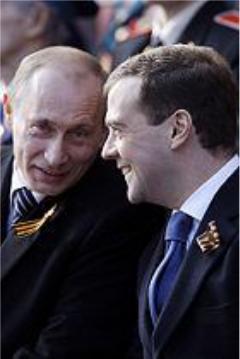
Pic. 42. Prime Minister Vladimir Putin
and President Dmitry Medvedev
The president is elected by popular vote for a four-year term]; election last held 2 March 2008. The national legislature is the Federal Assembly, which consists of two chambers; the 450-member State Duma and the 176member Federation Council. Leading political parties in Russia include United Russia, the Communist Party, the Liberal Democratic Party of Russia and Fair Russia.
164
1)When was the Russian constitutional crisis?
2)When was the Constitution adopted according to which Russia is a federation?
3)What is the head of the state?
4)What is the head of the government?
5)What branches does the federal government comprise?
6)What do these branches consist of?
15.Using your answers tell about the government and politics in Rus-
sia.
16.In pairs discuss the problem of presidential term extending to a six-year term. Imagine you are one of the Duma’s members. One of you agrees with this idea, and another disagrees. Prove your ideas.
17.Look at the word economics. Write your associations with this word.
ex.
E n e r g y
C O N O
M o n e y
I
C
S
18. Match the words with their definitions.
1)consumption;
2)currency;
3)energy;
4)industry;
5)investment;
6)money;
7)nuclear power;
8)office;
9)oil;
10)outlook;
165
11)regrowth;
12)supply.
a)the resurgence of an industry, economy, etc;
b)a source of power;
c)the official currency, in the form of banknotes, coins, etc;
d)a metal or paper medium of exchange that is in current use in a particular country;
e)a room or set of rooms in which business, professional duties, clerical work, etc;
f)power, especially electrical or motive, produced by a nuclear reactor
g)another name for petroleum;
h)organized economic activity concerned with manufacture, extraction and processing of raw materials, or construction;
i)expenditure on goods and services for final personal use;
j)the act of investing money;
k)willingness and ability to offer goods and services for sale;
l)view or prospect.
19.Using the dictionary find the definitions to your own associations to the word “economics”.
20.Read and translate the text below about Russia’s economy.
21.Discuss with your partner if the modern economic situation in Russia is on the rise. Use your associations. Prove your ideas with the facts from the text you have read.
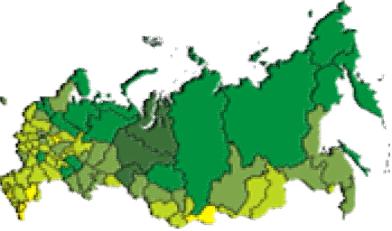
Pic. 43. Regional product per capita as of 2006 (darker is higher)
166
Economy
Since the turn of the century, rising oil prices, increased foreign investment, higher domestic consumption and greater political stability have bolstered economic growth in Russia. In 2007, Russia's GDP was $2.076 trillion (est. PPP), the 6th largest in the world, with GDP growing 8.1% from the previous year. Growth was primarily driven by non-traded services and goods for the domestic market, as opposed to oil or mineral extraction and exports. The average salary in Russia was $640 per month in early 2008, up from $80 in 2000. Approximately 14% of Russians lived below the national poverty line in 2007, significantly down from 40% in 1998 at the worst of the post-Soviet collapse. Unemployment in Russia was at 6% in 2007, down from about 12.4% in 1999.
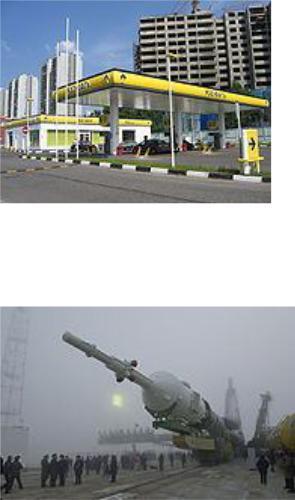
Pic. 44. A Rosneft petrol station. Russia is the world's leading natural gas exporter and the second leading oil exporter
Pic. 45. Soyuz TMA-2 moves to launch pad, about to carry the first resident crew to the International Space Station
167