Материал: 2425
the rest of the group, you are residents (you will have to prepare some questions to the speakers).
The information below can be helpful.
Climate change: Uncharted waters?
By Alex Kirby
BBC News Online environment correspondent
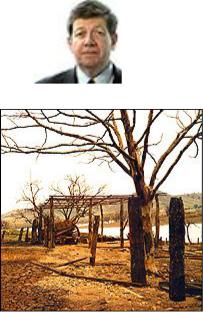
Pic. 32. Many water-scarce regions now will probably become thirstier
As part of Planet Under Pressure, a BBC News series looking at some of the biggest environmental problems facing humanity, Alex Kirby explores the implications of climate change.
Climate change is our biggest environmental challenge said the UK Prime Minister, Tony Blair. His chief scientific adviser, Sir David King, called it a far greater global threat than international terrorism.
It is certainly possible that warming temperatures could take the Earth into uncharted waters, even though nobody can say exactly how fast it may happen and who will be most affected.
Life on Earth exists only because of the natural greenhouse effect, the ability of the atmosphere to retain enough heat for species to thrive (and no more).
The Intergovernmental Panel on Climate Change (IPCC), a consortium of several thousand independent scientists, says rising levels of industrial pollution are unnaturally enhancing this effect, with increasing amounts of heat trapped near the Earth instead of escaping into space.
153
The main culprits, it says, are the burning of fossil fuels - oil, coal and gas - and changes in land use.
The chief greenhouse gas from human activities is carbon dioxide (CO2). Before the Industrial Revolution, atmospheric CO2 concentrations were about 270-280 parts per million (ppm).
They now stand at almost 380ppm, and have been rising at about 1.5ppm annually.
Rising temperatures
The consequence of increasing CO2 and other pollutant levels will be higher average global temperatures, meaning unpredictable weather, rising sea levels, and perhaps runaway heating as the whole climate system slips out of gear.
Scientists predict that if we go on as we are, by 2100 global sea levels will probably have risen by 9 to 88cm and average temperatures will be between 1.5 and 5.5C higher than now.
That may not sound very much - but the last Ice Age was only 4-5C colder than today.
The sceptics are unmoved. Some say the human influence on the climate is negligible, and that isolating one small variable, CO2 and other greenhouse gas levels, in an immensely complex natural system is meaningless.
Others insist such measurements are flawed and the predictions unreliable. Yet others believe a warmer world would be better for most of us.
They are entirely right to argue that there are still many uncertainties about the climate and any influence we may have on it.
Sobering facts
But many who were once sceptics now accept that enhanced climate change is happening, and that we have to respond - not necessarily by trying to reduce its extent but by adapting to its effects.
Part of the problem is that climate change is now part of the stuff of science fiction, with Hollywood and some campaign groups alike feeding scare stories that owe little, if anything, to scientific fact.
But the facts are sobering enough. We know that average global surface temperatures have risen by 0.6C in the last 140 years.
All of the 10 warmest years have occurred since 1990, including each year since
1997. The possibilities are sobering too.
Many water-scarce regions now will probably become thirstier.
154
Some countries may be able to produce bigger harvests, but in others yields will drop. Sea level rise may make many coastal areas uninhabitable.
Weather patterns may change, producing more heat waves, droughts, floods and violent storms.
Aid agencies are warning that these combined effects could seriously jeopardise attempts to lift the world's poorest people out of poverty. Furthermore, there is also the possibility of "positive feedbacks"- for example, higher temperatures may release more methane from the Arctic tundra and CO2 from peat bogs, which will themselves speed up the warming process.
Then there is the inertia of the atmosphere and the oceans.
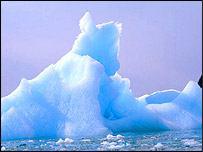
Pic. 33. If we could halt all greenhouse gas emissions tomorrow, the heating would continue for decades or more
Delayed effect
If somehow we could halt all greenhouse gas emissions tomorrow, the heating would continue for decades or centuries.
What we do today may literally determine how long the Greenland icecap survives - even though, at fastest, it will still take a good few centuries to disappear.
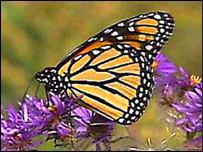
And wildlife, less equipped to adapt than humans, could be hit hard. One estimate suggests hundreds of thousands of species may be at risk of extinction by 2050 because of climate change.
Creating worldwide consensus on this global problem is difficult, not least because of the economic cost of cutting down on greenhouse gas emissions.
155
The Kyoto Protocol, which commits rich countries to reducing emissions, is a small but necessary start on building an international system for tackling climate change, its proponents believe.
But the country responsible for about a quarter of the world's greenhouse gas emissions, the US, has refused to sign up to it.
The protocol does not require developing countries to cut their emissions, although fast-industrialising countries like China will soon be significant contributors as those in poor nations increasingly demand rich world lifestyles.
For them, emissions cuts could have significant social costs in slowing the growth that feeds economic development, creates jobs and helps lift the poor out of poverty.
A prudent look at the evidence, preliminary though it is, suggests we shall be wise to err on the side of caution.
Dr Geoff Jenkins, of the UK Met Office's Hadley Centre for Climate Prediction and Research, said recently: "Over the last few decades there's been much more evidence for the human influence on climate.
"We've reached the point where it's only by including human activity that we can explain what's happening."
And what's happening now could lead to a world beyond our experience
Pic. 34. Hundreds of thousands of species may be at risk of extinction by 2050
156
Economy
1.The Russian Federation
1.Study the following country profile and make up as many questions as you can:
Full name: Russian Federation Population: 142.5 million (UN, 2007)
Capital: Moscow
Area: 17 million sq km (6.6 million sq miles)
Major language: Russian
Major religions:Christianity, Islam
Life expectancy: 59 years (men), 73 years (women) (UN) Monetary unit: 1 rouble = 100 kopecks
Main exports: Oil and oil products, natural gas, wood and wood prod-
ucts, metals, chemicals, weapons and military equipment GNI per capita: US $4,460 (World Bank, 2006)
Internet domain: .ru International dialling code: +7
President: Dmitry Medvedev (2008)
2. Make up sentences using the information above and the words in the box:
to cover |
to number |
to export |
to speak |
|
to occupy |
|
|
surface |
territory |
to count |
economy |
|
resources |
|
|
ex. The full name of our country is the Russian Federation.
3.Make a dialogue about our country profile with your partner using your own sentences and questions from the previous exercises.
4.Choose the words concerning the geographical location of some country:
area |
climate |
plains |
economy |
resources |
nature |
desert |
executive |
opportunity |
legislative |
157