Материал: 2425
e.Climate change.
f.Food.
g.Water.
BBC News Online's Planet under Pressure series takes a detailed look at six areas where most experts agree that a crisis is brewing:
An estimated 1 in 6 people suffer from hunger and malnutrition while attempts to grow food are damaging swathes of productive land.
By 2025, two-thirds of the world's people are likely to be living in areas of acute water stress.
Oil production could peak and supplies start to decline by 2010.
The world's greatest environmental challenge, according to the UK prime minister Tony Blair, with increased storms, floods, drought and species losses predicted.
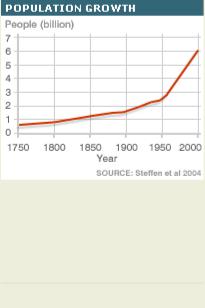
Pic. 27. From population to cars to forests - graphs of the increasing pressures on our planet
Many scientists think the Earth is now entering its sixth great extinction phase.
Hazardous chemicals are now found in the bodies of all new-born babies, and an estimated one in four people worldwide are exposed to unhealthy concentrations of air pollutants.
All six problems are linked and urgent, so a list of priorities is little help. It is pointless to preserve species and habitats, for example, if climate change will destroy them anyway, or to develop novel crops if the water they need is not there.
And underlying all these pressures is a seventh –
There are already more than six billion of us, and on present trends the UN says we shall probably number about 8.9 billion by 2050. Population growth means something else, too: although the proportion of people living in poverty is continuing to fall, the absolute number goes on rising, because fecundity outstrips our efforts to improve their lives.
143
Poverty matters because it leaves many people no choice but to exploit the environment, and it fuels frustration.
Above all, it condemns them to stunted lives and early deaths - both avoidable.
http://news.bbc.co.uk/2
/hi/science/
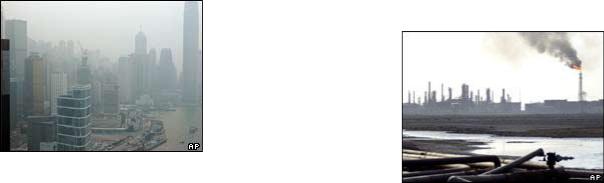
Pic. 28. Air pollution is a serious problem in the world's biggest cities
Pic. 29. Dependence on fossil fuels is pushing up CO2 emissions
16.Find and underline a word in the first part of the article that mean:
1) a person who studies or practises any of the sciences or who uses scientific methods.
2) a system involving the interactions between a community of living organisms in a particular area and its nonliving environment.
3) all the people of approximately the same age, especially when considered as sharing certain attitudes, etc.
17.Write these words in your language.
18.Look at the words in bold in the second part of the article and try to explain them and then write the words in your language.
1)suffer;
2)hunger;
3)malnutrition;
4)productive land;
5)water stress;
6)supplies;
7)avoidable;
8)species losses;
9)extinction phase;
10)hazardous chemicals;
11)unhealthy concentrations;
12)urgent;
144

13)climate change;
14)population growth;
15)poverty;
16)to exploit the environment;
17)environmental challenge.
19.Choose any five words and make sentences.
20.Read the text again. Are these statements true or false? Prove your ideas.
1.Some scientists think that we are coming back to Renaissance.
2.Some scientists think that humans are pressed by ecosystem so they can disappear as species in the nearest future.
3.No one in the world starves.
4.Some people like to live in water stress areas.
5.Tony Blair predicted great disasters.
6.In the USA new-born babies are fed by chemicals.
7.United Nations says that the population will decrease.
21.Answer the questions.
1.What is human pressure?
2.Why can it be useless to protect wild animals and to develop new crops?
3.What causes all environmental problems?
4.How many people are there in the in the world?
5.How many of them live in Russia? What are the future prospects?
6.Why is poverty a factor of environmental problems?
22.Use the Internet to find some data on important environmental problems. Design a poster arranging your information in tables/charts. As a group, choose the best poster.
23.Write the words which are connected with the word pollution into
the bubbles.
pollution
145

24.What do you think life and death issue is?
25.Look at the pictures in 27. What do you think the text is about?
26.Before you read try to predict the right answers to the questions 1
– 4.
1. Life on earth exists only because of
a) greenhouse effect; b) warm temperatures; c) fresh water.
2. The main reason of the global warming is
a) burning of oil, coal and gas; b) changes in land use; c) industrial emissions.
3. When CO2 and other pollutant levels increase
a) some wild animals die; b) humans and animals can feel oxygen scarcity; c) average global temperatures rise.
4. The last Ice Age was …… colder than today.
a) more than 20C; b) only 4-5C; c) approximately 10 – 15C.
27. Read the text and choose the best answers to the questions 1 – 4. Pollution: A life and death issue
By Alex Kirby
BBC News website environment correspondent
As part of Planet Under Pressure, a BBC News website series looking at some of the biggest environmental issues facing humanity, Alex Kirby considers the Earth's growing pollution problem.
One of the main themes of Planet Under Pressure is the way many of the Earth's environmental crises reinforce one another.
Pollution is an obvious example - we do not have the option of growing food, or finding enough water, on a squeaky-clean planet, but on one increasingly tarnished and trashed by the way we have used it so far.
Cutting waste and clearing up pollution costs money. Yet time and again it is the quest for wealth that generates much of the mess in the first place. Living in a way that is less damaging to the Earth is not easy, but it is vital, because pollution is pervasive and often life-threatening.
146
Air: The World Health Organization (WHO) says 3 million people are killed worldwide by outdoor air pollution annually from vehicles and industrial emissions, and 1.6 million indoors through using solid fuel. Most are in poor countries.
Water: Diseases carried in water are responsible for 80% of illnesses and deaths in developing countries, killing a child every eight seconds. Each year 2.1 million people die from diarrhoeal diseases associated with poor water.
Soil: Contaminated land is a problem in industrialised countries, where former factories and power stations can leave waste like heavy metals in the soil. It can also occur in developing countries, sometimes used for dumping pesticides. Agriculture can pollute land with pesticides, ni- trate-rich fertilisers and slurry from livestock. And when the contamination reaches rivers it damages life there, and can even create dead zones off the coast, as in the Gulf of Mexico.
28.Find and underline a word in the first part of the article that means:
1.Washed so clean that wet strands squeak when rubbed, completely clean.
2.Easy to see or understand, evident.
3.A large amount of money and valuable material possessions
4.Any transport in or by which people or objects are carried, especially one fitted with wheels.
5.Illness or sickness in general.
29.Write these words in your language.
30.Look at the words in bold in the first part of the article and try to explain them, and then write the words in your language.
environmental crises; increasingly tarnished; clearing up pollution; less damaging; life-threatening; outdoor air;
indoors;
industrial emissions;
147