Материал: 2425
dead zones; contaminated land.
31.Choose any five words and make sentences.
32.Read the second part of the article and match the headings with the paragraphs.
a. Trade-off |
b. For one and all |
c. Chronic problem |
1.
Chemicals are a frequent pollutant. When we think of chemical contamination it is often images of events like Bhopal (1) that come to mind.
But the problem is widespread. One study says 7-20% of cancers are attributable to poor air and pollution in homes and workplaces.
The WHO, concerned about chemicals that persist and build up in the body, especially in the young, says we may "be conducting a large-scale experiment with children's health".
Some man-made chemicals, endocrine disruptors(2) like phthalates(3) and nonylphenol(4) - a breakdown product(5) of spermicides, cosmetics and detergents - are blamed for causing changes in the genitals of some animals.
Affected species include polar bears - so not even the Arctic is immune. And the chemicals climb the food chain, from fish to mammals - and to us. About 70,000 chemicals are on the market, with around 1,500 new ones appearing annually. At least 30,000 are thought never to have been comprehensively tested for their possible risks to people.
2.
But the snag is that modern society demands many of them, and some are essential for survival.
So while we invoke the precautionary principle, which always recommends erring on the side of caution, we have to recognise there will be trade-offs to be made.
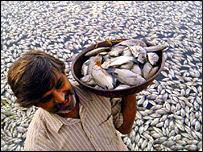
Pic. 30. Chemical pollution was blamed for killing fish in Kankaria Lake in Ahmadabad, India
148
The pesticide DDT does great damage to wildlife and can affect the human nervous system, but can also be effective against malaria. Where does the priority lie?
The industrialised world has not yet cleaned up the mess it created, but it is reaping the benefits of the pollution it has caused. It can hardly tell the developing countries that they have no right to follow suit.
Another complication in tackling pollution is that it does not respect political frontiers. There is a UN convention on transboundary air pollution, but that cannot cover every problem that can arise between neighbours, or between states which do not share a border.
Perhaps the best example is climate change - the countries of the world share one atmosphere, and what one does can affect everyone.
3.
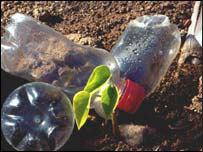
Pic. 31. A recent study detailed the plastic litter that pollutes the marine environment
One of the principles that is supposed to apply here is simple - the polluter pays.
Sometimes it is obvious who is to blame and who must pay the price. But it is not always straightforward to work out just who is the polluter, or whether the rest of us would be happy to pay the price of stopping the pollution.
One way of cleaning up after ourselves would be to throw less away, designing products to be recycled or even just to last longer.
Previous generations worked on the assumption that discarding our waste was a proper way to be rid of it, so we used to dump nuclear materials and other potential hazards at sea, confident they would be dispersed in the depths.
149
We now think that is too risky because, as one author wrote, "there's no such place as 'away' - and there's no such person as the 'other'".
Ask not for whom the bell tolls(6) - it tolls for thee(7), and for me.
1.Bhopal is a city in central India, the capital of Madhya Pradesh state and of the former state of Bhopal: site of a poisonous gas leak from a USowned factory, which killed over 7000 people in 1984 and was implicated in a further 15 000 deaths afterwards.
2.Endocrine disruptors – вещества, нарушающие деятельность желез внутренней секреции.
3.Phthalate – фталат (соль или эфир фталевой кислоты).
4.Nonylphenol – нонилфенол.
5.Breakdown product – продукт распада.
6.The bell tolls for smb. (smth.) – пришёл конец кому-л. (чему-л.).
7.Thee – уст. косвенный падеж от thou – тебе, тебя, тобой
33. Are these statements true or false? Prove your ideas.
1.Environmental problems don’t have any influence on each other.
2.Majority of environmental problems can’t do any harm to people and animals.
3.The poorer the country, the more people die from air pollution.
4.Water can’t kill a child.
5.Polluted soil is a great problem only in industrialised countries.
6.The Gulf of Mexico has the purest water in the world.
7.Cancer is a genetic disease.
8.All chemicals in food are carefully tested: they are not harmful to people.
9.Humans can live easily without any chemicals.
10.Every country in the world is responsible for clear environment to the neighbouring countries.
11.The only way to clear up the planet is to burn our waste.
34. Read the whole article again and make notes under the following headings PROBLEM – CAUSE – EFFECT as shown in the table.
PROBLEM |
CAUSE |
EFFECT |
Air pollu- |
Vehicles, industrial emis- |
4,6 million people are killed |
tion |
sions, solid fuel using. |
worldwide. |
150
35.Tell about the pollution using your notes.
36.What are the most well-known ecological threats in Russia? Are people in Russia environmentally conscious?
Is there a Green Party in Russia? How is the rubbish dealt with?
What recycling facilities are there in Russia?
Our Precious Planet
Read the questions and choose the answer you agree most with. Are your answers mostly a, b or c? See the key to find out how green you are.
How Green Are You?
1. If you had a lot of old newspapers and empty bottles, would you …
a)leave them on the pavement?
b)put them in a rubbish bin?
c)recycle them?
2. If somebody offered to give you one of the following as a gift, which would you choose?
a)a big, fast car;
b)a motorbike;
c)a bicycle.
3. If you were in the middle of a city and wanted to go somewhere one or two kilometers away, would you …
a)take a taxi?
b)take a bus?
c)walk/cycle?
4. If you had a picnic on the beach, what would you do with rubbish? Would you …
a)leave your rubbish on the beach?
b)put your rubbish in the first bin you found?
c)take your rubbish home?
151
5. If you had £1,000 to spend, would you …
a)buy a fur coat?
b)go on a safari?
c)adopt a dolphin?
mostly a’s: You’re not very green, are you? Please Look after our world before it’s too late!
mostly b’s: You’re trying to be more green, but you don’t always get it right. Learn more about the environment and think before you act.
mostly c’s: Well done! You’re really green! We need more people like you to help us save our environment!
37.In groups, write a Green Party manifesto, giving your proposals for an environmentally friendly lifestyle.
A paper factory is planned for your town, which is very beautiful but high in unemployment. There are concerns from the local community about pollution and the destruction of an ancient forest nearby.
Some people in the town are in favour of the factory. They are: the mayor, representatives of paper company, the building contractor, unemployed people.
Members of the Green Party, environmental scientists, local craftsmen and local hotel owners are against the factory.
Allocate these roles sand role-play a public consultation meeting to listen to the local views.
Think about pollution, visual impact, tourism, jobs and effects on the local businesses.
38.Be ready to discuss some environmental problems.
Student A, B, C, D, you are biologists (you will have to prepare a short presentation concerning global warming and its effects),
Student E, you are a politician (you will talk about some measures various governments take to protect our environment),
152