Материал: 2096
С |
|
|
|
|
|
|
|
|||
и |
|
|
|
|
|
|
||||
|
|
б |
|
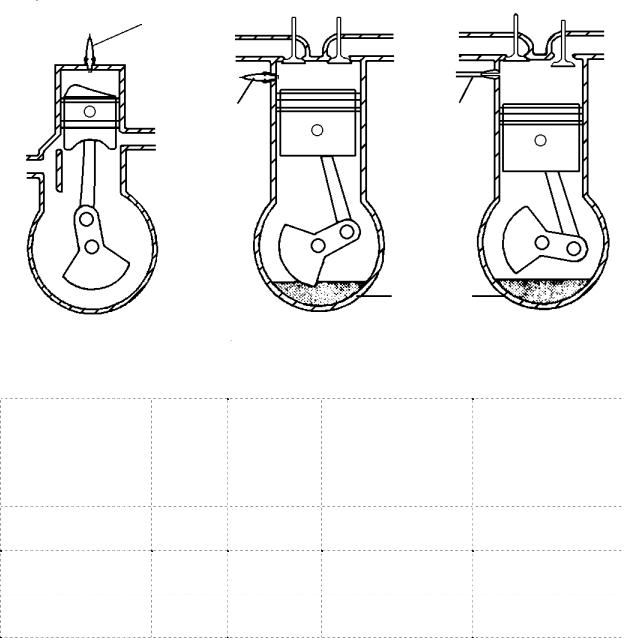
4-stroke diesel engine |
||||||
|
2-stroke petrol engine |
4-stroke petrol engine |
||||||||
|
type of |
engine |
А |
|
|
|
||||
|
|
valves |
|
fuel injector |
spark plug |
|||||
|
|
|
|
oil sump |
|
|
|
|
|
|
|
2-stroke |
petrol |
– |
– |
|
– |
|
+ |
|
|
|
engine |
|
|
|
Д |
|
|
|||
|
|
|
|
|
|
|
|
|
|
|
|
4-stroke petrol |
? |
+ |
|
? |
|
? |
|
||
|
engine |
|
|
|
|
|
|
|
||
|
4-stroke diesel |
? |
? |
|
? |
|
? |
|
||
|
engine |
|
|
|
|
|
|
|
||
|
|
|
|
|
|
|
|
|
|
|
|
|
|
|
|
|
|
И |
|||
|
Type of fuel |
|
|
Type of vehicle where this fuel is |
|
|
||||
|
|
|
|
Usually used |
Sometimes used |
Never used |
|
|||
|
|
|
|
|
|
|
|
|
|
|
|
|
|
|
|
|
|
|
|
|
|
|
|
|
|
|
|
|
|
|
|
|
|
|
|
|
|
|
|
|
|
|
|
7. Look through the text devoted to the oil and discuss the following points:
•purpose;
•sphere of use;
•origin;
•operating principals;
91
• |
possible additions; |
• reasons of it’s changing; |
|
• |
types; |
• |
properties; |
• |
grades; |
• |
standards; |
• |
service classes; |
• |
additions; |
• |
synthetical oil; |
• |
maintenance. |
|
Motor oil, or engine oil, is an oil used for lubrication of various internal |
combustion engines. While the main function is to lubricate moving parts, motor |
|
С |
|
oil also cleans, inhibits corrosion, improves sealing and cools the engine by |
|
carrying heat away from moving parts. Motor oils are derived from petroleum and |
|
non–petroleum synthesized chemical compounds used to make synthetic oil. Motor |
|
oils are today mainly blended by using base oils composed of hydrocarbons |
|
и(mineral, polyalphaolefins (PAO), polyinternal ofefins (PIO), thus organic |
|
compounds consisting entirely of carbon and hydrogen. The base oils of some |
|
high–performance motor oils contain up to 20 wt.–% of ester. |
|
|
Motor oil is a lubricant used in internal combustion engines. These include |
motor or road vehicles such as cars and motorcycles, heavier vehicles such as |
|
|
б |
buses and commercial vehicles, non–road vehicles such as go–karts, snowmobiles, |
|
boats (fixed engine installations and outboards), lawn mowers, large agricultural |
|
and construction equipment,Аlocomotives and aircraft, and static engines such as electrical generators. In engines, there are parts which move against each other causing friction which wastes otherwise useful power by converting the energy to heat. Contact between moving surfaces also wears away those parts, which could lead to lower efficiency and degradation of the motor. This increases fuel consumption and decreases power output and can, in extreme cases, lead to engine
moving parts to minimize direct contact betweenИthem, decreasing heat caused by friction and reducing wear, thus protecting the engine. In use, motor oil transfers heat through convection as it flows through the engine by means of air flow over the surface of the oil pan, an oil cooler and through the build up of oil gases evacuated by the Positive Crankcase Ventilation (PCV) system.
failure. |
Д |
|
|
Lubricating oil creates a separating film between surfaces of adjacent |
|
92
Си бLubricating oils
In petrol (gasoline) engines, the top piston ring can expose the motor oil to
to the motor oil. ManyАmotor oils also have detergents and dispersants added to help keep the engine clean and minimize oil sludge build–up.
temperatures of 320 °F (160 °C). In diesel engines the top ring can expose the oil
to temperatures over 600 °F (315 °C). Motor oils with higher viscosity indices thin
less at these higher temperatures. Coating metal parts with oil also keeps them
from being exposed to oxygen, inhibiting oxidation at elevated operating
temperatures preventing rust or corrosion. Corrosion inhibitors may also be added
in the oil, it is typically circulated throughДan oil filter to remove harmful particles. An oil pump, a vane or gear pump powered by the engine, pumps the oil throughout the engine, including the oil filter. Oil filters can be a full flow or bypass type.
Rubbing of metal engine parts inevitably produces some microscopic
metallic particles from the wearing of the surfaces. Such particles could circulate in
the oil and grind against moving parts, causing wear. Because particles accumulate И
Other oils. While it may still be used in motor vehicles, ATF or Automatic Transmission Fluid is a separate type of specialized lubricating fluid. Varying specifications of ATF are used in automatic gearboxes and some power steering systems, and should not be used to lubricate the engine. It is typically colored dark red to distinguish it from the motor oil and other fluids in the vehicle. Other non– motor oils include gear or transmission, and differentials oils. These are used in manual gearboxes and driven axles. They could include specialty uses including EP (Extreme Pressure), hypoid, and limited slip functions. Again, they are not to be used for engine lubrication.
Non–vehicle oils. Other kinds of motors also use motor oil, as well as engines that are not in vehicles such as those for electrical generators. Examples
93
include 4-stroke or 4-cycle internal combustion engines such as those used in many «walk behind» lawn mowers and other engines, and special 2–stroke oil used in 2– stroke or 2-cycle internal combustion engines such as those used in various smaller engines like mopeds, snow throwers (blowers), chain saws, toy engines like those in model airplanes, certain gardening equipment like weed/grass trimmers, leaf blowers, soil cultivators, etc. Often, the applications are not exposed to as wide a temperature range in use as vehicles, so these oils may be single grade or have less
Сviscosity index improver. 2-cycle oil is used differently from other motor oils in that it is pre–mixed with the gasoline or fuel, often in a gasoline: oil ratio of 25:1, 40:1 or 50:1 up to 100:1, and burned in use along with the gasoline. Some 2–stroke engines used in cars, such as the Saab two–stroke engine, had an oil injection иsystem rather than oil pre–mixed.
In addition to the 2-cycle oil used if they have gasoline engines, chain saws also separately use «bar and chain oil» for lubricating and cooling the surfaces where the cutting chain moves around the bar.
Otherбexamples of mechanical equipment often using oil include oil–driven compressors, vacuum pumps, diffusion pumps, sewing machines and other devices with motors, oil–driven hydraulic equipment, and turbines.
The oil properties will vary according to the individual needs of these devices. Non–smoking 2-cycle oils are composed of esters or polyglycols. Environmental legislationsАfor leisure marine applications, especially in Europe, enhanced the use of ester–based two cycle oils.
Properties. Most motor oils are made from a heavier, thicker petroleum hydrocarbon base stock derived from crude oil, with additives to improve certain properties. The bulk of a typical motor oil consists of hydrocarbons with between 18 and 34 carbon atoms per molecule.ДOne of the most important properties of motor oil in maintaining a lubricating film between moving parts is its viscosity. The viscosity of a liquid can be thought of as its «thickness» or a quantity of resistance to flow. The viscosity must be high enough to maintain a satisfactory lubricating film, but low enough that the oil can flow around the engine parts satisfactorily to keep them well coated under all Иconditions. The viscosity index is a measure of how much the oil's viscosity changes as temperature changes. A higher viscosity index indicates the viscosity changes less with temperature than a lower viscosity index.
Motor oil must be able to flow adequately at the lowest temperature it is expected to experience in order to minimize metal to metal contact between moving parts upon starting up the engine. The pour point defined first this property of motor oil, as defined by ASTM D97 as « ...an index of the lowest temperature of its utility...» for a given application [6], but the « cold cranking simulator» (CCS, see ASTM D5293–08) and « Mini–Rotary Viscometer» (MRV, see ASTM D3829–02(2007), ASTM D4684–08) are today the properties required in motor oil specs and define the SAE classifications.
Oil is largely composed of hydrocarbons which can burn if ignited. Still another important property of motor oil is its flash point, the lowest temperature at which the oil gives off vapors which can ignite. It is dangerous for the oil in a
94
motor to ignite and burn, so a high flash point is desirable. At a petroleum refinery, fractional distillation separates a motor oil fraction from other crude oil fractions, removing the more volatile components, and therefore increasing the oil's flash point.
Another manipulated property of motor oil is its Total Base Number (TBN), which is a measurement of the reserve alkalinity of an oil, meaning its ability to neutralize acids. The resulting quantity is determined as mg KOH/ (gram of
Сlubricant). Analogously, Total Acid Number (TAN) is the measure of a lubricant's acidity. Other tests include zinc, phosphorus, or sulfur content, and testing for excessive foaming.
The NOACK volatility (ASTM D–5800) Test determines the physical иevaporation loss of lubricants in high temperature service. A maximum of 15% evaporation loss is allowable to meet API SL and ILSAC GF–3 specifications. Some automotive OEM oil spec require lower than 10%.
Grades. The Society of Automotive Engineers (SAE) has established a numerical бcode system for grading motor oils according to their viscosity characteristics. SAE viscosity grading include the following: 0, 5, 10, 15, 20, 25, 30, 40, 50 or 60. The numbers 0, 5, 10, 15 and 25 are suffixed with the letter W, designating their « winter» (not «weight») or cold–start viscosity, at lower temperature. The number 20 comes with or without a W, depending on whether it is being used to denoteАa cold or hot viscosity grade. The document SAE J300 defines the viscometrics related to these grades.
Kinematic viscosity is graded by measuring the time it takes for a standard amount of oil to flow through a standard orifice, at standard temperatures. The longer it takes, the higher the viscosity and thus higher SAE code.
Note that the SAE has a separateДviscosity rating system for gear, axle, and manual transmission oils, SAE J306, which should not be confused with engine oil viscosity. The higher numbers of a gear oil (eg. 75W–140) do not mean that it has higher viscosity than an engine oil.
A single–grade engine oil, as defined by SAE J300, cannot use a polymeric Viscosity Index Improver (also referred to as VicosityИModifier) additive. SAE J300 has established eleven viscosity grades, of which six are considered Winter– grades and given a W designation. The 11 viscosity grades are 0W, 5W, 10W, 15W, 20W, 25W, 20, 30, 40, 50, and 60. These numbers are often referred to as the 'weight' of a motor oil.
For single winter grade oils, the dynamic viscosity is measured at different cold temperatures, specified in J300 depending on the viscosity grade, in units of mPa·s or the equivalent older non–SI units, centipoise (abbreviated cP), using two different test methods. They are the Cold Cranking Simulator (ASTM D5293) and the Mini–Rotary Viscometer (ASTM D4684). Based on the coldest temperature the oil passes at, that oil is graded as SAE viscosity grade 0W, 5W, 10W, 15W, 20W, or 25W. The lower the viscosity grade, the lower the temperature the oil can pass. For example, if an oil passes at the specifications for 10W and 5W, but fails for 0W, then that oil must be labeled as an SAE 5W. That oil cannot be labeled as either 0W or 10W.
95