Материал: surgical knot tying manual covidien

When the tension is reapplied in equal and opposing directions, the slip knots can usually be converted into either the square or granny knots. A simple code has been devised to describe a knot’s configuration (Figure 2).21 The number of wraps for each throw is indicated by the appropriate Arabic number. The relationship between each throw being either crossed or parallel is signified by the symbols X or =, respectively. In accordance with this code, the square knot is designated 1=1,
and the granny knot 1x1. The presence of a slip knot construction is indicated by the letter S. This method of describing knots facilitates their identification and reproduction. It is, for example, perfectly obvious what is meant by 2x2x2, without giving the knot a name, and all surgical knots can be defined unequivocally in this international language.
Sutures remain the most common method of approximating the divided edges of skin. Skin closure can be achieved by either percutaneous suture closure, dermal suture closure, or a combination of both techniques. Dermal or percutaneous suture closures are accomplished by either interrupted suture or a continuous suture closure technique.
When utilizing a continuous suture, the first suture loop is constructed by using the single strand of the fixed suture end attached to the needle and a single strand of the free suture end. However, the knot of the last suture loop at the end of the continuous suture is constructed by a suture loop containing two strands and the single strand of the fixed suture end attached to the needle.
27
IV. components of a knotted suture loop (cont’d)
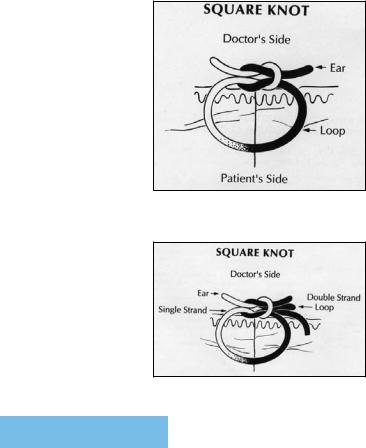
Figure 6. Construction of a square knot with two single strands.
Figure 7. Construction of a square knot with a single strand and suture loop.
The first knot in a percutaneous and dermal suture closure usually has a square knot construction. A tied square knot suture has three components (Figure 6). The loop created by the knot maintains the apposition of tissue. The knot is composed of a number of throws secured against each other. The ears are the cut ends of the suture, which add security to the knot by preventing untying during slippage.
At the end of a percutaneous and dermal closure, te knot must be constructed as a square knot with a single strand and a suture loop. A square knot of an interrupted suture loop is formed by two single throws in which the right ear and loop come out in a position that is directly opposite to that of the left ear and loop. The configuration of a knot using a looped suture end and a fixed suture end attached to a needle is markedly different from the interrupted knotted suture loop in which knot construction is accomplished by two separate strands of sutures. The interrupted suture has a knot constructed by two single strands. In contrast, knots constructed with a suture loop have two suture strands that
28

are intertwined with the single strand of the fixed suture end. When knot construction is complete, the interrupted percutaneous suture has two cut suture ends. Knots constructed by a double-strand suture loop and a single strand of the fixed suture end has three separate knot ears (Figure 7). The square knot is formed when the right ear and the loop of a two-throw knot exit on the same side of the knot and are parallel to each other.
During wound closure, knot construction involves two steps. The first secures precise approximation of the wound edges by advancing either a one-throw or a two-throw knot to the wound surface. The second step is the construction of additional throws until knot security is attained and slippage is prevented.22
Our biomechanical performance studies demonstrate that secure knot configuration of the interrupted suture loop created at the beginning of the wound is quite different from secure knot configuration of the knot constructed at the end of the wound. These differences in secure knot configurations are related to the types of suture strands used in knot construction. The first knot in a continuous suture is constructed by two single strands, and the second knot is created by a single strand
and a suture loop. Knot construction with a suture loop predisposes the knot to suture slippage and requires additional throws for knot security. When constructing the
first interrupted suture loop with either absorbable or nonabsorbable monofilament sutures, knot security is achieved with square knot construction by using three or four throws. The last suture loop and single strand involves at least five or six throws for knot security. If the trauma surgeon fails to construct secure knots at the beginning or the end of the laceration, knot slippage will occur, resulting in wound dehiscence.
29

V. mechanical performance
The mechanical performance of a suture is an important consideration in the selection of a surgical suture and can be measured by reproducible, biomechanical parameters.23 The suture’s stiffness reflects its resistance to bending. Its coefficient of friction is a measure of the resistive forces encountered by contact of the surfaces of the suture material during knot construction. Strength is a key performance parameter that indicates the
suture’s resistance to breakage. The knot breakage load for a secure knot that fails by breakage is a reliable measure of strength. During these tests, forces are applied to the divided ends of the suture loop, the patient’s side of the knot. As the suture is subjected to stress, it will elongate. The load elongation properties of a suture have important clinical implications. Ideally, the suture should elongate under low loads to accommodate for the developing wound edema, but return to its original length after resolution of the edema. Although it should exhibit an immediate stretch under low loads, it should not elongate any further while continuously maintaining the load, exhibiting a resistance to creep.
These biomechanical parameters play important roles in the clinical performance of the suture.24 Surgeons consider the handling characteristics of the suture to be one of the most important parameters in their selection of sutures. Surgeons evaluate the handling characteristics of sutures by constructing knots using manual and instrument-tie techniques. The surgeon prefers a suture which permits two-throw knots to be easily advanced to the wound edges, providing a preview of the ultimate
30

apposition of the wound edges. The force required to advance the knot is called knot rundown force. Once meticulous approximation of the wound edges is achieved, the surgeon prefers to add one more throw to the two-throw knot so that it does not fail by slippage.
The magnitude of the knot rundown force is influenced considerably by the configuration of two-throw knots. 24 Knot rundown of the surgeon’s knot square (2=1) generates sufficient forces to break the knot. In contrast, knot rundown of square (1=1), granny (1x1) and slip (S=S, SxS) knots occurs by slippage. For comparable sutures, the mean knot rundown force for square knots is the greatest, followed by that for the granny (1x1) knots, and then the slip (S=S, SxS) knots.
Failure of the knotted suture loop may be the result of either knot slippage or breakage, suture cutting through tissues, and mechanical crushing of the suture by surgical instruments. Initially, the knotted suture fails by slippage, which results in untying of the knot. All knots slip to some degree regardless of the type of suture material. When slippage is encountered, the cut ends (“ears”) of the knot must provide the additional material to compensate for the enlarged suture loop. When the amount of knot slippage exceeds the length of the cut “ears,” the throws of the knot become untied. In general, surgeons recommend that the length of the knot ”ears” be 3mm to accommodate for any knot slippage. 3 Dermal sutures are, however, an exception to this rule. Because the “ears” of dermal suture knots may protrude through the divided skin edges, surgeons prefer to cut their dermal suture “ears” as they exit from the knot. It must be emphasized that knot security is achieved in a knot with “ears”with one more throw than in a comparable knot whose “ear” length is 3mm.
31