Материал: Стандарт MIL-STD-202G
MIL-STD-202G
2.2 Monitoring. Monitoring involves measurements of the vibration excitation and of the test item performance. When required in the individual specification, the specimen may be monitored during the test. The details of the monitoring circuit, including the method and points of connection to the specimen, shall be specified.
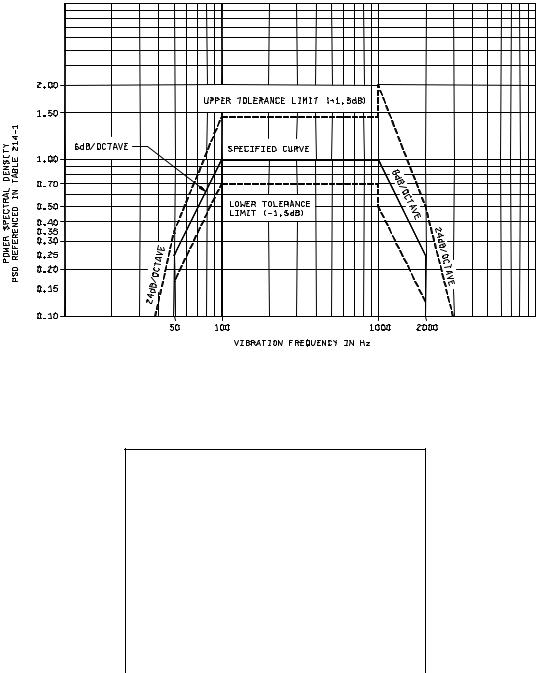
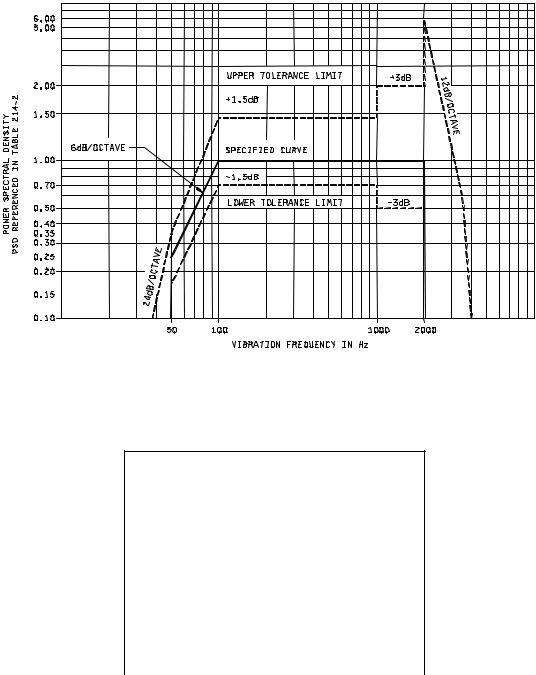
2.2.1 Vibration input. The vibration magnitude shall be monitored on a vibration machine, on mounting fixtures, at locations that are as near as practical to the test item mounting points. When the vibration input is measured at more than one point, the minimum input vibration shall normally be made to correspond to the specified test curve (see figures 214-1 and 214-2). For massive test items and fixtures, and for large force exciters or multiple vibration exciters, the input-control value may be an average of the average magnitudes of three or more inputs. Accelerations in the transverse direction, measured at the test item attachment points, shall be limited to 100 percent of the applied vibration. The individual specification shall specify the number and location of the test points.
3.METHOD OF MOUNTING. The specimens shall be mounted in accordance with the instructions in the individual specifications. The orientation of the specimen or direction(s) of the applied vibration motion shall be as specified. Any special test fixtures or jigs required to run the test shall be as specified in sufficient detail in the individual specification to assure reproducibility of the input motion applied to the specimen. These details shall include the dimensions, the materials, temper, etc., as applicable.
4.PROCEDURE. The specimen, or substitute equivalent mass, shall be mounted in accordance with 3 and the monitoring equipment attached, if applicable, in accordance with 2.2. The vibration machine shall then be operated and equalized or compensated to deliver the required frequencies and intensities conforming to the curves specified test condition I, figure 214-1, or test condition II, figure 214-2 (see 2.1). If the order of application of the different directions is critical, it also shall be specified in the individual specification. The specimen shall then be subjected to the vibration specified by the test condition letter (see tables 214-I and 214-II) for the duration as specified in the individual specification:
3-minutes; 15-minutes; 1-1/2 hours; or, 8-hours;
In each of three mutually perpendicular directions, and in the order specified as applicable. The measurements made before, during, and after the test shall be made in accordance with 5 and if the specimen shall be monitored during the test, the details shall be as specified in 2.2.
5.MEASUREMENTS. Measurements shall be performed before, during, and after the test as specified in the individual specification.
6.SUMMARY. The following details are to be specified in the individual specification:
a.Monitoring instrumentation, if applicable (see 2.2).
b.The number and location of test points (see 2.2.1).
c.Method of mounting and orientation (see 3).
d.Test condition (I or II); letter (A-K); and duration of test (3-minutes, 15-minutes, 1-1/2 hours, or 8-hours) (see 4).
e.Order of application of vibration direction, if applicable (see 4).
f.Measurements before, during, and after test (see 5).
METHOD 214A
28 March 1984
2
MIL-STD-202G
FIGURE 214-1. Test condition I, random vibration test-curve envelope (see table 214-I).
TABLE 214-I. Values for test-condition I. 1/
Characteristics
Test |
Power spectral |
Overall |
condition letter |
density |
rms G |
A |
.02 |
5.35 |
B |
.04 |
7.56 |
C |
.06 |
9.26 |
D |
.1 |
11.95 |
E |
.2 |
16.91 |
F |
.3 |
20.71 |
G |
.4 |
23.91 |
H |
.6 |
29.28 |
J |
1.0 |
37.80 |
K |
1.5 |
46.30 |
1/ For duration of test, see 4.
METHOD 214A
28 March 1984
3
MIL-STD-202G
FIGURE 214-2. Test condition II, random vibration test-curve envelope (see table 214-II).
TABLE 214-II. Values for test-condition II. 1/
Characteristics
Test |
Power spectral |
Overall |
condition letter |
density |
rms G |
A |
.02 |
6.21 |
B |
.04 |
8.78 |
C |
.06 |
10.76 |
D |
.1 |
13.89 |
E |
.2 |
19.64 |
F |
.3 |
24.06 |
G |
.4 |
27.78 |
H |
.6 |
34.02 |
J |
1.0 |
43.92 |
K |
1.5 |
53.79 |
1/ For duration of test, see 4.
METHOD 214A
28 March 1984
4

MIL-STD-202G
METHOD 215K
RESISTANCE TO SOLVENTS
1.PURPOSE. The purpose of this test is as follows:
a.To verify that markings or color coding will not become illegible or discolored on the parts (including printed wiring boards) when subjected to solvents and processes normally used to clean solder-flux, fingerprints, and other contaminants from printed-wiring and terminal-board assemblies, etc.
b.To verify that component protective coatings and encapsulant materials are not degraded to the point where electrical or mechanical integrity is disturbed when subjected to solvents and processes normally used to clean solder flux, fingerprints, and other contaminants from printed-wiring and terminal-board assemblies, etc.
1.1Formulation of solvents. The formulation of solvents is considered typical and representative of the solvents used in printed wiring assembly processing of electronic components. Processing conditions are representative of processes used for printed wiring assembly.
1.2Checks for conflicts. When this test is referenced, care should be exercised to assure that conflicting requirements, as far as the properties of the specified finishes and markings are concerned, are not invoked.
2. MATERIALS
2.1 Solvent solutions. The solvent solutions used in this test shall consist of the following (see table I for summary).
a.A mixture consisting of the following:
1.One part by volume of isopropyl alcohol, American Chemical Society (ACS) reagent grade, or isopropyl alcohol in accordance with TT-I-735, grade A or B, and
2.Three parts by volume of mineral spirits in accordance with MIL-PRF-680, type I, or three parts by volume of a mixture of 80 percent by volume of kerosene and 20 percent by volume ethylbenzene.
b.This solvent has been deleted. When a suitable replacement solvent has been determined, it will be added as solution b.
c.A terpene defluxer consisting of a minimum of 90 percent d-limonene and 10 percent surfactant. 1/
d.A mixture consisting of the following:
1.Forty-two parts by volume water, 1 megohm-cm minimum resistivity.
2.One part by volume of propylene glycol monomethyl ether (glycol ether PM, 1-methoxy-2-propanol).
3.One part by volume of monoethanolamine. 2/
2.1.1Solvent solutions, safety aspects. Solvent solutions listed in 2.1a through 2.1d exhibit some potential for health and safety hazards. Safety precautions as listed in the appropriate manufacturers material safety data sheet shall be observed.
1/ A commonly used terpene defluxer is BIOACT EC-7R. "BIOACT" is a registered Trademark of Petroferm INC; "EC-7 and EC7R" are trademarks of Petroferm INC.
2/ Normal safety precaution for handling this solution (e.g., same as those for diluted ammonium hydroxide) based on O.S.H.A. rules for monoethanolamine.
METHOD 215K
8 February 2002
1 of 4
MIL-STD-202G
2.2Vessel. The vessel for solvent immersion shall be a container made of non-reactive material and of sufficient size to permit complete immersion of the specimens in the solvent solutions specified in 2.1.
2.3Brush. The brush shall be a toothbrush with a handle made of a non-reactive material. The brush shall have three or four long rows, 1 and 1/8 ±1/8 inch in length, of hard bristles. Each row shall contain eight to twelve tufts, the free ends of which shall lie substantially in the same plane. The brush shall be used with a single solvent and when there is any evidence of softening, bending, wear, or loss of bristles, it shall be discarded.
3. PROCEDURE
3.1Procedure. The specimens subjected to this test shall be divided into three groups of approximately equal size. a. The first group shall be exposed to the solution specified in 2.1a.
The solution shall be maintained at a temperature of 25°C ±5°C. The specimens shall be completely immersed for 3 minutes +0.5, -0 minutes in the specified solution contained in the vessel specified in 2.2. Immediately following immersion, each specimen shall be tested as follows: The bristle portion of the brush, specified in 2.3, shall be dipped in the solution until wetted and the specimen shall be brushed with normal hand pressure (approximately 2 to 3 ounce force applied normal to the surface) for ten strokes on the portion of the specimen where marking has been applied. The brush stroke shall be directed in a forward direction across the surface of the specimen being tested. Immediately after brushing, the procedure shall be repeated two more times, for a total of three immersions, followed by brushing. After completion of the third immersion and brushing, the specimens shall be air-blown dry. The specimens shall be inspected in accordance with 4.1 and 4.2 to determine the extent, if any, of deterioration that has occurred.
b.This solvent solution has been deleted.
c.The second group shall be exposed to the solution specified in 2.1c.
The solution shall be maintained at a temperature of 25°C ±5°C. The specimens shall be completely immersed for 3 minutes +0.5, -0 minutes in the specified solution contained in the vessel specified in 2.2. Immediately following immersion, each specimen shall be tested as follows: The bristle portion of the brush, specified in 2.3, shall be dipped in the solution until wetted and the specimen shall be brushed with normal hand pressure (approximately 2 to 3 ounce force applied normal to the surface) for ten strokes on the portion of the specimen where marking has been applied. The brush stroke shall be directed in a forward direction across the surface of the specimen being tested. Immediately after brushing, the procedure shall be repeated two more times, for a total of three immersions, followed by brushing. After completion of the third immersion and brushing, the specimens shall be rinsed in approximately 25°C water and all surfaces air-blown dry. The specimens shall be inspected in accordance with 4.1 and 4.2 to determine the extent, if any, of deterioration that has occurred.
d. The third group shall be exposed to the solution specified in 2.1d.
The solution shall be maintained at a temperature of 63°C to 70°C. The specimens shall be completely immersed for 3 minutes +0.5, -0 minutes in the specified solution contained in the vessel specified in 2.2. Immediately following immersion, each specimen shall be tested as follows: The bristle portion of the brush, specified in 2.3, shall be dipped in the solution until wetted and the specimen shall be brushed with normal hand pressure (approximately 2 to 3 ounce force applied normal to the surface) for ten strokes on the portion of the specimen where marking has been applied. The brush stroke shall be directed in a forward direction across the surface of the specimen being tested. Immediately after brushing, the procedure shall be repeated two more times, for a total of three immersions, followed by brushing. After completion of the third immersion and brushing, the specimens shall be rinsed in approximately 25°C water and all surfaces air-blown dry. The specimens shall be inspected in accordance with 4.1 and 4.2 to determine the extent, if any, of deterioration that has occurred.
METHOD 215K
8 February 2002
2