Материал: Snote
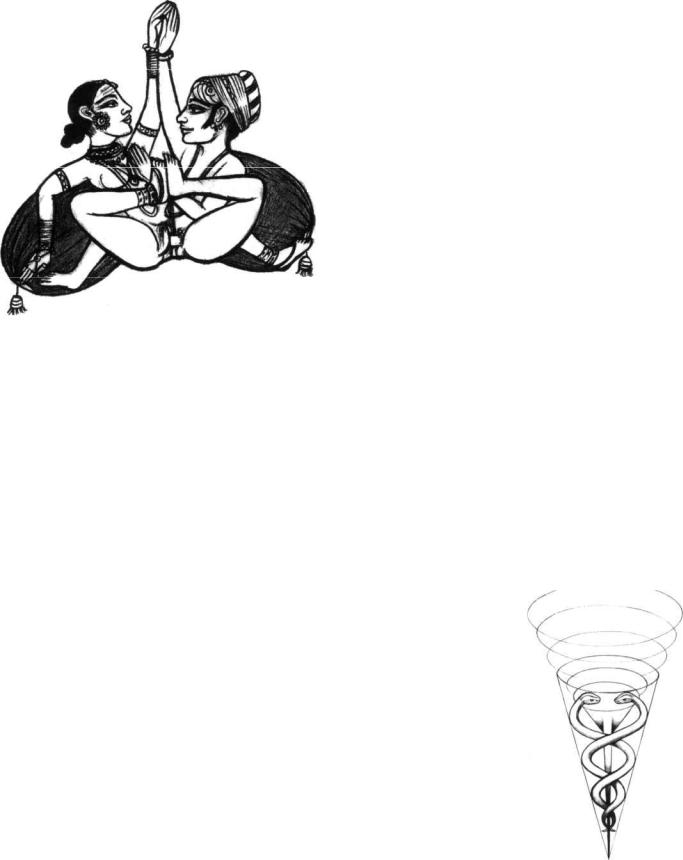
Lovers depicted in a Tantric posture for channeling energy upward. Mutual adoration uplifts the senses and helps the circulation and transformation of energy. From a Rajasthani miniature painting, India, circa 1800.
Here in this body are the sacred rivers; here are the sun and moon, as well as all the pilgrimage places.
I have not encountered another temple as blissful as my own body.
SARAHA DOHA
the temple of the body
T h e physical b o d y is |
the |
||
temple of the soul, the mi- |
|||
crocosm |
of the universe. |
||
Within |
this |
temple |
are |
found all of the cosmic |
|||
principles. |
The Tantras |
||
teach that no temple sur- |
|||
passes |
in |
sanctity |
the |
"Temple of the Body." All |
|||
the elements, space, air, fire, water, and earth are found within the body, together with their properties. The bodily temple has
its "gardens," "rivers," "sanctuaries," and
"gates." By definition, a temple is a place of worship, an edifice dedicated to the service of God. This God, according to Tantra, is our highest self or soul, to be known and served through the Temple of the Body.
Tantra teaches that there are nine "gates" to the bodily temple. These are divided between the upper part and the lower part. The "lower gates" are the orifices of the anus and the sexual organ. The "upper gates" are the mouth, nose, two eyes, two ears and the fontanel opening at the top of the head. The fontanel is clearly visible as an opening at the
time of birth, but it gradually closes up |
dur- |
ing the first year of life. Eastern esoteric |
tra- |
dition tells us that through this opening, known as the "Aperture of Brahma," the soul enters and leaves the bodily temple. Though the other gates may be used by the soul in its journeys, it is the uppermost one that leads to the higher spiritual realms.
The Temple of the Subtle Body contains three main "rivers," from which branch out innumerable tributaries. One Great River or "psychic pathway" runs from the region of the lower gates, the perineum, up the spine to the uppermost gate at the top of the head. This is sometimes referred to as the Great Axis, the Holy Mount Meru, or just the Great Pathway. It connects the individual with the cosmos.
At either side of the central Great River are two "rivers" that emanate from the same source and lead to the upper "gates." These are associated with the solar and lunar ener-
gies, related to the right and left sides of the body respectively. They are conceived of as crossing the central Great River at stages in the ascent, like twin snakes wound around a central staff. This symbol, known as the caduceus, or wand of Mercury, has been adopted as an emblem by the medical profession.
The act of worship in the Temple of the Body consists in focusing the creative attitude by channeling the sex energy upward. The evolutionary process, experienced as an ecstatic thrill, rises up from the sexual region and flares at the solar plexus. The sixty-four vital flames burn up all negativity and purify the psychic pathways. The fire of love floods the three rivers and the solar and lunar energies unite, thus illuminating the temple. This psycho-cosmic process manifests as the ecstatic emotion, which no words can truly describe. Through knowledge of the psychic pathways, the sexual experience becomes more potent. By practicing the secret techniques of Tantra one can consciously experience orgasm and the ensuing transcendental delight.
The psycho-cosmic process or "self-wor- ship" in the Temple of the Body takes place on every level, from the physical to the most subtle. It is important to really regard the body as a temple. Awareness of its physical and subtle condition is an integral part of the creative attitude. The bodily temple should
Twin snakes around a central column. This ancient Hermetic symbol, the caduceus, clearly illustrates the basic concept of the Subtle Body. The rising swirling energies of the snakes produce an ascending vortex of power, used in Tantra for personal transformation.
12 Brahma the Creative
be kept clean, healthy and harmonious, out |
neous and total act of love. By worshipping |
of respect for the divinity within. Provide |
in the Temple of the Body during love-mak- |
enjoyment and spare no effort to ensure the |
ing, all desires are fulfilled. That sensual love |
temple divinity's complete satisfaction. Do |
is an act of great magical and spiritual po - |
not hold back, for real worship is a sponta- |
tency is one of the main principles of Tantra. |
When my beloved returns to the house, I shall make my body into a Temple of Gladness. Offering this body as an altar of joy, my let-down hair will sweep it clean. Then my beloved will consecrate this temple.
VAISNAV BAUL SONG
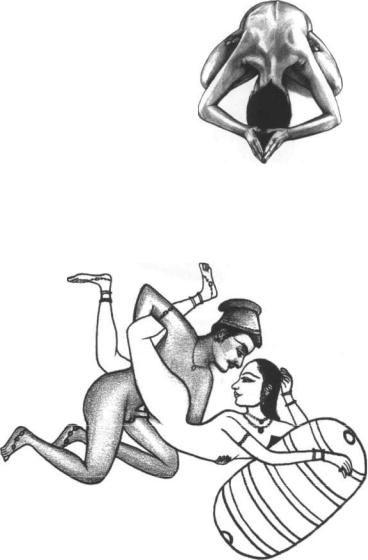
Obeisance to the spiritual ideal. This gesture focuses the practitioner on selfsurrendering and channels energy in a spiritual direction.
head and heart
The head and the heart are two distinct parts of the body that, in the West, are a cause of psychic disunity. But the Temple of the Body, though comprising many parts, is in fact a Divine Unity. We speak of the "heart ruling the head" when someone seems to have lost all common sense and is prey to emotions. The head is said to rule the heart when the mind is calculating and unmoved by human feeling. In both cases, one center dominates at the expense of the other. This dichotomy of head and heart always produces a breakdown of intimacy in a relationship. It is completely incompatible with the selfless ecstasy of Tantric love.
In Western mystical traditions, one frequently encounters the idea of "renouncing the flesh for the sake of the soul." This is, in reality, a hopeless endeavor. For whatever is repressed will inevitably erupt, usually at the most inopportune moment. The Tantric way
teaches that we must use all our endowments of mind,
body, head, and heart, on the Path to Liberation. Through the consecration of
all parts of our being to an exalted purpose, we integrate them
into a whole. In this way,
the emotions and passions of the heart can
be transformed into the joy of transcendent ecstasy. This transformation takes place through the interplay of head and heart, reason and emotion. The Tantric image of this process is the heart's "fire of emotion" melting and distilling the head's "waters of wisdom."
The notion of exchange and mutual enrichment is an essential ingredient of Tantric love-making. It makes possible a true exchange between the lovers. The path of Tantric love encompasses all aspects of the emotions and intellect. It leads to an experience of cosmic ecstasy through awareness of the Universal Self in both partners.
When there is only worldly enjoyment, there is no release. And when there is only release, there is no worldly enjoyment. But both worldly enjoyment and release are in the palm of the hand of those who are devoted to the Higher
Being.
KAULARAHASYA
A Tantric love-making posture. From an Indian miniature of the eighteenth century.
By those same deeds which create bondage for dualistically inclined beings, one can be liberated from the bondage of this world. The main principle is that the act must be accompanied by non-dualism between "head" and "heart."
ADVAYASIDDHI
Brahma the Creative 13
Where there is ecstasy, there is Creation; Where there is no ecstasy, there is no Creation. In the Infinite, there is ecstasy; There is no ecstasy in the finite.
CHANDOGYA UPANiSHAD
The louse of habit-forming thoughts is both self originated and self destructive. Kill this louse and find the teaching.
TILOPA
The mind is wavering and restless, difficult to guard and hard to restrain; let the wise person straighten his mind, just as an arrow maker makes his arrows straight.
DHAMMAPADA
breaking habits
Personal growth can be accelerated simply by changing one's habits. It is the condition of dependency inherent in habits that must be broken. When you find yourself saying or thinking, "But I can't change that.. .I always do that," then that is undoubtedly the first habit to break. Freedom of choice results from mastering habit. Independence from habits in the area of sexuality should be cultivated, as sexual habits
are the most restrictive. Any intentional act of will has a magical potency and is far more effective than a habitual or unintentional act. The human body is capable of quite extraordinary adaptation, even when it seems set in a rigid pattern. The potential for change is always there, but it is better not to wait for a
moment of crisis before ridding ourselves of habits. Our very survival as a species is due to our ability to change and adapt.
Mental habits are more difficult to deal with than physical ones, as they are less obvious. Often enough, they are inherited from parents or acquired through social conditioning. They restrict our whole way of life, insidiously providing a false sense of security. By causing us to forget our Higher Selves, they obliterate our awareness and are fatal to an intimate relationship. Frequently, an unawareness of disagreeable habits or idiosyncrasies is a source of contention between people. Yet often, all that's needed to overcome this obstacle is the willingness, on the part of both people, to change, grow, and evolve. When the initial fear of change is overcome, one can really begin to enjoy new experiences. Sexual habits are especially limiting and it is here that Tantra requires absolute adaptability. All Eastern teachings on the sexual mysteries point to the need for variety and uninhibited spontaneity.
Love resulting from the constant and continual performance of some act is called love acquired by habit.
KAMA SUTRA
self-examination
Self-examination is vital to the evolutionary path of love. Only in an atmosphere of complete honesty can unconscious psychic impediments to our growth be cleared away. When we turn our consciousness inward to reflect upon the self, a new sensitivity unfolds. Self-examination helps to renew and fine-tune the senses. Sexual habits are particularly dulling to the senses, and it is here that self-examination is of great value.
If one partner depends exclusively on the other for support and comfort rather than seeking these within, the result can be a bur-
densome imbalance in the relationship. Real love places no value on projection of selfish fantasies onto the other. This does not allow room for the play of ecstatic, spontaneous love, which is the goal of Tantra. Instead, a relationship becomes limiting; it may even drag both partners into an unresolvable conflict.
Failures in both love and marriage often result when one partner does not live up to the expectations of the other. This suggests that there is no real partnership, but rather that one partner is being selfish with the other. In this situation a couple lives together in an inner state of separation and hypocrisy.
In the Tao te Ching, a Chinese philosophical work of the sixth century B.C., there is a beautiful and clear statement about selfknowledge. The author, Lao-tzu, declares: "Knowing others leads to Wisdom; know-
14 Brahma the Creative
ing the self leads to Enlightenment. Mastering others requires force; mastering the self calls for inner strength."
Self-examination is both a touchstone and a support in life. It strengthens the mental attitude necessary for self-development. It is a very personal practice and should not be made a topic of general conversation, for doing so results in psychic dispersion and weakened self-confidence. Positive selfexamination deepens the capacity for intuitive experiences. It creates a state of enhanced receptivity. By seeing ourselves in a clear light, we can eliminate negativity and doubt, which tend to pollute our relationships. Authenticity within the couple fosters spontaneity, thus liberating the relationship from the conventional and predictable. Invoke an earnest desire to know your true self. Put aside self-doubt and fears.
Self-examination is a prerequisite of any practice of meditation. It can be performed at any time and is an internal reflective process far removed from the mind's chatter and random thoughts.
Self-examination starts with the observation of one's relation to the things and events of the world. Try to view all experiences as connected to one another and to oneself; notice the fine details and cultivate an inquisitive but detached attitude. Examine whatever comes to you and try to understand the causes behind each situation and your actions in it. A simple procedure for self-examination is to sit comfortably in front of a mirror, close your eyes and empty your mind of all thoughts. Then gradually begin to open your eyes, looking at the reflection in the mirror as if meeting that person for the first time. See what sort of impression you make on yourself. Notice how changes
in your facial expressions are linked to thoughts and emotions. Gradually enter into rapport with your mirror image, gently relaxing your face while maintaining conscious control of breathing. If you notice negative qualities in your reflection, make a careful adjustment of attitude and emotion, using the breath to stabilize the psyche. Imagine that you are replacing a negative quality with a positive one, and try to feel the "new you" as real and lasting. Then gradually close your eyes and concentrate on assimilating the experience, imagining it as pervading your whole being.
The essence of meditation is using the mind to know the self. External objects can help in meditation, but should not be relied upon exclusively. A lit candle can, for example, be a helpful aid to self-examination. Study the flame and focus all thought upon it. Then compare qualities in yourself with the bright dancing candlelight. Imagine that the flames are burning away all the impurities in your psyche. Then mentally center an image of the candle flame between your eyes and keep it burning in your mind. Bathe your whole being with this inner light of the mind and use it as a focus for self-examination.
By knowing yourself you can come to know others. Don't criticize others before correcting faults in yourself. Only through self-examination can you develop real insight. Real insight requires courage and rigorous honesty. An attitude of constant self-exami- nation will quickly overcome inner obstacles to growth and generate a marvelous potential for Tantric love. Self-examination is the most direct path to the experience of nonduality and mystic awareness. Only in that experience can a physical relationship take on a lasting meaning.
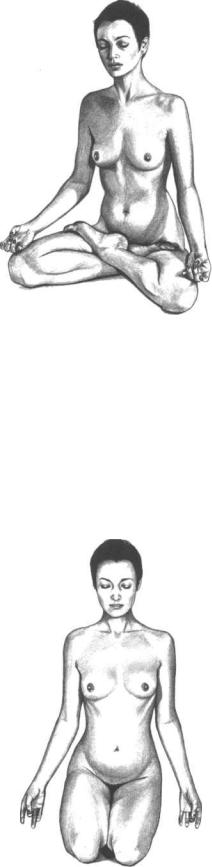
Meditation posture, traditionally referred to as padmasana, meaning "lotus seat." The second finger and thumb are linked, to aid channeling of psychic energy. Padmasana, a comfortable and balanced position, is described in the Shiva Samhita in the following way: "Cross the legs, carefully placing the feet on opposite thighs. Fix the eyes on the tip of the nose and press the tongue against the roof of the mouth, behind the teeth. Inhale and exhale slowly, in an unobstructed stream. By this practice the vital airs are balanced and the whole organism harmonized."
Constantly maintain alertness of consciousness in walking, sitting, eating, sleeping, and in all other acts. Avoid concealing your own faults and speaking of the faults of others. Should thought processes be difficult to control, be sure to persevere in your efforts to overcome them. Know that the meditator, the object of meditation and the act of meditation constitute an inseparable unity.
GAMPOPA
Virasana, or heroic posture, of Hatha Yoga is both easy and comfortable. It is ideal for meditation and breathing practices.
Brahma the Creative 15
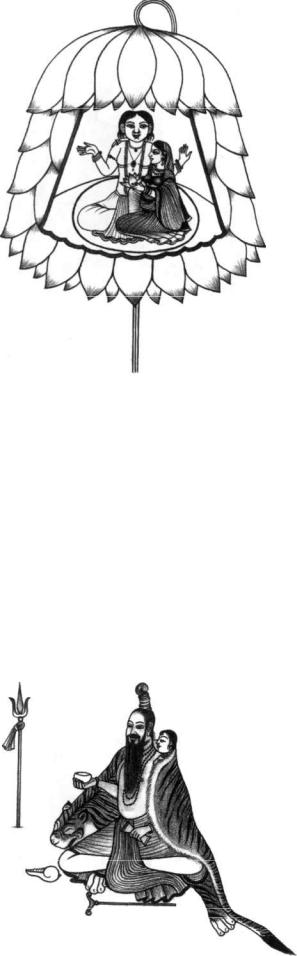
The cosmic couple, Shiva and Shakti, seated together in spiritual ecstasy. As Animus and Anima, they symbolize the union of consciousness and energy by the power of faith and devotion. From an Indian painting, Kangra Hills, circa eighteenth century.
Lord Shiva, the Supreme Yogi, seated with Parvati, his consort. This male/female icon, known as Bhairav Raga, tells of the power inherent in sexual harmonization. From an Indian miniature painting, Deccan, circa eighteenth century.
bhakti and shakti
T h e re are two important requirements for the person em- b a r k i n g on a j o u r n e y of self-awareness. These are the provisions that sustain one on the journey. The first is Bhakti, meaning faith or devotion. This
quality can make the impossible possible. On the spiritual path, faith dissolves self-doubt, and devotion speeds one rapidly to the goal. By maintaining faith in the higher direction of evolution, one will overcome all obstacles. Faith has no substance, but is a deep feeling; people generally cannot say why they have faith, they just
know and believe.
The erotic sentiment stimulates faith and leads to commitment. Eroticism can create the awareness of a timeless state of non-du- ality. There is an Eastern saying that "in the unsteady mind enters time"; faith is a timeless and steadying experience that can transform an ordinary physical love into the supersensual union of a "god" and "goddess," the highest attributes of our spirits. The truly erotic experience is always timeless; the couple evoke faith in each other and awaken the non-dual essence within. So it is with faith in the cosmic nature of our consciousness and in the highest spiritual ideals common to every inner tradition. Test your faith by the practice of self-examination; open in your heart a field within which lasting faith can grow. Be devoted to everything you believe in and especially to the transforming power of sexual energy. A couple who are united in faith and mutual devotion can experience their true natures as god and goddess.
The second provision for the journey is
Shakti, the Divine Energy of Creation, the exalted feminine principle that pervades all things. The term Shakti has several connotations, all of which relate to creative energy. In the human body this energy is located primarily in the sexual region. It is the power of
transformation, an uplifting and liberating force that, when awakened, leads to the ecstasy of fulfillment. It is the power of the orgasm, the thrill of sexual delight, the sudden flash of insight. Shakti exists on many different levels, from the physical to the very subtle. When Shakti is evoked during sexual love, the couple can awaken to a new creative potential within themselves. Recognizing and honoring Shakti opens the path of love.
There is a well-known Tantric saying that "without Shakti the lover is but a corpse." Shakti is especially concentrated in woman and it is this power that enables her to give birth. The term Shakti therefore can also refer to the female partner, without whom no act of Tantric love can be completed. An "inner woman" exists in both men and women and manifests as sexual energy. This natural (bisexual) quality of all human beings results from our origin through the union of the two sexes. The attempt to suppress this natural androgyny in favor of an exaggerated "male" or "female" emphasis has created serious psychological imbalance in the West. Psychiatrists report sexual role confusion as one of the dominant neuroses in contemporary society.
A liberated attitude to sexuality demands an awareness of the natural bisexuality of all human beings. The couple should make full use of this kind of awareness during lovemaking and playfully exchange sex roles, recognizing that there is a female in every male and a male in every female. Both Taoist and Tantric teachings state that it is important to recognize the significance of role reversals when engaging in mystic sexual practices. This does not mean that a man needs to become "effeminate" or a woman "aggressive." Rather it means one should let go of preconceptions about sexual roles and allow spontaneity to enrich the relationship. Honor male and female qualities equally. Try to understand the mystery of life through the subtle interplay of male and female principles. All that is created is but an emanation of the one Creative Force of Nature. In this world the female principle, or Adi Shakti (Original Shakti), is particularly exalted and as such should be greatly honored.
A man's attitude toward women is a direct reflection of his attitude toward life. Therefore a man should always take care to honor the female principle in his partner, in other women, and in himself. Likewise, a