Материал: Snote
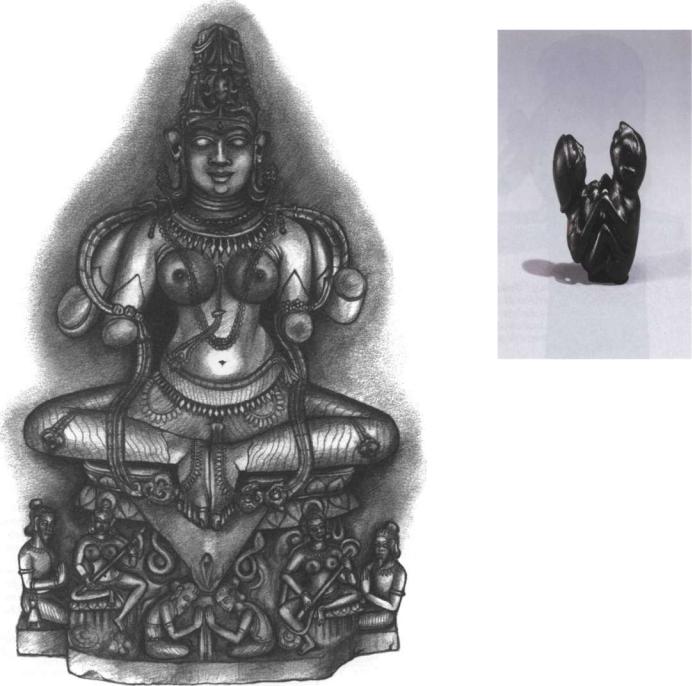
woman should recognize the qualities of the Goddess in herself and try to embody them. She should also try to relate to the "inner woman" of her partner, aiming to please both aspects of the One Creative Power or Shakti. When a man spontaneously views his part-
ner as an embodiment of Supreme Shakti, the Creative Goddess, she will respond with Bhakti, pure faith and devotion. She will become his high priestess and initiatress into the mysteries of love; he will then reveal himself as her Lord and Lover.
The great goddess Kameshwari in the Yogic posture known as bhagasana, with feet together and Yogis making obeisance to a representation of the Yoni. Kameshwari is the original Shakti or power principle of Tantra and is here portrayed in her lustful form. This image, from the sixty-four-Yogini Temple of Bheraghat, Madhya Pradesh, circa late eleventh century, was totally disfigured by Moslem invaders who viewed the Hindu elevation of feminine energy as heretical. We have restored some of the damaged details of the sculpture in the drawing at left.
Shakti is the essence of Bliss; she is the love-power. Bhakti or devotion is the uplifting force of faith.
DEVI PURANA
Shakti performs all the physical needs of Shiva. The bodiless Shiva, being of the nature of Pure Consciousness, must have the creative energy of Shakti for support.
KAMAKALA VILASA
Brahma the Creative 17
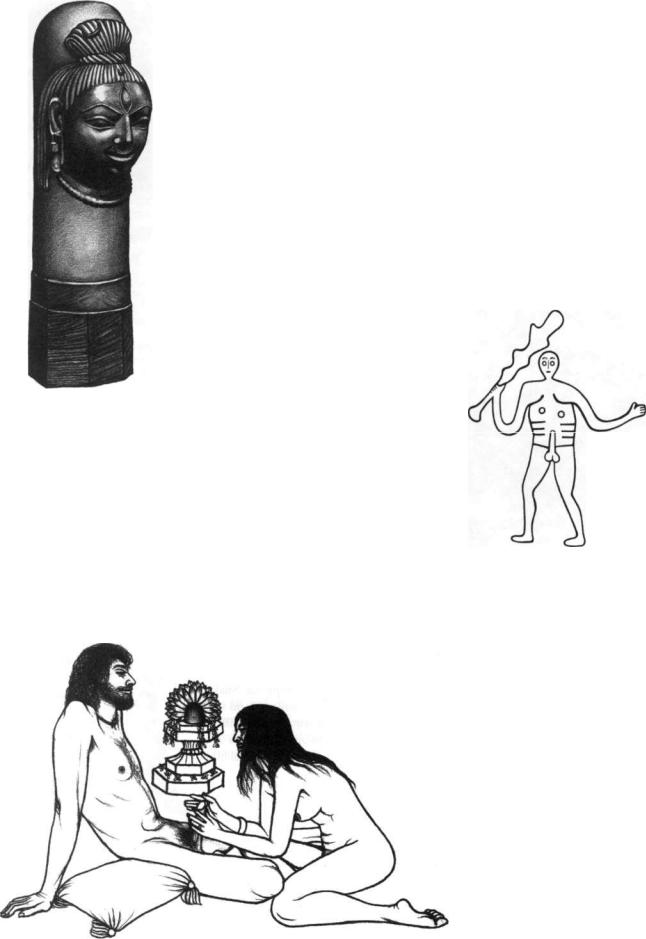
Lingam stone with face of Shiva carved on it. Known as Ekamukhalinga (OneFaced Lingam), this type of image is used as a focus in acts of worship and ritual. The Third Eye of Shiva is shown open and the face in ecstatic blissfulness. From a stone sculpture, Madhya Pradesh, circa fourth century.
When the male organ is honored as the Shiva Lingam, sex takes on a deep transcendental significance.
Shiva and jiva
In the previous section we dealt with the relationship between faith and devotion and the Creative Energy. We introduced the concept of androgyny, the male and female within each of us. Any discussion of the Tantric view of Shakti as the exalted female principle automatically calls to mind her counterpart, Shiva, the exalted male principle. In the central part of this book we ex-
p l o r e the m e a n i n g of Shiva from a
transcendental viewpoint. Here we shall briefly examine the relationship between Shiva and Shakti, so the reader may recognize the exalted male principle within. Finally, the metaphysical meaning of Shiva will be presented. The Indian terminology may at first appear formidable, but a little patience will prove it useful, as the innate simplicity of Tantric teaching becomes apparent.
Shiva, the exalted male principle, is found within both man and woman. Referred to in the ancient texts as the "Great God" or the "Immortal Divine Principle," Shiva's symbol is the erect phallus, the Lingam, which represents the Great Spirit in a state of excitement. The stimulus is the Creative Energy, the Shakti, swirling around Shiva's cosmic erection like an ocean of ever-chang- ing variety, a veritable sea of sensation.
The ancient Egyptians, Greeks, Romans, and other pre-Christian peoples worshipped the phallus as the symbol of the exalted male principle. Shiva is the Yogic archetype par
excellence, the evolutionary Lord of All Creatures. The Shiva-principle is directly related to the mental function and to the Eternal Spirit. In ancient mythology the god Shiva is referred to as "the One who conquers death." This conquest is achieved through the power of Tantric Yoga, the union of Shiva and Shakti. The whole universe is created out of the union of Shiva and Shakti, the cosmic male and female archetypes.
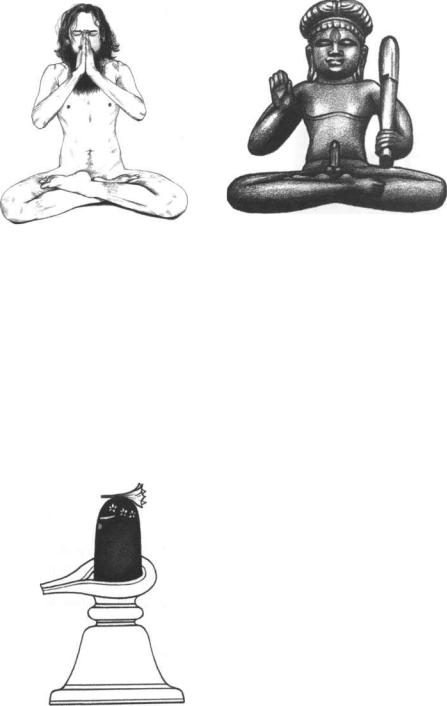
In Eastern iconography Shiva is portrayed as a Lingam, an abstract phallic form, a Lingam with a face, a column, a seated or standing Yogi with Lingam erect and in many multi-armed anthropomorphic forms. The Tantras teach that there is a Lingam within
Giant primitive figure with phallus erect. Cut into the turf of a chalk hillside, this type of image indicates the sexual emphasis in pagan beliefs. Cerne Abbas, Dorset, England, probably of the time of the early Roman invasion of Britain.
each Yoni. This observation refers anatomically to the clitoris, which is capable of erection when excited, and also reminds us of the inherent bisexuality of the female.
Knowledge of Shiva, the Transcendental, permits passage through the doorway to other worlds. Identify with the vital mind energy of Shiva during Tantric love-making. This will eventually cause an experience of transcendence beyond your normal worldly role or limitations. Shiva is experienced as a penetration into the depths of space, as being pulled out into the universe, beyond all knowable things or events. T h e Shiva Samhita, an important Hindu Tantric text, declares that "those who experience the Shiva-principle are heroic, enterprising, freed from the effects of blind emotions, skillful, persevering, talented, contented, and firmminded."
We cannot know the transcendental from our limited everyday viewpoint, as by definition it transcends the boundaries of the sense-perceptible universe. The Hindu term
Jiva expresses a similar concept: the "Eternal, Unchangeable Essence, without beginning or end," the Immortal Soul, the very principle of life. Jiva is also used to refer to the individual soul and is likened to a single ray from the solar orb of Brahma, the Creative. Thus Hinduism does not consider the individual soul as in any way separate from its original Divine Source.
The Shiva Samhita gives a concise account of the nature and function of the Jiva. It states:
The Jiva dwells in the body of man and |
Yogic lotus posture with hands joined in |
|
|
|
Ithyphallic figure of Shiva, the Supreme |
|
|||||||||||
salutation to the divine Shiva-principle |
|
|
|
Yogi. He holds a club, signifying his all- |
|
||||||||||||
woman and is adorned with a garland of |
within. |
|
|
|
|
|
|
|
|
powerful role as the Yogic ideal. Stone |
|
||||||
endless desires. The Jiva is chained to the |
|
|
|
|
|
|
|
|
|
sculpture from Jageshwar, Uttar Pradesh, |
|
||||||
|
|
|
|
|
|
|
|
|
India, circa tenth century. |
|
|
|
|||||
body by the various Karmas amassed in |
|
|
|
|
|
|
|
|
|
|
|
|
|||||
|
|
|
|
|
|
|
|
|
|
|
|
|
|
|
|||
previous lives. Whatever happens to an |
|
|
|
|
|
|
|
|
|
|
|
|
|
|
|
||
individual is born of Karma; all people |
energy will awaken the Shiva-principle |
|
|
|
|
|
|
||||||||||
enjoy or suffer according to the results |
within. With Shakti as its counterpart, the |
|
|
|
|
|
|
||||||||||
of their actions. The Jiva that has accu- |
Shiva-force |
of pure |
consciousness |
arises. |
The whole universe was created |
||||||||||||
mulated an excess of virtuous actions re- |
Through |
the intimate union of Shiva |
and |
||||||||||||||
from the seed that poured from |
|||||||||||||||||
ceives a happy life and gets pleasant |
Shakti in |
ecstatic delight, the Jiva, the |
indi- |
||||||||||||||
the |
erect Lingam |
of Shiva during |
|||||||||||||||
enjoyments from the world. The Jiva that |
vidual soul, |
becomes |
freed |
from the |
bond- |
||||||||||||
has accumulated an excess of evil never |
his |
love-making. |
All |
the gods |
|||||||||||||
age of past lives. Then the |
couple |
can truly |
|||||||||||||||
rests in peace. Of whatever nature is the |
|
|
|
|
|
|
|||||||||||
soar to the |
heights |
of Liberation. |
|
|
|
worship |
that Lingam, |
the symbol |
|||||||||
desire, that nature clings to and accom- |
|
|
|
||||||||||||||
|
|
|
|
|
|
|
|
|
of Lord |
Shiva, the Supreme Yogi. |
|||||||
panies the Jiva through its various incar- |
|
|
|
|
|
|
|
|
|
||||||||
|
|
|
|
|
|
|
|
|
|
|
MAHABHARATA |
||||||
nations. |
|
|
|
|
|
|
|
|
|
|
|
|
|||||
|
|
|
|
|
|
|
|
|
|
|
|
|
|
|
|
||
The concepts of Shiva and Jiva, the ex- |
|
|
|
|
|
|
|
|
|
There is a bridge between |
Time |
||||||
alted male principle and the immortal indi- |
|
|
|
|
|
|
|
|
|
||||||||
|
|
|
|
|
|
|
|
|
and Eternity; this |
bridge is |
the |
||||||
vidual soul, are of great significance to anyone |
|
|
|
|
|
|
|
|
|
||||||||
|
|
|
|
|
|
|
|
|
individual soul, |
the Jiva. |
|
||||||
who wishes to practice Tantric love. If you |
|
|
|
|
|
|
|
|
|
|
|||||||
|
|
|
|
|
|
|
|
|
|
CHANDOGYA UPANISHAD |
|||||||
identify with Shiva, the Transcendental, you |
|
|
|
|
|
|
|
|
|
|
|||||||
|
|
|
|
|
|
|
|
|
|
|
|
|
|
|
|||
will realize a deeper insight into the essen- |
|
|
|
|
|
|
|
|
|
|
|
|
|
|
|
||
tially divine nature |
of the interplay between |
|
|
|
|
|
|
|
|
|
|
|
|
|
|
|
|
male and female. |
If you conceive of your |
|
|
|
|
|
|
|
|
|
|
|
|
|
|
|
|
partner as the embodiment of the transcen- |
|
|
|
|
|
|
|
Natural Lingam stone installed in Yoni |
|
|
|
||||||
dental, beyond prediction and known lim- |
|
|
|
|
|
|
|
|
|
|
|||||||
|
|
|
|
|
|
|
base. During rituals of worship, flowers |
|
|
|
|||||||
its, the experience of transcendence will enter |
|
|
|
|
|
|
|
and other offerings are placed on top of |
|
|
|||||||
your relationship. If you serve the loved one |
|
|
|
|
|
|
|
the stone, and milk, oil, and holy water are |
|
|
|||||||
|
|
|
|
|
|
|
poured over it. Here a datura flower, |
|
|
|
|||||||
with faith and devotion, the creative Shakti- |
|
|
|
|
|
|
|
|
|
|
|||||||
|
|
|
|
|
|
|
symbolic of divine intoxication, is offered |
|
|
||||||||
|
|
|
|
|
|
|
|
|
on the Lingam. From an Indian painting, |
|
|
|
|||||
|
|
|
|
|
|
|
|
|
Kangra valley, circa eighteenth century. |
|
|
|
|||||
Shiva's love-play transforms the universe. The sexual |
activity |
of Shiva |
and |
|
|
|
|
|
|
|
|
|
|||||
Shakti makes the moon wax and wane. Shiva finds that his consort becomes a |
|
|
|
|
|
|
|
|
|
||||||||
Yogini [female ascetic] whenever he practices Hatha |
Yoga, and when he is filled |
|
|
|
|
|
|
|
|
|
|||||||
with the desire for making love, she becomes a lustful mistress. |
|
|
|
|
|
|
|
|
|
|
|
|
|||||
|
|
|
|
|
SHIVA PURANA |
|
|
|
|
|
|
|
|
||||
Brahma the Creative 19
Prana, the vital breath, is born of the Self. Like a person and his shadow, the Self and the Prana are inseparable. Prana enters the body at birth so the desires of the mind, continuing from past lives, can be
fulfilled.
PRANA UPANISHAD
breath is life
There is a well-known saying that "breath is life." When the breathing process ceases, life is quickly extinguished; yet people take breathing very much for granted. When a baby is born, the first breath is vital. If there is any obstacle or delay, the child will die. At the other end of life, the last breath marks the individual's departure to another dimension. Between the points of birth and death, there is constant breathing, which in most people is totally unconscious.
The Yoga teachings stress the supreme importance of breath. According to ancient Yogic texts, the average healthy adult takes 21,600 breaths during the course of a complete day and night. This means an overall average of fifteen breaths per minute, or one breath every four seconds. In fact, a person generally breathes less frequently when at rest and more rapidly during extreme exertion. Love-making produces an increase in the rate of breathing, comparable to the effect of a hard run or prolonged jogging. A particularly energetic burst of love-making creates all the physical symptoms of an athletic breakthrough; the heart pounds and the blood rushes through the veins. Eastern mystic teachings stress the value of prolonged lovemaking in conjunction with deep and controlled breathing.
According to Yogic tradition, life expectancy is linked to the frequency of breathing. This certainly seems to be true of reptiles and mammals; the tortoise breathes very slowly and lives long, whereas the mouse breathes fast and has a very short life. According to the Gheranda Samhita, a Yogic source book of the medieval period, "By decreasing the frequency of breath, there takes place an increase of life energy; by increasing the breathing rate, life energy is decreased." Another important Hindu text, the
Shiva Samhita, states: "The body of the person practicing the regulation of breath becomes harmoniously developed, emits sweet scent, and becomes strong and beautiful. The wise practitioner surely destroys all his Karma, whether acquired in this life or in the past, through the regulation of breath." Many Yogis devote themselves exclusively to gain-
ing conscious control of the breathing function, believing that by doing so, they can become masters of their destiny.
Right now, without changing your normal breathing, place one hand on the region of the abdomen, just below the solar plexus. See whether your breathing reaches down that far and notice whether the abdomen is distended on completion of inhalation. Natural breathing should work this way, with the lower region protruding as the breath is drawn in, and contracting as it is expelled. However, most people breathe contrary to the natural way. Generally, the breath is drawn in only to the region of the chest. Also, many people breathe only through the mouth, instead of through the nose, and under physical exertion, they pant through the open mouth. The long-term effect of such breathing is loss of the ability to concentrate, physical debility and heart trouble. Tantric teachings declare that if lovers breathe in an unnatural way and exert themselves excessively, there is a real danger of premature aging, impotence, inability to climax, emotional and mental problems, as well as general physical debility. Both Tantric and Taoist texts emphasize that love-breathing should preferably be deep, from the diaphragm, through the nose, with the consciousness focused on the assimilation and retention of life energy.
Many popular books are available that deal extensively with Yoga postures (asanas) and breathing techniques (Pranayama). Since we are covering this subject from the point of view of sexuality, we will not attempt a comprehensive teaching on Yogic breathing. However, it is helpful to consider one or two points here. First, be aware of the natural division of the breathing process. It has three parts: the in-breath, the retention and the out-breath.
The in-breath should be natural and never forced; air should flow into the body as a result of the expansion of the abdomen. When the breath is retained, the lower part of the body should take the shape of a pot; the Yoga term for this is kumbhak, meaning "container." The retention of breath is the point of greatest potency. During this period the inhaled air is partly absorbed by the lungs, vitalizing the whole body. The outbreath or exhalation rids the system of waste and surplus products. Tantric teachings advise that during inhalation one should imagine oneself absorbing the life-giving energies
20 Brahma the Creative

of Brahma. During retention one should focus on extracting the life force of the air and circulating it through the whole body. During exhalation one should imagine all negativity, physical ailments or tension leaving the body and returning to the earth for purification. These three parts of the breathing process should interact smoothly, without any harsh or jerky movements. Furthermore, one should cultivate mental awareness of the movement of breath in and out of the body.
It is the conscious retention of breath that is the most crucial element. Conscious breath retention strengthens the circulation and reinforces the subtle connections among all parts of the body. It also produces an increase in body secretions, particularly saliva, which, according to Yogic teachings, is vitalizing and nourishing. The Goraksashatakam, a Yogic text of the medieval period, aptly states: " O n e should inhale breath slowly and exhale it likewise, neither exceeding one's capacity to retain it nor exhaling too rapidly. Breath control frees the bonds of Karma and establishes harmony and balance throughout the organism."
The complete breath—conscious inhalation, retention, and exhalation—is the first step toward using the breathing function as a means to Liberation. Having established a healthy and harmonious pattern of breath, one can then advance to specific breathing rhythms. The healing breath, for example, is extremely simple and can be practiced at any time. It consists of a conscious alteration of the proportions of time spent on each part of the breathing cycle. This new breath rhythm is particularly suited to the extraction of vital energy from the atmosphere. The new ratio will seem unnatural at first and the body will take time to adapt to it, so do not force things, but be patient.
In the healing breath the ratio of inhalation to retention is 1:4:2, retention lasting four times as long as inhalation, and exhalation lasting twice as long as inhalation. The in-breath establishes the measure for determining the other two time periods. At first make the period of inhalation slightly longer than normal and proportion the periods of retention and exhalation accordingly. Then gradually increase the measure of inhalation, adjusting to it the periods of the other parts. The result of this practice is a slowing down of the breathing process, which relaxes and heals both body and mind.
Never practice the technique of the healing breath to the point of physical strain. If you feel dizzy or tired, or if your heart starts beating rapidly, you are overdoing the practice, so take it easier. The proportion of the three parts can be measured either against the heartbeat (which can be noted by mov - ing the fingers without counting) or a clock. But the proportions should never be mentally counted, for counting while meditating tends to n e g a t e the benefits of meditation. The reason is that the mind becomes filled with the logical process of counting and cuts itself off from the abstract process of meditation.
An ideal method of measuring the proportion of breaths is to focus the mind on the sounds of inhalation and exhalation, so creating a measure with an audio rhythm. Various Yogic texts refer to different sounds of breathing. For example, the Gheranda Samhita states:
In entering, the breath of every person makes the sound "SAH," and in coming out, the sound " H A M . " These two sounds make the p o w e r words "SAHAM" (or "SOHAM," meaning "I am it") or "HAMSA" (meaning "Great Swan" or "Bird of the Soul"). Every living being performs this repetition, but normally it is unconscious. This subtle sound reverberates in three places; in the sexual center (between the anus and sexual organ), in the heart center (the heart) and in the Third Eye center (just above the point where the nostrils unite). The Yogi should perform this repetition consciously, measuring and changing the inhalation length and adjusting the retention and exhalation accordingly.
An additional and effective method of measuring the proportion of breathing is to make up a positively charged power phrase such as "I am surrounded by a positive protective aura," using its length as a measure while visualizing this aura as a golden light surrounding the body. Similarly, one can use a Mantra or power word repeated for each part of the breath cycle. Walking is an ideal time to practice and develop the healing breath, since you can use your pacing to measure the proportion of inhalation, retention, and exhalation.
The correct practice of complete and healing breaths vitalizes and invigorates the
Crow-beak breathing exercise (Kaki Mudra) for cooling the body and eliminating disease. Air is inhaled slowly through the curled-up tongue. Another name for this exercise is shitali, meaning "cool." It helps activate liver and spleen, soothes eyes and ears and cools the whole bodily system.
Brahma the Creative 21